Showing posts with label DC Comics. Show all posts

Sunday, August 31, 2025

Blackhawk - a novel based on the DC Comics characters

The 1970s and 1980s were the decades when I was just getting into comic books as a kid, and while my growing love of the medium expanded by leaps and bounds, my knowledge of all the non-comic merchandise being put out there was very limited (remember, this was pre-Internet days!).  Thus, just like I was unaware of the two House of Mystery novels by Jack Olsek (The House of Mystery, Book 1 and The House of Mystery, Book 2), I was also unaware of the William Rotstler novel from the early 1980s based on some DC characters that were acquired from Quality Comics.  While I am not really a fan of war comics or war stories, this book was passed on to me by my friend, Kevin, after he finished reading it.  So, since it was a gift, I figured it was time to sit down and read it.
 
Blackhawk was originally published by Quality Comics and first appeared back in 1941 in the first issue of Military Comics.  The character and team was created by Chuck Cuidera, with assistance from comic legend Will Eisner, along with Bob Powell.   The character has seen a number of iterations through the decades, and his origin (and even his real name) has changed as well.  Author William Rotsler, as he states in the book's Afterword, stays pretty close to the original story in Military Comics No. 1.  The main character is an ace pilot who is shot down over Poland, and while trying to reach the house of his brother and sister, he witnesses the Germans bomb the house, killing both of his siblings.  He vows vengeance on Von Tepp, the man responsible for their deaths, and he sets about building a squadron of men to take on the Nazi forces and find, and kill, Von Tepp.  Assuming the name "Blackhawk," he gathers a rag-tag team of men to form his team:  Andre, a French pilot; Olaf, a Swedish pilot; Stanislaus, a Polish fighter; Hendrickson, a Dutch flyer; and a Chinese man skilled in karate, who they refer to as "Chop-Chop."  
 

I had expected there to be one story within the book; however, Rotsler wraps up the tale of vengeance against Von Tepp within the first half of the book, and the second half is spent with the team rescuing a female British agent known as "Bluebird" and working to take out a WarEagle machine terrorizing England.  From what I can gather online (since I never read any of the Blackhawk comics from either company), the story of Blackhawk's search and ultimate revenge on Von Tepp stay pretty true to the comic tale.  In the comics, they track down Von Tepp in France, where he is holding one of Blackhawk's men hostage.  Blackhawk sends a note demanding the release of his man, so Von Tepp orders his execution along with two other captives, including an English nurse.  The Blackhawks arrived in time to save the captives, capture Von Tepp, and take him back to Blackhawk Island where Blackhawk challenges his adversary to a one-on-one aerial duel.  Both planes crash, and Von Tepp is killed in a volley of bullets.  The book maintains most of these story elements, with slight variations - there is only one other captive being held by Von Tepp (the nurse), and Von Tepp is killed during a physical fight after the planes crash, and he is pushed back against a sharp piece of metal that pierced his heart, leaving him dead.
 
The other two adventures - the rescue of Bluebird and the take-down of the WarEagle - are more fast-paced and read like your typical war stories. And while the Blackhawks are a team, the stories are definitely focused on Blackhawk himself (who, curiously enough, is never identified by any real name - it seems no one, not even his own teammates, know his true identity), who turns out to be the hero of every story.  His men serve him faithfully and rarely, if ever, question his command or his orders.  Again, war stories are not really my cup of tea, so I had to force myself to read page after page to ultimately finish the book.  The writing itself is not bad by any means, but the stories simply did not interest me that much.
 
 The cover art is provided by Romas Kukalis, a Canadian artist, who is well known for his cover art for science fiction and fantasy novels.  Some of his early work apparently included illustrations for Creepy, Eerie, and Heavy Metal magazines, before he moved on to painting book covers for publishers such as Ace, Berkley, Del Ray, and others.  His cover for this novel depicts not only Blackhawk and his men firing off against an unseen enemy, but it includes a lone female figure standing right beside Blackhawk.  The scene does not actually occur anywhere in the book (as the females rescued by the Blackhawks do not take an active role in fighting the enemy during the stories), but is merely a representation of the characters and action.
 
 In my research online after reading this book, I discovered Blackhawk has had much more exposure than I realized - not only the various comic book series and this novel, but there was also a serial back in the 1950s starring Kirk Alyn; there was a radio series, voided by Michael Fitzmaurice; there was even a limited edition G.I. Joe doll of Blackhawk in 2002, complete with various uniforms!  Apparently, in the 1980s, Steven Spielberg had plans to adapt the comic into a movie, but the project was scrapped; later, in 2018, Warner Bros. tried again, with Spielberg once again attached to the project.  In 2022, a script was confirmed to have been written for a film; however, with the new Gunn-driven DC film universe, it's unlikely that film will see the light of day.
 
For those who love war stories and war/military comics, this book is probably a great read.  For me, it was somewhat tedious, and I had to force my way through it to finish it.  There were hints in the Afterword that this was to be the first in a series of novels, but no other Blackhawk novels were ever published.
 
And, ah, yes, before I forget, I should mention that Rotsler did provide some Easter Eggs in the story for comic fans.  The name of Blackhawk's benefactor, who helps finance the planes, provides their secret island, and keeps them informed with secret military information is named "Levitz" - obviously after Paul Levitz, a major player at DC Comics during the '70s and '80s, as both an editor and writer.  The name of Levitz' firm in the book is "Levitz, Cuidera, and Dillin" - a tribute to Paul Levitz, Chuck Cuidera (Blackhawk's creator), and Dick Dillin (who provided art for Blackhawk in both the Military Comics series by Quality, as well as Blackhawk's own series).
 
Aside from that, Rotsler has Blackhawk utilize a "small sabotage device called a fire pencil [which was] the size of a small fountain pen..." (p. 106).  I found this interesting, because it immediately brought to mind those "pencil bombs" that Mildred Wirt referenced in the 12th Penny Parker mystery,  Voice from the Cave.  I had never heard of these before reading the Penny Parker book, and now here they appear for a second time in this Blackhawk novel!  An interesting coincidence...
 
RATING:  6 twin-engine Grummans out of 10 for a novel filled with plenty of wartime action, dramatic battles, and heroic last-minute saves - a definite compliment to the comic stories upon which the book is based. 

Saturday, May 3, 2025

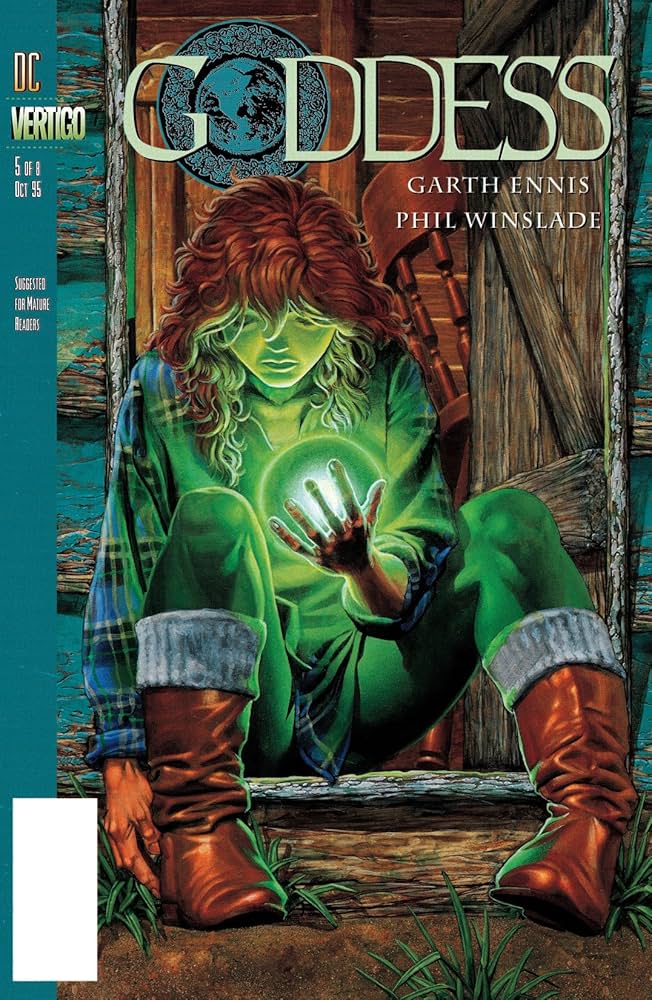
Goddess - a Vertigo comics mini-series

I vaguely remember this series being solicited back in the mid-90s when it was originally published; however, it was not something that fit within my "likes" of comic reading back in the day, so I passed on it.  A few weeks back, a local comic store was having a huge sale on back issues, $1.00 each or 50 for $25.00.  A friend and I went and managed, between the two of us, to find 50 comics that would cost us only $0.50 an issue!  Included in those 50 comics was the full eight-issue run of this series - I figured since they had the entire run, and at only $0.50 per issue, I might as well pick them up.  After all, my taste in comics have moved far beyond just superheroes these days, and if it turned out I didn't like it, then I could always just trade them in somewhere later on.  Well, the comics are staying in my collection, so that should tell you what I thought of them!
 
Goddess
was the creation of writer Garth Ennis and artist Phil Winslade. I was familiar with Ennis, having read some of his work on The Boys, Hellblazer, Crossed, and others; but I had never heard of Phil Winslade.  Or so I thought.  It turns out Winslade provided the art for DC's Wonder Woman: Amazonia graphic novel from back in the day (which I have), but I suppose I never paid attention to the artist's name when I read that book (either that, or it's simply been so long that I had forgotten it).  In any even, both of these creators have some magnificent work out there, so just imagine combining the two for an eight-issue mini-series!  And Ennis being who he is, you know the book is going to have a certain level of violence - which it does!
 
While Goddess is definitely the story of Rosie, a beautiful, young Scottish redhead who has unbelievable powers that she cannot seem to control - such as literally ripping her own country in half or blowing the heads off of government agents or even calming a ferocious tiger to save a young boy's life.  However, it is also the story of Mudhawk, Samantha Flint, and Jeff - a tough guy, and even tougher girl, and a weak-kneed man who may just be in love with Rosie.  Sure, they may only be the supporting cast in the story, but without them, Rosie would never get where she needs to go - she would never figure out who she really is - and she would never be able to make the decisions she does to put things right in the world again!  Oh, and we certainly can't forget the government agent who will stop at nothing get his hands on Rosie and her powers, even if that means killing anyone and everyone who gets in his way.  

Jeff in the narrator of this tale, so it might be a little slanted from his google-eyed point of view.  But through his eyes, the reader is able to see all of the characters for who they really are.  None of them are perfect by any means, but each of them has heart in their own ways - even Mudhawk (whose real name turns out to be "Walter Gaylord"), who manages to save this motley crew on more than one occasion.  And while Jeff points out the flaws of everyone, he also manages to give readers a clear delineation of who the good guys are, who the bad guys are, and, well, there quite literally is no in-between.  And as the story progresses, we get to see Rosie become stronger and more confident, gaining more control of her powers, and ultimately making her way to the top of the world where she discovers the truth about her identity, her powers, and her destiny.  The question is - will she fulfill the destiny established for her, or will she create her own path?  (Let's just say, I love the answer to that question!  And if you are really wondering who she is, well, quite honestly, the answer is right on the cover of each issue, staring you in the face!)
 
The art is absolutely stunning.  Winslade paints some beautiful long-rage shots of the planet earth, while also some superb close-ups, with character expressions that provide clear insight into the characters and their motivations without the need for any dialogue whatsoever (although, Ennis certainly provides plenty of that).  From the bloody shark attack in the first issue, to the full-page window-breaking scene near the end of that same issue, to the gorgeous panels of Rosie's first meeting with the spectral "Jenny," to the otherworldly scenes in the final issue - Winslade proves that he can give readers a visual experience they will never forget.  I think he was the perfect fit for Ennis' story here, since it goes from peaceful beauty to bloody violence in just a matter of panels or pages, and then slides into normal, everyday life scenes before once again turning right back to some graphic violence.  Winslade does it with apparent ease, keeping the story moving without any jarring breaks at all.  That's not an easy feat for any artist, but Winslade succeeds, and then some!

I was not sure what to expect with this series, but I went into it with an open mind and came out of it with the satisfaction of knowing I had just read something well worth the read.  

RATING:  10 giant water horses out of 10 for a different kind of story with a different kind of heroine for a different kind of comic reader!
 

Monday, March 10, 2025

DC 100-Page Super Spectacular No. 5 - LOVE STORIES

Comic fans who remember comics of the '50s, '60s, and '70s will remember the "romance" craze that littered the comic racks at the local convenience stores and newsstands.  Pretty much every publisher out there (with maybe the exception of Gold Key) was publishing romance comics, with titles ranging from Young Romance to Our Love to Teen-Age Romance to Career Girl Romance to Secret Hearts and so many more.  DC Comics, who is most famous for Superman, Batman, and Wonder Woman put out their fair share of romance titles during that period, and in fact, they held out the longest, with their comic, Young Love, being the series that closed out the genre.  In the early 1970s, DC published a line of 100-Page Super Spectaculars, which was not necessarily a regular ongoing series, but rather, an oddly numbered series of reprint titles featuring Weird Mystery Tales, World's Greatest Super-Heroes, Superman, Batman, Our Army at War, The Flash, Superboy, Justice League of America, Tarzan, and others.  The numbering was hard to follow, since there were no issues 1, 2, and 3; rather, the series started with issue 4 (being the Weird Mystery Tales issue), and with issue 7, it was published as part of the regular line of series (issue 7 being Superman #245, issue 7 being Batman #238, and the like).  While I do have several of the super-hero related issues, issue 5 is the specific issue that is the focus of this post.
 
DC 100-Page Super Spectacular: Love Stories
is not an issue of which I was aware.  To be honest I was not aware of the separate 100-Page Super Spectacular series until I got this issue and began looking into it.  But at a local comic convention last year, I obtained a copy of this particular issue from a comic dealer I know, because he was aware of my love of romance comics. The issue is a bit worse for the wear, with a part of the cover torn (although the missing piece does not really affect the cover art, nor are any words missing), some tears here and there, and a few stains on some of the pages throughout the comics - none of which affects its readability.  The less-than-perfect condition does not bother me in the least, since I get the comics to read and enjoy them, not to worry about their value (although when I went on line to research this particular issue, I was absolutely SHOCKED to discover what this issue sells for!).
 
The issue is a mix of new stories (prose and comic) and reprints (from previously published romance titles from DC).  Like most comics of that era, the stories do not give credit to the creators, so I had to turn to the Grand Comics Database (GCD - Love Stories) to uncover names of the writers and artists, if known.  Turns out some pretty big names in comics contributed to this issue - Bob Oskner provided that fantastic cover (100 Page! The Biggest Love Mag Ever! the cover cries out), and the work of great artists like Tony DeZuniga, Win Mortimer, Jay Scott Pike, Vince Colletta, Art Saaf, John Romita, John Rosenberger, Bernard Sachs, Ric Estrada, Wally Wood, Morris Waldinger, Norman Nodel, Mort Drucker, Bob Lander, and Mike Sekowesky graced the interior pages (all ad-free!).  And the back cover is a rather unique, almost psychedelic, word-free art by Charlie Armentano - who also provided a similar style cover to a sister title, DC's Super Giant #S-21 - Love (1971).  It's interesting to note that Oskner's cover has a young couple almost kissing, while Armentano's back cover has the young couple fulfilling that desire by actually kissing - perhaps a commentary on the stories inside, which always open with hesitancy or lost love, but always end with a happy reunion and that all-too-important true love's kiss.
 
The first comic story, "How Do I Know When I"m Really in Love?" and the fifth tale, "The Wrong Kind of Love," seem to be the only non-reprint comic stories.  While there are a few prose features scattered throughout the issue, all of the remaining comic stories are reprints from Young Love (1967), Girls' Love Stories (1962), Girls' Romances (1953, 1960, 1964, 1968),  and Heart to Heart Romance Library (1958).  The stories range in length,the shortest being 6-pages and the longest being 24-pages (a two-part tale titled "Made for Love," each chapter being 12-pages).  One thing I thought was rather humorous (in my opinion) was the two-page spread titled "How to Look Fabulous" by Ted Long, described as the "hip" hairdresser from the Today Show. "He's the gentleman who helps to prettify Barbara Walters," the first paragraph reads, "and other stars for the camera ... and he's quite a doll himself!"  Interestingly, I could not find any information online to verify whether Ted Long was an actual hairdresser or not (although I did find a Ted Gibson, who is a more recent hairdresser for the Today Show and other television shows).  The spread features a photo of Long, with four illustrations by Morris Waldinger that depict young women applying make-up, exercising, enjoying a steam treatment, and simply walking home with a courteous gentleman.  I would be curious to know how many girls read this article and took these tips to heart!
 
While a number of the stories are typical romance comic fare, there are a couple that stood out to me as I was reading them.  One was "My Sister Stole My Man," reprinted from DC's Girls' Love Stories #91 (December 1962).  It features a young woman whose sister is in a wheelchair following an accident.  Ellen feels she will never have love while stuck in a chair, so Jane convinces her boyfriend to encourage her - not realizing that as he spent more and more time with Ellen, he would come to love her and ultimately leave Jane for her wheelchair-bound sister!  An unusual tale where the heroine (Jane) not only does not win her love in the end, but instead, willingly gives him up for her sister, thinking to herself in the last panel, "I'll find love again - a love that will last!"  Written by Robert Kanigher and drawn by John Romita, the Grand Comic Database indicates the pencils and inks for this reprinted version were "extensively revised" to update hairstyles and fashions, and even the lettering is revised to change emphasis in the narrative.
 
Another not-so-typical story was "The Other Girl," also written by Robert Kanigher and with art by Bernard Sachs.  This story was reprinted from DC's Girls' Romances #70 (September 1960) and features an African-American cast, which is surprising considering the era in which it was first published. Although, being in the last decade of the civil rights' movement, perhaps the creators (and even DC, as the publisher) felt it was only appropriate that such diversity be portrayed in their comics.  Whatever the cause, I was actually happy to see a story with a Black cast.  The story centers around Donna, who happens to spot through a restaurant window her boyfriend (Peter) getting cozy with another woman!  She immediately burns all of his letters and pictures, gives away every gift he ever gave her, and breaks off all the friendships that tied her to Peter.  But getting him out of her head is not that easy - everywhere she goes, something reminds her of the love they shared - the beach, the art gallery, the theater, and even the park.  And to make matters worse, while Donna is suffering over the loss, Peter has been out dating dozens of new girls ... but, of course, in the end, love wins out, and Peter returns, admitting he did everything he could to forget her, "...but it was useless.  I just can't stop loving you!" he exclaims as he pulls her into a passionate kiss for that final panel.
 
One story, which may be said to be somewhat standard romance fare, turned out to be my favorite of them all because it somewhat reminded me of my mother's own story.  "The Wrong Kind of Love," which is one of the two originals stories in this issue, was written by Robert Kanigher and penciled by Ric Estrada, with inks by the legendary Wally Wood.  The story is about star-crossed lovers Linda and Kenny.  They are so much in love, but Linda refuses to allow Kenny to meet her family.  It turns out Linda's family is rather well-to-do, and as Linda's mother puts it, Kenny is "from the other side of the tracks," reminding Linda that "He's not our kind, dear!"  No matter what Linda says, she cannot convince him that Kenny is a great man, despite his lower class status.  It is not until Kenny rescues Linda from a collapsing bridge and saves her life that her parents give in, finally admitting, "We didn't understand ... but we're learning!"  My mother told me that as a teenager, there was a boy she liked in high school; however, her mother refused to allow her to date the boy, saying "he is from the wrong side of the tracks."  My grandparents even drove my mother to the boy's house and showed her where he lived to emphasize their disdain for him.  Unlike the story, my grandparents never relented, and my mom never got the opportunity to date the boy - who later went on in the '60s to be in a somewhat famous singing group (but don't ask me which one, because I can't recall now...)
 
Overall, the issue was thoroughly enjoyable, and whoever chose the various stories to include deserves some praise.  No two stories are alike, and they offer a great variety of scenarios and characters, as well as some truly beautiful artwork.  As indicated above, my issue does have its mars (see image of the the cover to my copy of the issue to the right), but that in no way detracted from my savoring each and every story (although, I will admit, I just skimmed over the text articles, as I was not overly interested in make-up tips, love letters, or to hear how girls met their boyfriends!).  I am truly grateful to John Neville for sharing this issue with me, as I doubt I would have ever learned about it, let alone found it at a price I could ever afford, on my own.  This particular issue definitely has its special place now in my collection of romance titles, and it will always stay at the head of the stack!
 
RATING:  10 couples kissing in a soap commercial out of 10 for a collection of tantalizing love stories with some of the most beautiful art to grace a comic page!

Monday, October 14, 2024

The Detective Chimp Casebook - a DC Comic Book Collection

Detective Chimp is a comic book character few people are likely to know.  To be honest, I really had no idea who he was until DC started to integrate him into some of their supernatural titles, like Shadowpact and Justice League Dark.  Since I have been reading comics with Detective Chimp in them, he has always been able to talk; however, this collection of the great detective's earliest adventures (pre-Crisis) have given me a lot of new insight into the character. Not only do readers get treated to Bobo's origin story (yes, Bobo is his real name), but you get the opportunity to see what kind of character Detective Chimp originally was and how he went about solving mysteries back in the 1950s - quite frankly, it's a real treat!

The Detective Chimp Casebook
collects Bobo's adventures from his first appearance in The Adventures of Rex the Wonder Dog # 4 (July/August 1952) to his last regular appearance in # 46 of that same series (September/October 1959), as well as his co-starring role in the "Whatever Happened to...?" back-up feature from DC Comics Presents # 35 (July 1981).  With the exception of issue # 5, Detective Chimp was a regular feature in The Adventures of Rex the Wonder Dog, enjoying 42 adventures, each story six pages in length (well, actually five pages of story, since the first page of each story is basically just an introduction to the story).  All 42 of those stories were written by John Broome, with most of them drawn by Carmine Infantino (who I recognize from his many years working as an artist on DC's The Flash series pre-Crisis).  One story was drawn by Alex Kotzky, while six were drawn by Irwin Hasen.  The series had a number of various inkers, such as Joe Giella, Sy Barry, Bernard Sachs, Alex Kotzky, and Gil Kane - although Infantino did ink a a large amount of his own stories.  The back-up story in DC Comics Presents in 1981 was written by Mike Tiefenbacher and drawn by Gil Kane, who definitely stayed true to Detective Chimp's original stories with regard to characterization and even set up (with Bobo's boss introducing the story).  

In the first tale, "Meet Detective Chimp," readers are introduced to Bobo through Sheriff Edward Chase of Oscaloosa County, Florida.  Now, I must note there is no Oscaloosa County in Florida, but there is an Okaloosa County, so I imagine Broome simply changed a couple of letters when creating his setting.  An actual city is never named.  Most of the stories are actually told by Sheriff Chase, although Bobo does have the opportunity once in a while to narrate his own adventures.  Anyway, in this first adventure, we learn that Bobo was a chimpanzee trained by Fred Thorpe to run errands and perform simple tasks around his animal farm there in Florida.  When Thorpe is murdered, Sheriff Chase is called in by Thorpe's niece to solve the crime.  It turns out, however, that Bobo is the one who leads Chase to the real crook and solves the murder!  This is the one and only 8-page story in the series.

There was no Detective Chimp tale in issue 5 of The Adventures of Rex the Wonder Dog, making me wonder if perhaps it was intended to be a one-off story, but it generated enough positive response that DC brought the simian sleuth back for more adventures starting in issue 6 with "The Return of Detective Chimp."  In this story, Bobo solves the murder of Carlton Meade, a wealthy man who lives on a private island with his daughter.  It's funny, one thing I noticed about these first two stories is that Thorpe's niece in the first one and Meade's daughter in this second one are both blondes who wear red dresses.  This seems to be a recurring theme throughout the series, as most of the young females in Bobo's tales are blondes who tend to be dressed in red.  Not sure if this was intentional or just coincidental.

The stories are anything but complicated, and although there are only five pages within which Broome and Infantino had to tell the tales, they manage to pack a whole lot of story into each one.  The mysteries Bobo solves involve wax museums, circuses, ball parks, fishing boats, horse tracks, animal farms, and various other places.  Bobo also manages to develop quite a lot of hobbies over the course of the series, with each hobby entangling him with a new crime to solve - from spear-fishing to stamp collecting to autograph collecting to trains to airplanes and so much more.  And, just like another popular detective in children's fiction, Bobo is given a number of rewards for his ingenuity and quick-thinking in solving cases, such as a baseball uniform, a jockey's outfit, a cowboy suit, an underwater spear-fishing ensemble, and even a $500 check from the bank where he stopped some robbers from making off with a fortune!

As the series progresses, the adventures become less about Bobo actually "solving" a crime and more about Bobo simply trying to capture crooks (often thieves whose pictures the sheriff receives in the mail to be on the lookout for).  He's a spry little chimp, and he does capture the crooks in some rather funny ways, usually by inadvertence when he pushes something he shouldn't, or leans against something that is not stable, etc.  The antics almost make one think of a typical television show with lots of physical comedy.  Near the end of the run, I think Broome was running out of ideas, because he begins to re-use some plot ideas, such as Bobo solving a crime while playing baseball, or when he stops some criminals while pursuing a fire-fighter dream (and it's odd that the second fire-fighter story has Sheriff Chase in the introduction saying, "The last thing I figured on Bobo taking up was the art of fire-fighting" in the March/April 1959 issue, when Bobo had already done this just three years prior in the January/February 1956 issue, albeit with the forest ranger in that earlier story rather than the fire department in the latter tale - in fact, the two stories have similar names: "Where There's Smoke - There's Trouble" in 1956 and "Where There's Smoke - There's Bobo" in 1959!).

In Detective Chimp's last adventure (September/October 1959), he manages to recapture a couple of criminals he accidentally releases from their jail cell while simultaneously helping his little league team win their big game.  His last thought is, "I hope I'm not around when the boss finds out what happened!" referring to the fact that the crooks who the sheriff came back to find safe in their cell were actually released and nearly escaped if it hadn't been for Bobo's quick thinking and a lot of good luck!

Flash-forward twenty-two years, and an aging Bobo is found meeting his long-time hero, Rex the Wonder Dog, in the back-up tale "Whatever Happened to ... Rex the Wonder Dog?" in DC Comics Presents # 35.  Bobo and Rex team-up to stop a couple of thieves from taking off with $10,000 in charity receipts from the circus where Rex was performing, and in the process, they happen across the fabled Fountain of Youth.  After drinking the water from the fountain, both Rex and Bobo are restored to their more youthful days, giving the Detective Chimp a new lease on life in Florida, where he was able to continue "making monkeys out of local criminals," as his DC Comics' Who's Who entry says.

In the back of this collection are a few covers on which the Detective Chimp has appeared over the years, including three issues of Tarzan, Lord of the Jungle, which reprinted three early Detective Chimp tales ("The Return of Detective Chimp," "A Whistle for Bobo!" and "Bobo's New York Adventure").  There is also a reprint of the Detective Chimp page from the original Who's Who: The Definitive Directory of the DC Universe, which gives fans some personal information and a history of the character.

All-in-all, this is a spectacular collection, which spotlights a lesser known character that definitely deserves the spotlight.  These are the types of collections DC Comics should be doing, providing fans with some reprints of the golden and silver age of comics, with a variety of colorful characters that deserve to be revived for new generations to read and enjoy!

RATING:  10 homemade jungle gyms out of 10 for good, clean, fun, and zany adventures of a chimpanzee with more talent for solving crimes than a dedicated small-town sheriff!

Wednesday, September 11, 2024

Comic Book Implosion: An Oral History of DC Comics Circa 1978

I started collecting comics in 1979, and I remember the first comic books I purchased were 40 cents each.  I soon discovered there were a few $1 anthology titles from DC Comics (such as Superman Family, Detective Comics starring the Batman Family, Adventure Comics, World's Finest, among others), and I was excited to see comics with more pages and story.  In 1980, the regular line of DC Comics' 40 cent titles suddenly increased in price, going up to 50 cents - but with that 10-cent increase came eight extra pages of story and art, offering some unique back-up features that, quite frankly, I found more exciting than the actual main titles!  Wonder Woman offered a back-up featuring the Huntress, a character new to me that I immediately fell in love with and has since become my favorite comic character of all time; DC Comics Presents offered a back up asking the question, "Whatever Happened To ...?" that introduced me to a number of characters I had never heard of before!  The Flash had Firestorm added to its comic; The Super Friends had alternating stories of the Wonder Twins and the Global Guardians; and so many others in the numerous regular titles being published at the time.  I was in awe, having never seen an idea I thought to be so innovative!  Of course, years later, as an adult collector, I discovered that this was not the first time DC did this.  It seems back in 1978, DC expanded its books with an increased price and increased page count - an attempt that allegedly failed, resulting in what fans have called for decades the "DC Implosion."  I've only known what I've read and heard through the years about this so-called Implosion; heck, I even purchased copies of copies of the two Cancelled Comics Cavalcade that gave fans black-and-white reproductions of the various stories and comics that were supposed to be published in 1978, but ended up in desk drawers, unpublished, due to the Implosion.  But now, TwoMorrows Publishing has given fans a look back at that year (and the years surrounding it), to provide a more in-depth look at what really happened to DC Comics at that time...

Comic Book Implosion (Expanded Edition)
is written by Keith Dallas and John Wells.  The original edition was published back in 2018, but this expanded edition came out this year, and I was quick to purchase a copy.  Dallas and Wells do not just give readers a narrative discourse on what transpired over those several years of ups and downs at DC Comics; no, instead, after a brief introduction and prologue that set the stage, they break down the saga into three sections:  the pre-explosion years (1976-78), the actual explosion (1978), and the implosion (1978-80).  In each of these sections, the authors provide a chronological look at what took place through the eyes of creators, editors, publishers, fans, and other various sources.  Each section is filled with quotes from fanzines, journals, magazines, interviews, books, and other various sources that allow the reader to follow along the journey - from the build-up to that big explosion, when DC wanted to try something different and expand the page-count to coincide with the necessary increase in price ... to the actual explosion itself, when many titles suddenly jumped from 32 pages to 40 pages, with the price increasing from 35 cents to 50 cents ... to the sudden implosion just three months after it began, with more than just the page count being cut at the comic company.  Rather than a simple narrative, readers hear it directly from the mouths of those involved:  Carmine Infantino, Jenette Kahn, Paul Levitz, Mike Gold, Tony Isabella, Steve Englehart, Bob Rozakis, Martin Pasko, Roy Thomas, Jim Shooter, Al Milgron, Jose Luis Garcia-Lopez, Larry Hama, Len Wein, Jack C. Harris, Walter Simonson, and many others, including Mike Tiefenbacher, then editor of The Comic Reader fanzine.  I absolutely love this method of relaying the tale, as it allows those involved to relate it from their own perspective and experiences as it happened, and it also allows the readers to draw their own conclusions.

This book offers a lot of insight into not just the explosion/implosion, but it reveals considerable information about the publishing of comics themselves.  I learned quite a bit about why the prices increased in the way that they did, and how the sales of the books themselves did not always dictate a book's frequency or cancellation.  I never knew that at one point, the companies were limited in the number of books they could publish, which resulted in some titles being bi-monthly, so that they could still offer a large variety, alternating some of the books every other month so they could stay within the limit.  I also never realized the corporate ownership of DC played a big part of the implosion, that it was not necessarily to do with the sales themselves being low.  I was also surprised to learn that characters such as Bucky O'Hare and Ms. Mystic were originally considered by DC for publication, but after the implosion and the large layoff of creators, those characters went with their creators and eventually saw publication with independent comic companies.  Even Mike Grell's Starslayer, which I never even thought about the fact that it was basically a space-take on his Warlord character already being published by DC.

I also love the fact that Dallas and Wells intersperse some breaks in-between all of the quotes, offering up listings of the titles published in each year - from early 1976 offering up 47 different titles, to early 1977 increasing to 51 titles, to early 1978 (just before the explosion) with a slight decrease to 49 titles, to the summer 1978 explosion line-up that gave readers only 43 titles, but most of them with additional back-up stories that filled the additional eight pages (and listing nine titles that were cancelled or never saw publication at all), to the early 1979, post-implosion list of only 26 titles being published - talk about a huge cut!  And last, but not least, they provide a list of the titles being published in 1980, when DC once again increased the price from 40 cents up to 50 cents, offering eight additional pages of story and art (but not increasing the page count; rather, they reduced the ads inside to accommodate the new back-up stories), which, at the time, was a total of 30 titles.  This was shortly after I started reading comics, so I can still remember that excitement of seeing these additional pages (although not necessarily thrilled with the additional 10 cents I had to pay for each comic).

Another great thing the authors do in this book is provide a section towards the end devoted solely to indexing the Cancelled Comic Cavalcade (the two-issue, never-published collection of all the stories and art that were cut when the implosion took place).  Not only do they provide details about each issue and story of all the comics that were cut, but they also provide some of the unpublished pages of art.  There are also some preliminary cover art pages that show what some of the comic covers would have looked like had the 40-page comics not been cut (such as Wonder Woman 250, which would have had an ad in he bottom right corner for the extra "Tales of the Amazons" story, and Flash 268, which would have had a blurb about the Kid Flash back-up story planned for that issue).  There is also considerable information about the delays in the Superman: The Movie special magazine that had to be postponed every time the movie got pushed back; and also, the Superman vs. Muhammad Ali super-size comic, and the troubles that special faced.  And then, at the end of the book, Dallas and Wells provide readers with a chronological list of all titles cancelled by DC and Marvel both, from 1976 through 1980, and it is a bit jaw-dropping to see just how many wonderful books were cut during that brief period.

This book truly is a wealth of information, even if you are not at all interested in the DC Implosion.  There are tidbits about the Whitman reprints, information about the adaptation of Star Wars (which DC passed on!!!!), the controversy over Black Lightning in the comics vs. Black Vulcan in the Super Friends cartoon, details about DC's Direct Currents newsletter, the ongoing competition between DC and Marvel, how other smaller companies were affected by DC and Marvel and the price increases, and so, so, SO much more!  After having read this book, I have an entirely new take on DC Comics' history and understand now just how much the comics industry has suffered as a whole due to corporate ownership by people who truly have no appreciation for what the comic book medium is able to offer its fans.  I think we all owe a huge debt to Keith Dallas and John Wells for compiling all of these interviews, blurbs, quotes, commentaries, press releases, and other documented sources and organizing them in a logical order - the amount of time and research this much have taken is awe-inspiring - kudos to them both!

RATING:  10 of the most exciting super-heroes in comics out of 10 for giving readers the most detailed, most well-researched, and most informative history out there of one of the comic industries' biggest, and most infamous, "events"

Wednesday, July 10, 2024

Love on the Racks - a History of American Romance Comics

I developed a love for comic books ever since my dad bought me my first comic book back in 1979 - an issue of Super Friends based on the Saturday morning cartoon.  For years after that, I can remember going to the nearby convenience store (Magik Mart, if I recall correctly), as well as the Walgreen's located in the local mall, to comb through all the comics on the spinner rack and pick out which ones I wanted to read next.  Needless to say, it was those colorful superhero titles that caught my eye and quickly filled up my ever-growing collection.  Never in a million years would I have considered buying, let alone even picking up and paging through, a romance comic.  Yuck!  Those were for girls!  So, flash-forward more than four decades, and suddenly I have discovered the beauty of the stories and art that fill the pages of many romance comics from the '50s, '60s, and into the '70s. With today's comics becoming more focused on splash pages and "pretty art," and less about the story, I find myself gravitating back to the yester-years of comic books, where each issue was filled with tons of story, making each comic book well worth the price paid.  In recent years, I've developed an interest in and appreciation for romance comics, which, often times, were written and drawn by talented creators who later went on to make a name for themselves in the industry - people like Dick Giordano, Jack Kirby, Gene Colan, Kurt Schaffenberg, Gil Kane, and countless others. So, this book offered me a chance to go beyond the stories themselves and find out more about the behind-the-scenes drama that went on with America's romance comics.

Love on the Racks is the first in-depth study of romance comics in America, looking at the entry of romance stories into comics in the late 1940s all the way through to the demise of romance comics in the late 1970s.  The author, Michelle Nolan, was a newspaper and magazine writer who has also spent time as a comic and pop culture historian.  With this book, Nolan offers fans of romance comics an opportunity to read a chronological history of the comics, learn about the driving force behind the expansion and collapse of the genre during the 1950s, see what affect the Comics Code Authority had on the books and their publishers, and consider the reasons why romance comics finally left the market entirely by the end of the 1970s.  The book also contains numerous examples of romance covers, as well as some interior pages, with eight color pages showcasing some of the important covers throughout the thirty-year period.

Nolan opens the book with a look at what existed before the advent of romance comics, to wit: the romance pulp!  I had already read about a lot of these romance pulps in The Art of Pulps Illustrated History book that I reviewed previously; but it was enlightening to see how a lot of these stories and magazines were just one step on the path to romance comics.  The next chapter gives readers a brief glimpse of the early teen humor comics (such as those published by Archie), as well as some of those early Marvel comics (such as Patsy Walker), which featured romance, but were more focused on the humor side of things.  It's eye-opening to see just how politically incorrect comic humor was back in the day, with Nolan showing "Moronica" (otherwise known as Miss Nitwit) as a prime example.  Personally, I think the strip still holds humor when read and appreciated for the time period it was created.  It's so easy to look at comics from the past through today's lens and condemn them; but it takes a true fan and collector to see and read the comics with an understanding of when it was written and drawn to be able to grasp the full impact of the strip.

Nevertheless, with Chapter Three, Nolan begins to study of romance comics with the publication of Young Romance #1 in 1947 from Crestwood Publications by two creators who eventually hit it big in the comics industry:  Joe Simon and Jack Kirby!  From this one comic spawned three-decade boom of romance comics that flooded the market (and perhaps over-saturated the market) and took the publishers, retailers, and fans by surprise.  Nolan goes into each of the first four issues of this comic, providing details of the stories contained within those issues.  Then she moves on to the second romance title, My Romance, which was published by Marvel Comics in 1948, who was hoping to cash in on the success it saw in Young Romance.  An odd romance comic also came out from Marvel that year called Venus, which starred the goddess of love herself; however, only certain issues actually fit into the romance genre.  Nolan indicates the title underwent numerous changes during its 19-issue run, from science-fiction to fantasy to others.  This was followed by Fawcett Comics, who published Sweethearts in late '48, oddly enough starting it with issue 68 (see below for a discussion on the whole numbering of romance comics during their heyday).  Sweethearts, it seems, was the first romance comic to be published monthly - its precursors were bi-monthly or quarterly.  This, according to Nolan, was a big chance to take, since the romance genre was still so new to comics.
 
Each chapter thereafter looks at the succeeding years and how the realm of romance comics grew exponentially, then contracted, and then expanded once again, gaining considerable popularity to the point where there were periods when nearly 1 in every 5 comic published was a romance title!   I have to say, Nolan educated me on quite a bit regarding the history of romance comics - I never realized just how many comic publishers existed at the time, and how many non-DC/Marvel publishers were out there, pushing out books each month.  It was surprising to learn that some smaller companies only published a few titles a month, and one company only published one book!  Yet, from 1947 to 1977, just about every company out there that published comics joined the bandwagon and pushed out title after title of romance books.  If one failed, they would throw another one out there.  Titles ranged from Secret Loves to Girls' Romances to Thrilling Romances to Love Diary to Sweet Love and so many others.  Of all the companies, though, it was Charlton comics, who entered the game late, that published the most romance comics of any company - more than 1,400 individual issues in all!  The only company who got anywhere close to that many was DC Comics, who came in at only 931 individual issues over the three decades.  

Thankfully, Nolan has a "Catalogue of Romance Comics" that she, along with other romance aficionados Dan Stevenson and Jim Vadeboncoeur, Jr., compiled, listing virtually every known romance comic to have ever been published.  The list is sorted by publisher, and it lists the titles, the number of issues published in each title, and the total number of individual issues published by each company.  This is an excellent guide, because as mentioned above, a number of companies did not start their series with issue 1; rather, if another series they published was cancelled, they would simply pick up the numbering with a new and different title, even if it was a completely different genre (for example, some companies switched science fiction or super hero titles to romance titles, continuing the number, but renaming the book and changing the content!).  According to Nolan, this happened many times because the publisher wanted to avoid having to set up new books with the postal mailing requirements; if they simply changed the title, but kept the numbering, they could try and slide it in under the old application with the post office and not have to pay any new fees for a new title!  I had always wondered why companies back in the day would do that.  This results in a number of romance titles that never saw an issue 1!  Charlton was really bad about this - Career Girl Romances began with issue 24; Romantic Secrets began with issued 5; Hollywood Romances began with issue 46; Summer Love began with issue 46; and so on. Today, with the internet, it's easy to find out exactly what issue a particular series started and ended with; but back when these comics were first published in the '50s, '60s, and '70s, I'm sure a lot of fans were frustrated when they could not find any "early issues" of these series!

I particularly enjoyed reading about how the implementation of the Comics Code Authority affected the stories and covers to the romance comics.  Nolan cites to a number of examples of how covers were changed, with woman no longer allowed to show cleavage, and how the "drama" depicted changed from physical altercations or sexual insinuations to the more generic girl crying as she sees her man being tempted by another woman (no sex indicated, of course!).  Nolan also provides an example of a story from First Love #27 (April 1953) titled "Sinful Surrender" was altered when it was reprinted just three years later in First Love #61 (February 1956) to "Foolish Dream," with certain suggestive dialogue removed to avoid any sexual context,.  And yes, as the romance period went on, it seems more and more comics began to reprint older stories in order to fill out content for the considerable numbers of books that were being published.  Gradually, though, the Code began to loosen its grip, as many of DC Comics' later titles in the '70s began to feature stories with what might be considered somewhat "risque" at the time, including the free-love of the hippie years, interracial romances, and even some darker teen angst.  

Sadly, by 1977, the romance genre had reached its ever-lovin' end, and DC Comics' Young Love #126 (July 1977) was the last romance comic to hit the stands.  Oddly enough, this book was one of the books DC purchased from Crestwood when that company went out of business, along with Simon and Kirby's Young Romance (the book that started it all!).  Young Love made its debut in 1949, and was a sister title to Young Romance.  It was created by Simon and Kirby as well, so I suppose it is only fitting that this tremendous team that created the first romance comic would have one of their original series also serve as a closing book end to the era.   

Nolan does an outstanding job of detailing the history of romance comics, and while there is a bit of repetition here and there throughout the book, as she mentions some of the same titles and publishers over and over, it does not get monotonous nor annoying - in fact, the repeated statistics and information serves as a great reminder as the reader is trudging through this thirty-year period of just how much these comics played an important part of comics history - even if they are nearly forgotten by today's fans!  And for a fan like me, who only recently came into the genre, this is a spectacular resource that will provide invaluable aid in my search for issues to complete various series.  This book is a definite must-have for any fan of romance comics!

RATING:  9 romantic photo covers out of 10 for providing unbelievable details about the nearly forgotten and sordid history of romance comics and the impact it had on the comics industry!

Tuesday, March 12, 2024

Wonder Woman - the Earth Two Adventures (DC Comics, 1977-78)

Okay, I know I don't normally do reviews of any ongoing comic book series, as it would take quite a bit of time and space to review hundreds of issues of the same series.  However, back in the late 1970s, DC Comics made the decision to take the Wonder Woman comic book in yet another new direction (let's face it - the character of Wonder Woman has had more face lifts than every actress in Hollywood combined!).  At the end of 1975, ABC aired a television movie, The New Original Wonder Woman, featuring Lynda Carter in the title role.  The movie was set in World War II and featured Wonder Woman/Diana Prince, Steve Trevor, Etta Candy, and General Blankenship.  It did well enough that in April 1976, two more specials were aired.  They did so well, ABC ordered more episodes, which aired during the 1976-77 television season.  So, DC Comics changed the direction of their comic book to mirror that of the television show, and returned Wonder Woman to World War II.  How did they do that, you may ask?  Well, easy - they shifted the focus from the Earth-1 Wonder Woman (present day) to the Earth-2 Wonder Woman (set during the second World War)!  And if you don't under the Earth-1 / Earth-2 references, well, I'm not going to explain them here - go look it up on the internet (true comic fans will understand easily what I am taking about...)

The saga began with Wonder Woman 228, in which the present day Wonder Woman of Earth-1 is suddenly faced with a Nazi plane being piloted by the mysterious Red Panzer.  When the Panzer uses a strange ray to return his ship home, he inadvertently brings Wonder Woman with him - to Earth-2 in the past!  There, we get the obligatory hero vs. hero fight due to a misunderstanding, until they stop long enough for the Earth-1 Wonder Woman to explain who she is and how she got there.  Together, they defeat the villain, and while Earth-1 Wonder Woman returns home, the comic stays on Earth-2 with the "golden age" Wonder Woman who battled Nazis in the second World War.  Written by Martin Pasko and beautifully drawn by Jose Delbo and Vince Colletta, the issue provides readers with a smooth transition to this alternate Earth and time, giving readers a brief, but easily understood description, of the differences between the two Earths (Earth-1 featuring the modern Justice League, Earth-2 featuring the golden age Justice Society).  Being a huge Justice Society and Earth-2 fan for as long as I have been reading comics, this jumping on point was pure excitement for me!
 
While the next issue concludes the Red Panzer story, issue 230 features a one-part tale starring the Cheetah as the villain of the story - and not just any Cheetah, but the original, Golden Age Priscilla Rich Cheetah, wearing her signature yellow and brown-spotted costume.  Only, this time, Cheetah is sporting some new claws that could do serious damage to Wonder Woman!  The story by Pasko, with art still by Delbo and Colletta, hearkens back to those Golden Age tales of woman vs. woman, where Wonder Woman must use her wits to defeat the villainous Cheetah (who has learned her secret identity in this issue).  It's a solid story with beautiful art.  I must say, the Delbo/Colletta collaboration truly was the perfect teaming for Wonder Woman, and while some other amazing artists have come and gone over the years, I still think Delbo/Colletta's issues are some of the best to appear in the pages on this comic.

The next two issues guest-star members of the Justice Society (after all, the book is now set on Earth-2 during World War II, which is the time when the JSA truly shined).  Sadly, Delbo had stepped away from the art chores and the new ongoing artist was to be Bob Brown, who penciled issue 231 with Colletta still inking. Brown's art was not that far off from Delbo's, but Wonder Woman just did not have the same appearance (partially, I think, due to the way Brown drew her hair).  The story centers around an Egyptian goddess, who turns out to be an alien from beyond the stars and who has her heart set on turning Steve Trevor into the man she once loved.  In order to do so, she has to eliminate anyone who can stop her, which includes the members of the JSA, as well as Wonder Woman.  It was great seeing the JSA in these issues, even if they only played in short scenes (after all, this is WW's comic, and so she as to be the focus of the story).  Sadly, though, Bob Brown took ill after the first issue, so artist Mike Masser stepped in to pencil thee second part of the story in issue 232.  There is a distinct difference in the art style, but I think my joy in seeing the JSA helped me overlook that difference.  Sadly, though, this was the last story written by Martin Pasko, as he moved on to other titles.

With issue 233, Gerry Conway took over the writing chores, starting off with a two-parter involving a villain who could control sea-life.  Kinda makes me wonder why Wonder Woman didn't simply call on Aquaman to help her out (although, in the 1970s, I'm not sure if DC was even acknowledging an Earth-2 Aquaman).  What is interesting about this tale is the fact Conway introduces two children - a brother and sister - who Wonder Woman rescues (their father is the villain who redeems and sacrifices himself at the end to save Wonder Woman).  They show up briefly in the next story (beginning with issue 235), but there is no real follow up with them after that.  I wonder if Conway had some plans for them that fell by the wayside, or that were derailed by editorial dictates, or if they were simply throw away characters that carried on farther than most.  I suppose we will never know at this point.  In any event, this two-part story also had a new artist in Don Heck, as it was revealed that Bob Brown had passed away due to his illness, and thus, the book would need a new artist.

Fortunately, Jose Delbo was available, and he returned to the art chores beginning with Conway's second two-part story beginning in issue 235. Not only does this two-parter see the introduction of a new villain named Armageddon, but it also guest stars Dr. Charles McNider (otherwise known as the JSA member, Doctor Mid-Nite!).  The doctor helps out Wonder Woman and Steve Trevor in both his medical persona and his superhero persona, which was rather nice to see, since we rarely saw the JSAers during that time outside of their costumes and heroics.  Conway continued his run with a third two-parter, this time bringing back a blast from the past - the REAL Diana Prince!  (Huh?  You mean you didn't know Wonder Woman was not the REAL Diana Prince?  Go back and read her original stories!)  Yes, Conway played off of the Golden Age origin of Wonder Woman by bringing back Diana Prince, who thinks Wonder Woman's alter ego is a spy who has stolen her identity.  Thus, when they meet, Wonder Woman has to reveal her origin (a nice way to integrate the Earth-2 Wonder Woman's origin into the run) and explain why Diana Prince has no recollection of giving Wonder Woman her identity to use.  The villain in the story, Kung the Assassin, was pretty much a throw-away villain who, as with the villains in the previous stories, redeems himself by the end.

Beginning in issue 239, Conway looks back at more of Wonder Woman's roots by bringing back the Roman gods, particularly Mars, the god of war!  Delbo and Colletta continue their run as artists, as Conway has Wonder Woman face off against Mars' lackey, the Duke of Deception - who makes Wonder Woman see things that are not there, leading the U.S. military to believe Wonder Woman has turned traitor to America!  Only the Flash (Jay Garrick, not Barry Allen - remember, this is Earth-2 still) is on the scene and once he figures out what is happening, he has to help his fellow JSA member before she does real damage to her reputation and the country!  I have to wonder if Geoff Johns didn't take a queue from Conway's story here when he wrote the Power Girl mini-series in the early 2000s (which featured Power Girl being taunted by the Psycho-Pirate into remembering her Earth-2 past by creating false visions around her, causing her to react against people no one else could see).  That would sort of make sense, since Conway helped revive All-Star Comics back in the mid-'70s, and he co-created Power Girl, and to mimic this story written by Conway would be a nice homage.  In any event, it was great seeing the Golden Age Flash in the story, and quite frankly, the cover to issue 240 by Jose Luis Garcia Lopez is probably one of my all-time favorite Wonder Woman covers.

By issue 241, with a cover date of march 1978, the television show had already entered its second season, in which Wonder Woman was updated and brought into the present.  Thus, there was debate raging in the letters columns of Wonder Woman as to whether the character in the comic should remain the Earth-2 Wonder Woman during World War II, or whether they should return to stories of the Earth-1 iteration in the present.  The story in issue 241 would be Gerry Conway's last story, and it features guest artists Joe Staton and Dick Giordano.  I've always loved Joe Staton's art (his run in All-Star Comics during the late '70s, as well as his work on the Huntress back-up stories in Wonder Woman during the '80s are some of the best), so I enjoyed seeing his take on Wonder Woman.  The story is a bit different from the previous tales, as it is narrated by the Spectre and finds Wonder Woman fighting not only a super-powered thief named the Bouncer, but unknowingly evading a killer named Sumo - formerly known as the Super Samurai, who she battled in the Superman vs. Wonder Woman giant tabloid-size comic from around that time.  Again, like so many of Conway's stories during his run, Sumo redeems himself, sacrificing himself to save the life of an innocent.

DC made the decision at that point to return Wonder Woman to the present, and so the tales of the Earth-2 Wonder Woman would come to an end.  Issues 242 and 243 saw Jack C. Harris step in as the new writer on the series, with Delbo on pencils still and new inkers Joe Giella (issue 242) and Frank Chiaramonte (issue 243).  His first issue was a special tribute to the end of World War II, which immediately took off in a completely different direction by having alien spaceships show up, kidnapping and transforming humans - starting with Steve Trevor! - into carbon copies of what they deem to be the "perfect" human.  Wonder Woman, of course, has to convince the aliens that humans are better with the unique, individual natures, and by the end of the issue, she is able to return everyone to their original forms.  The last page provides a send-off for General Blankenship, Steve Trevor, and Etta Candy, as they reveal what they will be doing now that the war is over ... and it also gives a sneak peak at the villain of the final issue of this Earth-2 run:  the Angle Man!  Thus, issue 243 sees the Angle Man, an adversary of the Earth-1 Wonder Woman, accidentally transporting himself into Earth-2's past, and it's up to the Wonder Women of both Earths to stop him!  The Earth-1 Wonder Woman, of course, must make everyone forget her presence (as the World War II versions of these characters had no knowledge of the multiverse), and she takes the Angle Man back to her own Earth, where the final page shows Wonder Woman in the Justice League satellite, reading a newspaper from Earth-2 that she inadvertently brought with her, revealing that her Earth-2 counterpart managed her life pretty well after the war and wondering if she can do the same on her own Earth...

I thoroughly enjoyed this 16-issue run of Wonder Woman, as it allowed me to revisit the original Earth-2 that I sorely miss.  The fact that DC followed the television version in some aspects (such as using General Blankenship instead of General Darnell, and the fact that Etta was not a short, chubby sorority girl) did not bother me, as the military personnel could easily change, and Steve and Diana could have been reassigned to work under a different general during the war.  Yes, Etta's appearance is a little more difficult to explain away, but hey!  I was just happy to see Earth-2 in print!  Of course, talking about Etta, there is one subplot involving her becoming engaged to a slippery character named Pierre Machand - a man Wonder Woman did not trust at all - that was dropped when Harris took over as writing.  Not really sure where Conway was going to go with that, but with the time jump between issues 241 and 242, that story simply disappeared without even a quick sentence or two to explain why Etta never married him!
 
Even after the Silver Age stories revealed the existence of the Golden Age characters still living on Earth-2 (as well as the Crime Syndicate on Earth-3, and the Freedom Fighters on Earth-X, and the Shazam family on Earth-S, and so on), other than the short-lived revival of All-Star Comics, we did not really see any ongoing series that featured Earth-2 characters on a regular basis.  And once Crisis hit, and the multiverse was destroyed (albeit temporarily, since it was reopened with Infinite Crisis and the countless crossovers DC has had over the last 40 years), we have yet to see any ongoing series focusing on the characters of Earth-2 (other than the short-lived Earth-2 series that came out with the "New 52" books, which quickly disappeared and has never really been mentioned since).  So, these World War II stories by Pasko, Conway, and Harris thrilled me to no end, and left me nostalgic for the "glory days" of comics from the 1970s and early '80s, which to me were some of the best comic book stories every written.

RATING:  10 super-secret vials of life-saving liquid out of 10 for taking me back to a time when comic stories were truly fun to read and satisfying a long-waited need for stories from Earth-2!

Sunday, November 5, 2023

WW84: Wonder Woman - The Junior Novel

The Wonder Woman '84 (titled "WW84") film came out three years ago (back in 2020).  As with the first film, there were plenty of merchandising that came out with the film, including a junior novelization of the film.  Unlike the first film, however, there was no adult novelization (which surprised me).  Since I pretty much collect all things Wonder Woman, I picked up the junior novel when it came up, and it has sat up on my "to-be-read" shelf ever since.  Having seen the movie, I knew the reading the book would feel a little redundant - but, I also knew that sooner or later I'd pick it up and read it just to see how it compares with the film.  And it pretty much was what I was expecting.

WW84: Wonder Woman is an abridged version of the movie, just as the junior novelization of the first movie was.  The original film was adapted by Steve Korte, while this one was adapted by Calliope Glass; however, Glass did not do any better of a job than Korte did with the original.  There are quite a number of elements from the film - important elements to the story! - that are missing in the book.  Now, I can understand when you are writing a book aimed at younger readers, you might want to leave out any adult content (such as scenes of a sexual or intimate nature, or scenes of harsh violence); but I don't understand leaving out elements that are important to the plot.  It leaves the story lacking and incomplete.

For example, in the opening scene, in which a young Diana is ready to compete in the Amazon games on Themyscira, Glass leaves out a very important part that results in Antiope stopping Diana before she can complete, and possibly win, the game.  In the film, Diana is knocked off her horse, and so she cheats by taking a short cut to catch up with her horse and stay ahead of the other contestants.  Thus, it makes sense when Antiope catches her and stops her from throwing the spear at the end, because she has to learn the lessen that she cannot take short cuts  cheat in order to win at something.  Sometimes it's just not meant for her to win.  Yet, that element of the story is omitted from this novelization, and so when Antiope snatches her out from victory, it doesn't make sense.

There's also the story of Steve Trevor's return.  The book follows the story with regard to Diana's wish for her one true love to return; however, the book completely ignores the fact that his return is in the form of taking over another man, whose life and identity disappears when Steve takes over the form.  Instead, Steve merely wakes up and is there, with no mention of this other man.  Readers also lose out on Maxwell Lord's son, who plays a pivotal role in his part of the story.  He is nowhere to be seen in this book.

And, just like the junior novelization of that first film, this book completely leaves out the final climactic battle, instead ending on the part where Diana and Steve are getting ready to stop Maxwell Lord and Barbara Minerva, while at the same time preventing the world from entering a nuclear war.  That final battle is important on so many levels, with the redemption of Lord, the complete conversion of Minerva over to the Cheetah, and Diana's ultimate sacrifice.  Young readers get none of that.  And while I'm all for not wanting to spoil the ending of a movie, this is a novelization, and as such, it should have the full story, regardless of how abridged.  Leave out the cheating, leave out the son, leave out the stolen identity - but leave out the ending?  No, sorry, that just doesn't work for me.

The book does include eight pages of color photos from the movie, so that is one saving grace.  Otherwise, this book feels much less than what it should be and is a big disappointment.

RATING:  5 wish-granting citrines out of 10 for, at the very least, giving young readers a portion of the story.


Friday, October 27, 2023

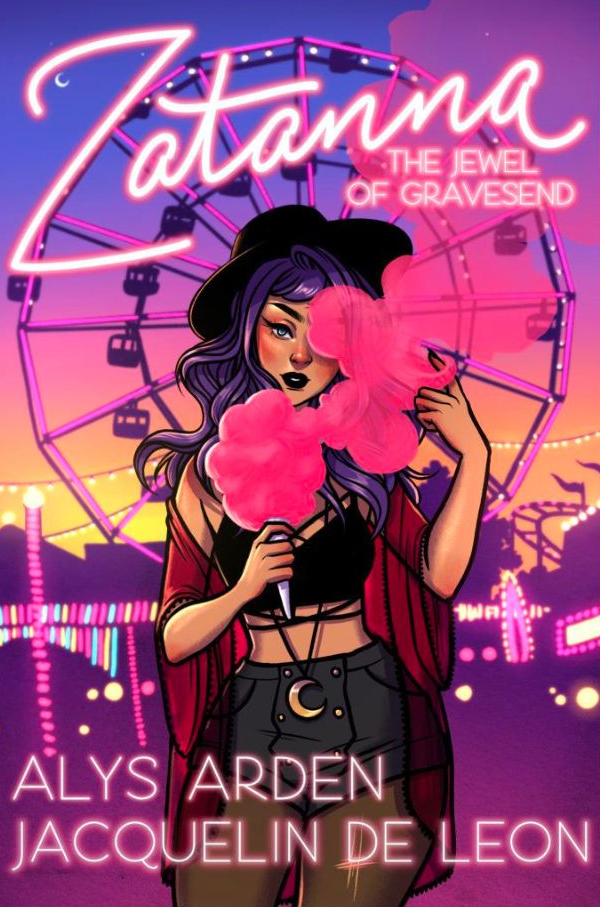
Zatanna: The Jewel of Gravesend - a DC Comics graphic novel

Zatanna has long been one of my favorite DC Comics characters (after Huntress and Power Girl, of course!).  I was never fond of her first couple of costumes, but truly fell in love with her when George Perez redesigned her costume in Justice League of America #187.  I also loved the fact that her magic spells were spoken backwards (of course, over the years, writers have not only done that in different ways - from keeping the words in the correct order, just spoken backwards to speaking entire sentence backwards), as it gave her something different than just a typical magic-user.  I've purchased all of her comic series (there haven't been many, and sadly, the never lasted long), and I purchased the previous graphic novels aimed at younger readers.  This latest graphic novel, though, is not aimed for children, and it provides a new, unique re-imagining of Zatanna's origin.
 
In The Jewel of Gravesend, written by Alys Arden with art by Jacquelin de Leon, Zatanna has been raised by Ezra and Lola Starr, stage magicians who were friends with Zatanna's parents.  Her mother died and her father is believed dead, and Zatanna is completely unaware of her parents' true magical abilities - Ezra has worked hard to keep that a secret.  But he has kept other secrets as well ... meanwhile, Zatanna has managed to live a somewhat normal life near Coney Island, New York, where her best friends, Izzy and Kenia, also enjoy the carney life.  Zatanna also has a boy who she loves - young Alexei.  The only problem is, his family is mafia, and they run a casino beneath the Golden Elephant where Zatanna lives with the Starrs (yes, the building really is shaped like a huge elephant!).  The main problem Zatanna has is Ezra's constant attempts to involve her in his magic shows.  She wants no part of them.

Until she and her friends check out the new magic and mermaid show, in which they find strange "mirror-script" along the wall.  Zatanna speaks the words, having no idea what they mean - and having no clue that her magical ability has been sparked, giving those words power and causing a near fatal accident! Suddenly, those words that appeared backwards look normal to Zatanna.  And so, her adventure begins as she starts to realize that she has the ability to cast spells and make things happen simply by speaking them backwards.  But someone else is aware of that ability, and that someone will do anything to get that power away from her.

Arden's re-imagining is a really good story.  There's an underlying Romeo/Juliet romance with Alexei and Zatanna ... there's the young girl coming into her own story of Zatanna discovering her powers ... there's the ultimately betrayal caused by the lies surrounding her past and her father ... and there is the unexpected surprise at the end that costs Zatanna way more than she could ever have imagined.  The origin story of most heroes begins with some kind of family tragedy, and this one is no different.  However, it is a far cry from Zatanna's original origin in the comics, and by the time the climatic moments hit, you will have found yourself so invested in the character that they are going to hit you, as the reader, as well.  I cannot deny that my heart broke for poor Zee, as she has to let go of everything in order to move forward to become the hero we all know she becomes.

The art on the book is very beautiful, and the colors are almost (dare I say it?) - magical!  The blues, the pinks, and the purples are brilliantly blended to provide an atmosphere very fitting for the story.  Yes, they are dark, but then, to a degree, so is the story.  While I doubt we will ever see any more stories with this version of Zatanna, I would love to see an ongoing series set in this world, just to see where Zee goes from here.  This is a story of love, magic, and family that is most definitely worth the read.

RATING:  10 blooming flowers out of 10 for a stunning new take on a beloved character that has everything a great story should have to make it an enjoyable read.

Saturday, September 30, 2023

World's Greatest Super-Heroes - a DC Comics 100-Page Super-Spectacular

I have wanted this comic book for such a long time.  I remember seeing images of it and people talking about it for years, but I've never been able to find a copy (at least, not at a reasonable price that I was willing to pay!). Thankfully, at a recent comic book convention, a dealer had a not-quite perfect copy (but still fully in tact with no tears or rips and no pages missing) for a very reasonable price - so I bought it!  The reason I wanted it is because it truly does feature the world's greatest super-heroes:  The Justice Society of America!  That's right - while many consider the Justice League the world's greatest super-heroes, ever since I met the JSA way back in 1980 in that classic JLA/JSA/New Gods cross-over, I have been in love with them.  The idea of an alternate earth where the super-heroes did grow older, where they had children, where some of them died fascinated me to no end - particularly when I was introduced to my favorite all-time comic book character, the Huntress (the grown daughter of the Earth-2 Batman and Catwoman!).  Thus, ever since that time, I have hunted down and read pretty much every possible appearance of the JSA that I could find - and this is one of the comics that I have never been able to get my hands on - until now!

 
DC 100-Page Super-Spectacular featuring World's Greatest Super-Heroes! (for only 50 cents back in 1971!) is a reprint issue, giving readers of the early 1970s an opportunity to read (or re-read, as the case may be) stories starring the Justice Society and some of its members from the 1940s, '50s, and '60s.  The book opens with the two-parter "Crisis on Earth-One!" and "Crisis on Earth-Two!" from Justice League of America issues 21 and 22 (Aug. and Sept. 1963, respectively).  The stories that follow are those of individual members of the JSA - The Spectre, Johnny Quick, the Vigilante (not the Marv Woflman/George Perez version), Wildcat, and Hawkman with Hawkgirl.  And, yes, I realize the Vigilante was never truly a member of the JSA; however, he was later included in the All-Star Squadron in the 1980s, so it could be said he was later retconned into the group of Earth-Two heroes!
 
Anyway, that opening story with the first historic cross-over of the JLA and JSA is always a treasure to read.  "Crisis on Earth-One!" re-introduced the Justice Society of America to young readers of the 1960s who may have never heard of that team (since its last appearance was back in 1951 with the cancellation of All-Star Comics).  By this time, the Flash of Earth-One had already discovered the existence of Earth-Two and its super-hero counterparts, but the two teams had yet to meet.  But when the villains of both Earths find a way to switch places in order to commit crimes, the JLA and JSA find themselves at a disadvantage - not only do they not know these other Earth's villains, but the ne'er-do-wells have set a trap to ensure the JLA and JSA cannot defeat them!  The two-part story continued into "Crisis on Earth-Two!" and allowed the Green Lanterns of both Earths to free the kidnapped Flashes and ultimately defeat the Crime Champions of two worlds.  The words of the Earth-Two Hawkman at the end of the story are oh-so-prophetic:  "We're going to keep in touch! There's no telling when we may be called upon to join forces again!"  And join forces again they did, every year in an annual team-up that saw them eventually meet up with a number of other teams, including the Seven Soldiers of Victory, the Freedom Fighters, the Legion of Super-Heroes, the Shazam family, the stars of the Old West, the New Gods, and even the All-Star Squadron!  Gardner Fox likely had no idea what an iconic story he had written, one that still resonates with fans more than 60 years later!

The Spectre's story, from More Fun Comics issue 55 (May 1940), is the oldest reprinted story in this comic.  With art by Bernard Baily, the story finds the ghost of vengeance battling another spirit who walks the Earth, only this one is spreading evil.  It seems he may have met his match, but a last minute trick enables the Spectre to turn the tables on his nemesis and imprison him for all eternity in solitude - a fate the villain had planned for the Spectre!  The author of the story is not identified, but an online search reveals the writer as Jerry Siegel, one of the creators of Superman!

The next tale features Johnny Quick and His Magic Formula in "Stand-In for 100 Convicts." from Adventure Comics issue 190 (July 1953).  I really enjoyed this story, as (a) I like the character of Johnny Quick, and (b) it was a creative story.  A prison warden agrees to release 100 criminals from prison on the belief they will not return to a life of crime - but when $100,000 worth of diamonds disappears, it seems the criminals have gone back to their old ways.  Johnny is on the case, but he discovers that only one of the criminals has gone bad - the others are searching for the bad seed, hoping that by bringing him back in, they can prove they have changed.  Johnny agrees to help and must distract the warden and the police in order to give the criminals a chance to find the one who stole the diamonds! Using his speed, Johnny tries to pretend to be all 100 of the released criminals, a pretty nifty trick!  Even though it is only six-pages in length, the story is full of action and dialogue (and, in today's comics, this would probably be spaced out into a six-ISSUE story, rather than just six pages).  The artist is identified as Ralph Mayo, but online sources indicate Hy Mankin was the artist, and Don C. Cameron was the writer.

Next up is the Vigilante and his little sidekick Stuff in a story titled "The Galleon in the Desert!" (from Action Comics issue 146 (July 1950).  I'm not going to lie here, I did not read this story.  The Vigilante is not a character that interests me, and while the art of the nine-page tale was actually pretty good, I just didn't have the desire to read it.  It was written by Joseph Samachson and drawn by Dan Barry.

The Wildcat story, however, I did read and I thoroughly enjoyed it.  "Crime Wore a Costume!" is actually an unpublished Golden Age story that never saw print before this comic, which made it a special treat.  The artist is identified as Jon Chester Kozlak, and I discovered online the writer was Bob Kanigher.  The story finds Ted Grant and his boxing contender, Mike Bailey, putting in a holiday appearance at a local department store when a group of Santa-wearing criminals try to escape with all the contents of the jewelry department! Ted quickly changes into Wildcat to fight the criminal Santas, and Bailey steps in to help, unmasking Wildcat's nemesis, the villainous Huntress (not the Batman and Catwoman's daughter from the late '70s, but the tiger-striped one from the Golden Age who Roy Thomas eventually renamed "Tigress" in his Young All-Stars series).  She sets up a number of traps for Wildcat, including a very nearly beheading; but, Wildcat manages to outwit the feline thief and flip her right into the hands of the waiting police.  

This issue wraps up with a tale of Hawkman and Hawkgirl from The Brave and the Bold issue 36 (June/July 1961) titled "Strange Spells of the Sorcerer."  Story by Gardner Fox and art by Joe Kubert, the Hawks find themselves battling a noted magical authoriy, Konrad Kaslak, and unknowingly the sly woman, Mavis Trent.  It must be noted that this Hawkman and Hawkgirl are the Katar and Shayera Hol of Thanagar - the Hawks of Earth-One!  It's a silver-age tale that was published just 10 years prior to this reprint and is only one of the two stories that originally appeared in that issue of The Brave and the Bold.  The story is a bit darker in tone and color than its Golden Age predecessors, and it is also longer than any of the previous tales (other than the JLA/JSA two-parter).  It's interesting that with all the other stories in this issue focusing on Earth-Two characters, they would end the issue with the Earth-One Hawks.

The wrap-around cover to this reprint issue is a masterpiece drawn by comic legend Neal Adams and features a conglomerate of heroes from both Earth-One and Earth-Two (interestingly, the front cover features mostly Earth-One heroes, while the back cover focuses mostly on Earth-Two heroes).  While I didn't really need it, I do like the fact that DC included a handy guide on the inside back cover to all of the characters who appeared on the cover.  This likely helped the readers back in 1971 who did not recognize many of the Earth-Two characters. I find it interesting that when identifying the characters, those who have doppelgangers on both Earths are identified by their Earth (such as Superman of  Earth-One and Superman of Earth-Two), but characters who have no doppelgangers are simply identified by their name (such as Mr. Terrific and Wildcat).  Black Canary is the only character identified as being from both Earth-One and Earth-Two, since she originally came from Earth-Two, but crossed over and stayed on Earth-One in one of the annual JLA/JSA crossovers.  There is also interspersed among the stories "A Checklist of DC Super-Heroes" (appearing on pages 35, 51, 97, and 98), which not only lists a number of the characters used by DC at the time, but provided the characters' first appearances.  The list is in alphabetical order and includes many well-known characters as well as some obscure characters such as Air Wave (first appearance in Detective Comics #60, Feb. 1942), Bwana Beast (first appearance in Showcase #66, Jan/Feb 1967), the Ghost Patrol (first appearance in Flash Comics #29, May 1942), and a number of others.  For me, this guide was a lot more informative than the character guide on the inside back cover!

Overall, this was a great issue of reprints and one I am absolutely thrilled to now have in my collection!

RATING:  10 museum animals brought to life out of 10 for keeping the Justice Society of America and its members "alive" for readers of every generation to read, fall in love with, and enjoy!