Showing posts with label parody. Show all posts

Tuesday, July 8, 2025

Love in the Afternoon - the wild novel of a soap opera superstar!

Sometimes you come across some of the best books when you are not really looking for them.  Such is the case with this book.  I was combing through the paperbacks at the Family Bookstore in DeLand, when, as I reached the end of the section, my eyes glanced over the title to this book and had to take a second look.  The slogan "Love in the Afternoon" was used by ABC to market its soap operas for a decade, from the mid-1970s to the mid-1980s - advertisements with a catchy theme, giving clips of the various soap operas in ABC's line-up - Ryan's Hope, Edge of Night, All My Children, One Life to Life, and General Hospital.  (It should be noted that NBC had used that same slogan to market their soaps in 1974, but gave up on it rather quickly, which is when ABC decided to take the banner for their channel.)  Because of this, the phrase "Love in the Afternoon" pretty much became synonymous with soap operas.  So, when I caught the title to this book, I figured it would have to be about soaps - and sure enough, it was!  Therefore, I shelled out the couple of bucks and bought it.
 
Love in the Afternoon gives two taglines on its cover: "Daytime TV will never be the same!" and "The wild, brilliantly hilarious novel of the on- and off-camera lives and loves of a soap-opera superstar."  Written by Ed Zimmermann, the book was originally published in hardcover in 1971, and the Pocket Books paperback came out two years later - and both came out before either NBC or ABC ever began their ad campaigns using that slogan!  Leads one to wonder if this book may have prompted the use of the phrase by NBC and ABC.  In any event, it turns out Ed Zimmermann, the author, was actually a soap opera actor himself, having played the role of Dr. Joseph Werner (the second actor to play the role) on the CBS soap, Guiding Light from 1967 to 1972.  He was only 39 years old when he died of a heart attack on July 6, 1972 (just a year after this book was first published).  He was also a stage actor, and he was in Ogunquit, Maine auditioning for a part in "Who Killed Santa Claus?" when he died.  He only authored this one book.  A huge Guiding Light fan, on her blog, indicates this book is based upon the behind the scenes experiences of Zimmermann while working on the soap.
 
The book tells the story of actor Steven Prince (which, to me, feels like a cross between Steve Trevor and Diana Prince from the Wonder Woman comics!), who takes a role on a television daytime drama, playing Dr. Harlan Cross on a soap opera that centers around Pinewood Hospital.  After acting on Broadway, making the transition from stage to the small screen is quite an experience for Prince.  For an actor used to months of rehearsals to a show where you get only hours of rehearsals before filming live - one can't even begin to imagine; however, Zimmermann does his best to provide the reader with just how much stress that can cause an actor new to daytime TV.  From being handed the first script, to meeting his co-workers, to learning where everything is in the production building - it is basically like being thrown into the water and being told, "Go ahead, now, and swim!" He even provides a schedule that Prince is given his first day on the set (from page 24):
8:00 - 10:00 - Dry for Blocking (First Rehearsal)
8:00 - 10:00 - Makeuip and Costume
10:00 - 10:30 - No Fax (Blocking on Set with No Cameras)
10:30 - 11:00 - Camera Conference
11:00 -12:00 - Fax 1 (Blocking with Cameras and Boom)
12:00 - 1:00 - Break
1:00 - 1:30 - Fax 2 (Run Through)
1:30 - 2:00 - Break and Film Check
2:00 - 2:30 - Dress
2:30 - 3:00 - Break
3:00 - AIR
I look at that schedule and realize just how tight it really is and how little time the actors have to get it right.  I've heard actors from Dark Shadows talk about how fast-paced daytime television is, and their experiences pretty much line up with what Zimmermann shares here.  It's evident he took his own experiences on the set of Guiding Light and integrated them into this story.  With frazzled nerves, Prince manages to make it through his first day, and as the days turn into weeks, he begins to enjoy playing the villain everyone loves to hate.  And his interaction with the cast is bound to have come from his real-life interactions - some actors who are laid back; others who demand attention; still others who rarely know their lines to those who make everyone else's life a disaster.   There is even the behind the scene attempts to seduce co-stars - thankfully, though, Zimmermann keeps his main character faithful to his real-life wife, for which I was happy to see.
 
One of the interesting tidbits I enjoyed in the book was how fans of Prince's on-screen character, Harlan Cross, could not see to separate the actor from his role.  Even his own mother was questioning his motives on the show, and Prince eventually gives up trying to convince her that he is not the character.  I have heard actors talk about these types of scenarios before (at General Hospital fan fests, several actors have talked about being berated by fans for the actions of their characters, as if they were the actual character), so reading about it in this book was not really much of a surprise. It makes me wonder if Zimmermann faced this same problem with his role on Guiding Light.  
 
Then there is the change in writers, which brings about major changes in the show - and for Prince, this results in his bad-boy doctor being redeemed and turned into a caring man searching for a real relationship, rather than breaking up all those around him.  Prince is not happy about the shift, but since it is his job, he must work with it.  Oh, and I loved the way the production had to accommodate Prince when he accidentally fractures his ankle - so they have to create work-arounds for all of his scenes.  The operating table is lowered so he can film the scene sitting down (but the cameras are angled to make it appear everyone is standing), and a body double is used when "Harlan" has to break down a door and rush into a room.  I can't tell you how many times I've seen actors in soaps with casts or crutches because they have injured themselves in real life, so the writers have to write that injury into the show somehow.  So, again, reading about this scenario feels like par for the course for a soap opera.
 
From what I have been able to gather online, the book apparently has a number of parallels with the Guiding Light, when it comes to characters and situations.  Having never watched that show, I cannot confirm such likenesses; however, I can say that much of what takes place behind the scenes in this story lines up with many stories I have heard from soap opera actors over the years.  I think it great that Zimmermann took his experiences and turned it into a comical story for fans to read.
 
One final observation is the opening paragraph to Chapter Eight.  Zimmermann discusses how soap opera writers have fun with time - "moulding it and stretching it and playing with it as if it were so much silly putty" (p. 156).  An entire season can pass by in just a few days, or weeks can be stretched out into months.  And yet, despite this stretching and contracting of time, all of the holidays still manage to show up at the correct time!  My friends and I have all made this observation about soap operas for years!  Passions, which ran on NBC from 1999 to 2007, was very bad about this.  One day on that show would sometimes last more than a month!  Thus, it was definitely appropriate for Zimmermann to make mention of this in the book, since any real soap fan would recognize this as a reality of daytime television!
 
Interestingly, the copyright page actually gives credit to the cover artist (which so few books from this era ever did!).  Lou Marchetti was well-known for his cover art for paperback books, but he also provided art for movie posters and magazines, such as Galaxy and Reader's Digest.  The cover gives us a scene with Prince and a fellow actress on what appears to be a crimson bedspread, with plenty of cameras and lights surrounding them.  More information can be found about Marchetti at the website run by his daughter, Louise (The Life and Art of Lou Marchetti).
 
While not exactly "brilliantly hilarious" as advertised on the cover, I would say the book does have some laughs and is a pretty good read - especially for anyone who enjoys soap operas!
 
RATING: 8 ankle-crunching slides into home plate out of 10 for a somewhat satirical look into what goes on behind the scenes of your favorite daytime drama! 

Monday, June 23, 2025

The Hawkline Monster - a Gothic Western

You just never know what you are going to find at a library book sale.  A few months back, I went to the large book sale held at the Orlando Public Library in downtown Orlando (where else would it be?), and while I did not really expect to find anything that would interest me, I stumbled across this particular book, with its cover showcasing a rambling house with three chimneys pouring out black smoke, while far in the background, a man on a horse watches.  The tagline under the picture describes the book as "The bestselling author's wildly imaginative novel about a mansion, a monster, and a Magic Child."  Looking back up at the title, that is when I noticed the subtitle: "A Gothic Western."  Okay, that was definitely unusual.  One never thinks of Gothic novels being set in the Old West.  So, I pulled out my phone and did a quick search - and discovered that Richard Brautigan is known for his satire and surrealism, writing on themes that include the absurdity in modern life.  Well, I don't think anything could be more absurd than what takes place in this book!
 
The Hawkline Monster, which is Brautigan's fifth novel, published in 1974, centers around two bounty hunters (for lack of a better term) - Greer and Cameron. Interestingly enough, the book opens with them in Hawaii, where they are watching their mark - only to see him teaching his child how to ride a horse, at which point Greer complains that he cannot kill a man who is teaching his kid how to ride a horse (p. 9), so the two return to San Francisco, where they kill a Chinaman to make some money before traveling on to Portland - and that is where the weirdness begins.  As they are whoring up at a whore house (yeah, don't ask), Magic Child shows up.  Yes, Magic Child is her name.  An Indian girl.  Or so she seems.  She has a job for the two men, a job only they can do.  A certain Miss Hawkline, who lives in an old mansion on Dead Hills, needs them to kill a monster that lives under her house.  A monster that her father created.  A monster that killed her father.  A monster that is now trying to escape.
 
That doesn't sound too weird, you say?  Well, did I mention that Magic Child was not an Indian at all.  In fact, Magic Child did not exist at all.  Upon their arrival at the Hawkline house, Magic Child mysteriously changes into a perfect duplicate of Miss Hawkline.  Her twin sister.  And the two Miss Hawklines have no knowledge of Magic Child.  They just want the monster gone.  You know, the one that lives down in the ice caves below the house.  The house that is freezing in the middle of summer - freezing so much, there are drift piles of snow around the house.  Despite the heat outside.  Greer and Cameron want to kill the monster, but somehow, they keep getting sidetracked.  And what is that strange little glimmer of light that seems to be floating around the house, dragging a rather reluctant shadow with it?  Greer and Cameron have their suspicions, but Miss Hawkline and Miss Hawkline are oblivious to it.  Oh, and then there is the Hawkline's butler, a massive giant who is oh-so-gentle.   Sadly, he dies.  Before they can decide what to do with the body, Miss Hawkline and Miss Hawkline decide they want to have their way with Greer and Cameron -so they go upstairs to the bedrooms and pass the time.  When they return to the ground floor, they discover the butler - who is still dead - is now a dwarf, completely shrouded by the giant's clothes.  Just what is going on in this house?
 
Brautigan manages to write a creepy novel while having all of his characters maintain completely unruffled and nonchalant attitudes about all of the weirdness going on around them.  The lack of fear, the lack of surprise, and the lack of disbelief - all of it works together to make this book a thoroughly enjoyable and fun read!  I never expected to read a gothic novel set in the Old West (the book takes place in 1902, just after the turn of the century), but Brautigan makes it work.   There are vulgarities within the story - not just the language, but the sexual scenes, as well - but they actually fit with the characters from the Old West and do not detract from the gothic nature of the house and its monster.  While we do not have the standard damsel in distress, the fact that Miss Hawkline and Miss Hawkline are twins can be construed as Brautigan's way of poking fun at the gothic trope of a young woman being torn between two men - here, instead, we have the same woman duplicated, so that each man has their own version of Miss Hawkline.  In fact, until the monster is destroyed, the two women do not even have first names, so it is impossible to differentiate one from the other.
 
The realization of the monster in the book is also a unique take on the gothic theme.  In most cases, the "monster" turns out to be human, usually one of the men courting the main character.  In this instance, the monster turns out to be a very real creature, created by a mixture of supernatural and scientific experimentation, and it has taken control of the entire house.  It has a mind of its own; however, it is not completely evil, as it has a shadow that seems to have a conscience - a shadow that is being forced to follow the light everywhere it goes, unable to stop it from doing what it is doing to the inhabitants of the house.  Thus, instead of an internal struggle of good and evil seen in your typical gothic characters, we have a very visible struggle between good and evil,, lights and dark.  The book is truly a unique take on the genre. 
 
If you can manage to get your hands on a copy of this book, I would recommend it - it's worth the read!
 
RATING:  10 elephant foot umbrella stands out of 10 for mixing two genres with hilarious success and completely unexpected results! 

Monday, September 23, 2024

The Simpsons / Futurama Crisis Crossover II - a Bongo comics mini-series

The only reason I picked up this mini-series is because I found out some time ago that Nancy Drew makes a brief appearance in the story - and let's face it, if it has Nancy Drew in it, I'm going to pick it up.  What's so funny is that it took me a while to finally find copies of the two issues at somewhat reasonable prices.  Not really sure why these are so high-priced, as I can't imagine they had low print-runs, nor can I imagine they are highly collectible, sought-after comics.  Yet, it seemed every time I found copies up for sale on eBay or other sites, people wanted $20.00 or more for issues that originally cost only $2.99 when they were originally published back in 2005.  Thus, when I finally found both copies up for sale for less than $15 for the two of them, I snagged them!  And while I'm neither a fan of the Simpsons, nor Futurama, I had to wonder, since I am a huge fan of parodies (and this was clearly, based on the title and the cover of the second issue, a parody), that I might actually enjoy reading this story.

The Simpsons / Futurama Crisis Crossover II is apparently the second comic book crossover of these two properties, the first having been published in 2002 and 2003 under the name The Futurama / Simpsons Infinitely Secret Crossover Crisis (clearly poking fun at the various names of big "crisis" series from the two major comic companies, DC and Marvel).  With this second Crisis mini-series, the Simpsons get top billing.  The story is written by Ian Boothby, who apparently wrote quite a number of Simpsons comics for Bongo, and drawn by James Lloyd (pencils) and Steve Steere Jr. (inker).  I can't say that I am familiar with either of them, but I do have to say that Steere's art definitely captures of the style of the Simpsons cartoon (as far as I can remember, since I only really watched the first season or so back in the day).  Whether Lloyd captures the essence of the characters, I'll leave that to real fans to decide!


The story is set in the Futurama universe, where the Simpsons are apparently fictional characters; yet, somehow, they apparently met once before and now here they are again crossing paths when Professor Farnsworth accidentally brings them (and pretty much ALL of the cast from the Simpsons television show) into their universe by creating a gadget that fractures the barrier between reality and the comic book universe based upon the TV show.  Before you know it, the citizens of Springfield are turned into human slaves for the citizens of New New York (the name of the city/state where the characters in Futurama reside).  The Simpsons escape by hiding out in Fry's apartment and pretending to be life-size action figures.  From here, the gimmick jokes start flying by page after page - Mo is tending bar and gets prank-called by Bart and Bender; Mr. Burns finds himself drawn to Mother; Apu is working at a convenience store; the Simpsons and Futurama cast end up on a frozen planet, hanging upside down in a Wampa cave; from there, they are fighting an Alien (yeah, figure it out) onboard a space ship; and by the end of the first issue, Bart and Bender mess around with the gadget that fractured the barrier and throw it out the window, where it ends up in the town's library - letting loose ever fictional character from every book ever written!  (No really!  Dr. Farnsworth says so on the last page of the first issue, so it must be true!)

And so, we ease on over to the second issue, where the fictional characters have taken over!  A martian from Mars Attacks is a newscaster!  Dracula is the mayor!  Hobbits and John Grisham lawyers have taken over Broadway!  The Complete Works of Stephen King are chasing the denizens of Futurama and Springfield!  And while all of this is going on, Mr. Burns and Mother watch with glee... Dr. Seuss characters hop on pop (er, that is, Homer), while Marge is surrounded by characters from the covers of romance novels ("take your time," she says to those who are coming to help her!).  And my favorite scene of all, which is the whole reason I bought these two comics, occurs on page 13 (hmmmm, my favorite number! a coincidence?!), when Lisa is trying to run away from Mr. Smithers' sword fight with one of the musketeers - and gets tripped by three of her favorite literary characters: Pippi Longstocking, Anne of Green Gables, and ... wait for it ... yes, our very own NANCY DREW!  In this one panel, America's favorite sleuth makes her first and only Simpsons' comic book appearance, with her original text blond hair and favorite color blue dress.  Sadly, she has no dialogue and does not appear in any additional panels (even though Pippi and Anne do! Not fair!).


I did find the DC and Marvel comic book hero references to be amusing, as all of the characters are kept in the shadows for "copyright protection," as the shadowed-out Spider-Man tells Bart.  And when the heroes are about to come after him, he outwits them with the best solution possible - pitting them in a battle against each other (DC vs. Marvel), because as any real comic fan knows, comic book heroes will always fight each other at the drop of a hat (which even Fry, in the far, far future, knows!).  So, how do they ultimately put a stop to the literary lunacy?  Why, with a giant Homer Simpson, taken straight out of the first Simpsons comic book published by Bongo, of course!  Remember, this is a comic book based on two comedy cartoons, so it doesn't necessarily have to make sense!

While I would not necessarily say these two issues were great reading, I would say there are some cute jokes, a few fun parodies, and a "gotcha" cliffhanger ending.  Regardless, it is another Nancy Drew collectible, so as far as I'm concerned, it was money well spent.

RATING:  5 spools of number three thread out of 10 simply for the Nancy Drew appearance, as well as a few literary jokes sprinkled in here and there...

Monday, January 1, 2024

Velda Gets Knotty - a Velda, Girl Detective mystery novel

Velda Bellinghausen is a very unique character - or maybe not so unique, depending on your point of view.  She's a former follies' girl turned private detective - she's a snarky woman trying to make it in a man's world - she's a noir private eye with the sensibilities of a modern woman - she's a tall, lean, not overly endowed beauty who seems to fall into situations that leave her with little to no clothing - and she's got a great sense of humor!  Velda, Girl Detective is a parody of the noir murder mystery fiction that long ago captured the eyes of many a young male, with their covers showcasing scantily clad women - only in this instance, Velda is the detective, and she's the one solving the crimes (often sans clothing!).

Velda Gets Knotty (and yes, the pun IS intended) is the first prose novel I've read of this character.  I have all three of her graphic novels, which were a real hoot, since they were modeled after the comics of those days long gone, even going so far as to throw in faux ad pages, featuring non-existent items that made fun of all those ads we used to see in comics back then.  They had some really fun stories in them, but the stories were very short and fast paced (after all, telling three or four, or even five, stories in one graphic novel, one must keep it short, sweet, and to the point).  With this novel, author Ron Miller has the opportunity to really flesh out (yes, that pun is intended, too!) the character, the supporting cast, and lead the reader on a few red herrings before finally revealing the killer.

I give Miller credit for crafting a murder mystery that is not easily solved.  A woman turns up badly beaten in an alley, her clothes ripped off, the letter "I" carved into her body, and her hand grasping a string with three knots tied into it.  Despite being taken to the hospital, the woman dies a few days later.  Velda wonders if the person who beat her up came back to finish the job, when another body turns up - with the same letter carved into her body and holding another string with the knots in it (hence, the title to the book).  The only connection Velda can find is a Women's Club.  But could the case be over when the police find the women's purses in the flower box of Velda's downstairs neighbor?  If you said "no," then you'd be right!  In fact, the mystery is far from over.

Miller gives the readers some interesting suspects, any of whom could have committed the murders.  First, there is Harry Tweedy, Velda's downstairs neighbor.  Sure, he claims to be innocent. Sure, he hires Velda to prove he's not guilty.  But what if he is guilty, and his hiring of Velda is nothing more than a ploy to throw everyone off the track?  Second, there is Tryphena Thistlethwayte (yeah, you gotta love those names!), the elderly woman who was rejected membership in the Women's Club.  She may appear elderly and weak, but looks can always be deceiving.  Third, there is Delilah Spoonbill, who was one of the victims - yet, she survived by some miracle.  But was it really a miracle?  Or was it purposefully planned to keep everyone from suspecting her?  Fourth, there's Doctor Patella.  This Boris Karloff knock-off just so happens to fit the description an eyewitness gave to a man who was seen running out of the alley where the first victim was found.  And wasn't it odd that the first victim died not long after he visited her at the hospital (where he insisted he must see her alone)?  

All of the clues keep leading back to the Women's Club, and Velda is certain that the serial killer is somehow connected to the rejection of Thistlethwayte for membership - she just can't seem to find the final piece to complete the puzzle.  And just what does that letter "I" mean and how do the knotted strings fit into it?  These are some really great questions, and when Velda does put everything together, it makes for quite an exciting conclusion (one where Velda, needless to say, finds herself very scantily clad!).  Even though this is a parody of sorts, the mystery is actually very well plotted and wonderfully written.

After reading this one, I definitely want to track down and get the other books Miller has written - if they are anything like this, they will be a blast to read!

RATING:  9 cold cans of Pabst Blue Ribbon beer out of 10 for a faux look back at the noir crime fiction of yester-year as told today!

Sunday, September 24, 2023

Mercy at the Manor Manor - a Gothic parody

There's a reason why, when I go to a used bookstore, I wander around the entire store, looking at books in pretty much every section - even sections that I would never normally buy books (such as the romance section, or the westerns) - and there's a reason for that.  This book is one of those reasons! While browsing through the romance section at the Family Book Store in DeLand, I saw the spine of a book that had a title that didn't make sense - Mercy at the Manor Manor.  I immediately thought this had to be a misprint, because why else would they have printed the word twice like that.  So, I pulled the book out and looked at the cover - with its cartoon-style art and very Gothic-style design, it seemed very much like any typical Gothic romance from the '60s.  Until I read the blurb at the top:
Could a beautiful young bridge, brought to the seacoast of Brooklyn, be completely unaware of - everything? You bet!
Obviously this was not your typical Gothic romance! And that's when I spotted those three small words just below the title: "A Gothic Spoof." Well, needless to say, that book was purchased faster than you could blink an eye.  I love the whole Gothic genre, and I definitely love a good parody, so mix those two together, and it's sure to be a fun read!  And it was!

Mercy at the Manor Manor
is the story of Mercy Manor - the happy new bride of Arthur Manor, the heir to the Manor Manor (and yes, that really is the name of the family homestead!), as well as the family curse.  Because this is a Gothic story, after all, so there has to be a family curse.  It's the "Sheepshead Curse" - which I thought would have something to do with a literal sheep's head, but instead it has to do with a fish (which I did not know existed, but apparently does - literal name is "archosargus probatocephalus," which grows to 30 inches, but is commonly only 10 to 20 inches, and normally has dark stripes down its side).  So, it seems there is a stuffed and mounted fish hanging in Manor Manor that has cursed this family for generations, and every time it falls from the wall, something bad happens to someone - including Arthur Manor's previous fiance, who died from a tragic accident while on a parachute ride at Coney Island (trust me - you can't make this stuff up!).  Yet, the memory of Becky Funch (pronounced "Funk," in case you were wondering) still haunts poor Arthur, which really puts a cramp in Mercy and Arthur's honeymoon - although, let's face it, if you're going to spend your honeymoon in the family manor that is supposedly cursed where your ex-fiance's mother remains as the housekeeper, well, you can't really expect that girl's memory NOT to haunt you.

The main character - Mercy - is your typical oblivious blonde.  She's so enamored by her husband, being married, and the idea of living in a grand manor, that she does not really understand much of what is going on around her.  Which is what drives some of the humor in the book.  In Gothic stories, the heroine is usually oblivious to a small degree, wondering what is going on around her - but in this book, poor Mercy accidentally uncovers a hidden room behind the wall of her bedroom and mistakes it for a dressing room with no light!  She thinks little to nothing of the hole in the stairway that later causes her husband to fall down the stairs! And she sees absolutely nothing wrong with the hookah that Arthur's father carries with him at all times.  She doesn't even seem fazed by the fact that she and her husband have absolutely no marital conjugations during the entire length of the book (and remember - these two are on their honeymoon!).  No, she is the perfect, naive, innocent young bride who comes to the dark, foreboding manor that is just filled with secrets...

Reading the book, I could easily picture this as a film in the same vein as the Airplane! or Naked Gun movies.  The silliness, the slapstick, the innuendos and double entendres - this book is just RIPE for a parody film.  I giggled, I laughed, I shook my head - Mundis was definitely able to capture the spirit of the Gothic tale and create a satire while staying true to the source material.  The mysterious husband who is keeping secrets ... the stepmother who seems to be in control of the house ... the housekeeper who doesn't like the new bride ... the handsome young lawyer who seems to have eyes on the bride ... and the curse that holds the family hostage in their own home.  But the sarcasm, the one-liners, and the slapstick are smoothly intertwined with the dark tale to make for a fun, light-hearted read that will definitely have you smiling the whole way through!

The surprising climax reveals, like any good Gothic novel, that the supernatural thought to be real was nothing but a hoax used for the wicked machinations of those trying to gain the property and wealth that comes with Manor Manor.  In fact, the ultimate reveal reads somewhat like a Nancy Drew mystery, which has to be more than coincidental based on references I found within the book:

1.    Mercy is told to stay away from the room with the "green door" (p. 54) - which hearkens back to the Penny Parker mystery, Behind the Green Door, written by Mildred A. Wirt;

2.    Mercy reminds herself that she donated all of her Nancy Drew books to the VA hospital (p. 134), unable to recall Nancy Drew's fail-safe formula for sleuthing - and, of course, Mildred Wirt (Benson) wrote a number of the original Nancy Drew books; and
 
3.    Mercy discovers a number of notes written by various women to her husband, one of which is signed by none other than Penny Nichols - another series of books written by Mildred Wirt (Benson) under the pseudonym of Joan Clark.
 
Now, that has to be much more than a coincidence that this one book, published in 1967 (by none other than Simon & Schuster!), has three references to series written by Mildred Wirt Benson!  For a moment, I wondered if perhaps "Hester Jane Mundis" was a pseudonym, being curious if the real author was a Benson fan; however, I discovered Mundis is, indeed, a real author, and this was one of several books she wrote (some of the others being about vitamins and reincarnation - go figure).  I would be curious to know if Mundis read Benson's books growing up, but then I thought about the fact that in the mid-1960s, I'm not sure if Mundis would have known Benson had authored the Nancy Drew and Penny Nichols books.  Perhaps she had simply read all three series (Parker, Drew, and Nichols) when she was younger and threw in the references for fun?  Who know ... that may be a mystery none of the sleuths will ever solve!
 
Regardless, the book was a truly fun read, and I'm definitely glad I bought it.  When researching information about the author, I was surprised to discover that the book is not easily found.  I'm guessing perhaps not many copies were sold back in the day, so if you want to find a copy, you better start searching!
 
RATING:  10 large helpings of lima beans out of 10 for Gothic tropes and parody zaniness combined to make a FUN-tastic read!

Wednesday, February 1, 2023

Elvira in Horrorland - a Dynamite Comics mini-series

I can remember back in the 1980s, when I still lived in Kentucky, I would stay up late on Saturday nights with my mom, and we would watch a show called "Elvira's Movie Macabre."  It was a fun way to watch horror movies, with Elvira providing commentary during commercial breaks, pointing out the inconsistencies, the bad editing or acting, and other humorous remarks about the films.  It made them thoroughly fun to watch, and I was heart-broken when we moved to Florida and could not find the show on any of the local channels here.  I also remember that at one time, DC Comics (after it's cancellation of its horror anthology title, House of Mystery) published a comic called Elvira's House of Mystery, which took the same concept as "Movie Macabre," but applied it to short tales or horror in comic form.  Sadly, it only lasted 11 issues, with one special.  I know an independent company later published another Elvia comic book series in the 1990s, which actually ran for quite a while (well over 100 issues, if I recall correctly), but I never picked that one up.  Well, at some point, Dynamite Comics must have gotten the rights to do new comics based on this iconic character, and they have been a lot of fun to read.  What started with a four-issue mini-series, then a 12-issue series, then jumped to a cross-over with Vincent Price, has now culminated in a mini-series featuring our titular mistress of the dark accidentally inserting herself into some of horror's most iconic films!

Elvira in Horrorland picks up where Elvira Meets Vincent Price left off.  Elvira was supposed to have been transported back to the "real" world after her adventure with Vincent Price, but the magical remote control didn't quite work right, and instead, Elvira finds herself jumping from one horror film to the next, trying to find her way back to her own world.  Issue one starts off with Elvira stuck in black and white at the Bloch's Hotel, which is run by Norbert, who is a huge mama's boy (and if you don't get the "Bloch" reference, then look it up!).  Of course, in true Elvira fashion, she screws up the whole film in order to get her hands on that magic controller - and is very nearly stopped by the remake!  (Yeah, you gotta read it to understand it.)

Which leads into the second issue, where instead of home, Elvira finds herself freezing at a snowy, mountaintop inn that is very, VERY isolated and where a certain writer is trying to create his next masterpiece while slowly going out of his mind.  Elvira's presence throws a monkey wrench into the story, and she even finds a spaced-out visitor who shouldn't be there (but would be very home in that other odyssey of a film that Kubrick directed).  It's all fun and games (and bloody murder!) until Elvira finds that darned clicker and clicks herself away from there ... and into space!  Only, not that space odyssey.  No, instead she ends up in the corner of space where no one can hear you scream.  Yup, issue three rips off an alien or two.  And after dealing with one mother in the first issue, she's none to happy about having to fight with another mother just to get her hands on that clicker.  And you gotta give Elvira credit - she does try to help the crew of the ship escape their fate, but they just don't want to listen (after all, they have a script to follow!).  So, Elvira simply clicks her way from this nightmare into another one...

The penultimate chapter in Elvira's romp through horrorland has Elvira taking advantage of her nightmare landscape - because remember, it is a dream, after all, and if Nancy taught us one thing, in your dreams, you have the power! - and jumping from one nightmare to another.  Well, from one to three to seven, I should say.  And poor Nancy ... er Heather ... er whoever she is in this comic ... is sure confused by Elvira's antics.  But Elvira only has one thing on her mind, and that's getting back home.  So, once she finds that clicker, she hits the button, only to wind up flying into her final issue - to face a remake of that annoying insect film ... as well as that other mind-blowing movie that Cronenberg did.  It's a battle royale as Elvira finally finds the way home, where Eddie is waiting for her.
 
David Avallone truly has a handle on Elvira and her personality - the quick wit, the snarky comebacks, and the absolute fun of it all!  He writes a wonderfully crazy story that is fun to read and not only pokes fun at all those horror movies of the '80s, but also provides readers (and fans!) with plenty of nostalgia at the same time.  Silvia Califano provides the art, and does an outstanding job of with Elvira, as well as the casts of all these films.  At times, I could almost "feel" the movie I was reading - it was fantastic!  I want to see more of Califano's work!

And if you think that's the end, well ... that little blurb in the final panel says that Elvira will return in Elvira in Monsterland!  (Yet, I've seen no advertisement or solicit for that series yet, so we'll see if it eventually makes it to print or not...)

RATING:  10 ripped shower curtains out of 10 for full-throttle, fun-filled Elvira zaniness that will satisfy every kind of comic reader out there!

Friday, September 23, 2022

The Mystery of the Mysteriously Missing Brother (The Hearty Bros # 1) - a Hardy Boys parody

I'm always up for a good parody, especially when it pokes fun of everyone's favorite teen detectives, Nancy Drew and/or the Hardy Boys!  In this latest find, Frank and Joe Hardy - oops!  I mean, Frank and Joe HEARTY (after all, in order to constitute a parody, the names have to be changed!) are all grown up, and Frank's two sons are now set to carry on the family tradition.  But these are the Hardys ... er, I mean the Heartys ... that you may remember from your youth!  Joe is troubled, Frank is a has-been detective trying to follow in his father's footsteps, Callie is now Frank's wife and nothing like that spirited young girl of her youth, and Frank and Callie's two sons - Fenton II and James - are nothing, and I mean NOTHING, like their father and uncle!  Well, they may have more in common with their uncle...

The Mystery of the Mysteriously Missing Brother opens with Frank Hearty starting a search for his brother, Joe, who has been incommunicado for way too long.  Frank is used to Joe dropping off the grid for a while - usually when he is hiding out from the police or people he has swindled or dealers to whom he owes money - but this time, his silence has lasted way too long.  Frank is beginning to worry.  Sheriff Colic is none to eager to help, because with Joe gone, that's less crime he has to deal with.  His wife is too large and too lazy to be concerned with her brother-in-law's whereabouts.  And his sons?  Well, they are either too high or too wrapped up in their own lives to be bothered.  So it falls upon Frank to begin the search for his mysteriously missing brother, even if that means going undercover in the absolute worst part of Bayporch to find him!

But don't count Fenton II and James out of the picture.  They may seem unconcerned, but in reality, they are just as determined to find Scoops (their affectionate name for their Uncle Joe).  But they have their own ways of searching for clues - so after smoking a few bowls, Fenton II manages to remember a few details from the last time he hung out with his uncle, and so beings the Hearty Bros. search for their mysteriously missing uncle.

The book definitely takes the Hardys ... er, the Heartys ... down a dark and twisted path.  The criminal element of Bayporch is considerably worse than that of Bayport, and the amount of drugs and other crimes going on in Frank's own family is something the Stratemeyer Syndicate would have never ever allowed in their series!  But there are some humorous elements to the story and the characters, and the obliviousness of Frank to the things his family is involved with (Fenton II's "herbal" garden, Callie's special brownies, etc.) gives him a slight air of innocence in a dark underworld type of tale.  There are pointed references to the actual books, with the house on the cliff, Shore Road, the secret of the caves, the hidden harbor, and others, so fans of the Hardy Boys will enjoy those Easter eggs.  And while the author did not fill the book with explicit sex (as many authors of parodies seem wont to to do), there is a considerable amount of vulgarities, including the "f---" word, that many times feels forced for no particular reason.

I will say there is one supporting character introduced into the story that, when he is killed off near the end of the book, I was rather disappointed.  I hadn't even realized how much I liked the character until the climactic battle in the drug dealer's sanctuary that resulted in this death.  I won't spoil it by telling you who the character is, but let's just say that no one is very safe in this book.  

Now, about that cover art ... I am surprised that they can get away with using the actual cover art from The Flickering Torch Mystery by Rudy Nappi.  Sure, someone took a marker and drew things all over the art, but it's still without a doubt the same art that Nappi painted for the revised 22nd volume of the Hardy Boys Mystery Stories.  Perhaps they can claim it is a "parody" of the original cover by the addition of the sharpee-drawn bong, smoke, and God-knows what else on the cover.

And, although this is touted as book 1 in a series,and there is a reference to the Hearty Bros' next mystery at the end of the final chapter ("They didn't know it yet, but they would in The Case of the Muff Diver's Muff Cave), there does not appear to be any second book in the series, at least not on Amazon or anywhere else that I can find.  Which is not necessarily a bad thing, since, although I did get a chuckle or two out of this book, I don't know if I could sit through another one.

RATING:  5 fresh glasses of water with lemon wedges out of 10 for giving fans a parody that is NOT focused solely on sexual situations.

Wednesday, June 8, 2022

Sham Comics Presents: The Adventures of the Nerdly Boyz (A Parody of Adventures of the Dover Boys)

So what exactly do you call a parody of a parody?  Well, over a year and a half ago, I picked up and read a reprint of an old 1950s comic titled Adventures of the Dover Boys, which was a parody of sorts of the old Stratemeyer series, The Rover Boys.  The story was actually well done, considering when it was published, and I thoroughly enjoyed the adventure.  Sadly, it was only a one-off comic, with no other issues of this title ever being published.  Thus, you can imagine my surprise when I'm thumbing through Previews a couple of months ago and saw a comic that sported the same exact cover as the Adventures of the Dover Boys!  Needless to say, it caught my attention, so I looked a bit further at the advertisement.  Published by Source Point Press, the comic was titled Sham Comics, and this second issue of the series presented a story titled "The Adventures of the Nerdly Boyz."

If the title of the comic itself was not enough to give away the fact that this was going to be pure parody, the cover dialogue more than confirms it!  Similar in nature to the MST3K comic series I recently read and reviewed, this series appears to take old comics (likely those in public domain) and while maintaining the original art, reworks all of the word balloons, thought bubbles, and text boxes to create an entirely different story!  And as the text on the cover proudly proclaims, "What is the idol's secret? You may never know because nothing like this actually happens in this issue!"  

The story of "The Nerdly Boyz and the Riches of the Wango Bango" provides readers with a hysterically new story involving Spud and Pud Nerdly, who are touted as identical twins (although Spud is ten months older than his brother and has a different mother).  They live with their father, Colonel Horatio Nerdly, and their doting housekeeper, Eudora Graybush.  Taking over the role of the villain is the colonel's former partner, Professor Basil Ratburn, and his son, Dickie.  The comic is represented exactly as the original, including advertisements at the end of some of the chapters (although these advertisements are not real and will certainly make you giggle, if not laugh out loud!).  And while the story is not overly vulgar, there are definitely some more adult moments (such as the 24-karat gold dildo in the shape of an ear of corn, the racist remarks of Mrs. Graybush, and the blunt use of the "f" bomb).

Tim Fuller is identified as the "rewriter and designer" for the comic, and while I'm not familiar with the name, I have to give him some high praise for his ability to create an entirely new story from an existing comic.  What was originally written to show two very smart, quick-thinking, and adventurous young men has been changed to show two inept, ridiculously incompetent, and unbelievably lucky nerds.  In fact, the re-write brought out some things that I never noticed when I read the original Dover Boys tale, such as the full-on lip-lock of Pud (Tim) and Mrs. Graybush (Aunt Martha) on panel three of page 10!  How in the world did I not catch that in the original comic?  Then there's the guy who shows up on page 29 of the story and immediately gets killed when he runs off with the treasure!  He appeared way back on page 7 for just a few panels and is not seen or heard from again until the end of the story - a fact that is quickly pointed out by Spud on page 30 (and which, again, I did not really catch when I read the original Dover Boys comic!). 

The rewritten story follows Spud and Pud as they go on a treasure hunt to steal the gold from the Wango Bango tribe of natives.  They are rescued by a doctor and his assistant ("Freebird!"), who join on the hunt.  Of course, they encounter the natives and have to rescue poor Freebird from being sacrificed as a virgin (although, as she so bluntly tells them, they are barking up the wrong bush!).  From smelly farts in the tunnels to an ancient butt plug as the last remaining momento of their treasure hunt, the Nerdly Boyz share an adventure that will undoubtedly make you laugh!

I'm all for a good parody, and this comic was a GREAT parody!  I'll be keeping on eye on this Sham Comics series to see what they'll be making fun of next!

RATING:  10 talking red Buddhas out of 10 for proving just how much fun a really great parody can be!

Wednesday, March 23, 2022

Mystery Science Theater 3000 - The Comic (a Dark Horse Mini-Series)

So, after discovering that Dark Horse published a MST3K comic book mini-series that included and parodied the Johnny Jason, Teen Reporter comic from Dell Comics (see my post from back in November 2021 -Johnny Jason, Teen Reporter), I had to track down all of the issues - and so I did!  And let me tell you, a couple of those issues were not so easy to find at reasonable prices.  Good grief, who knew the Mystery Science Theater 3000 comic would be so sought after!  But, at last, I did manage to track them all down, and I had a fun time reading them.  Not only did it feature a parody of the second issue of Johnny Jason, it also included parodies of the old Harvey comic, The Black Cat, as well as a horror title I had never heard of before.  I have to give huge kudos to Joel Hodgson, Harold Buchholz, Matt McGinnis, Seth Robinson, Sharyl Volpe, Mary Robinson, Todd Nauk, Mike Manley, and all of the others who managed to make this comic such a joy to read!
 

Now, I should start off by saying I've never actually seen an episode of Mystery Science Theater 3000.  I know, I know - it's been around for quite a while, and I've heard lots of friends talk about it.  But, quite frankly, it was just never something that I was interested in watching.  To be honest, the only reason I sought out this mini-series was because it poked fun at the Johnny Jason comic; otherwise, I would have never picked it up.  But after reading these six issues, if the television show is anywhere near as much fun, then I may have to go back and watch some of them!  I mean, I haven't laughed this hard when reading a comic since the days of Captain Carrot and His Amazing Zoo Crew!  And it's not just the cheesy jokes and one-liners from the characters during the bridge sequences - it's the way the creators managed to take old comics from over 50 years ago and re-write them (to a certain extent) with some characters with today's perspectives.  I mean, take a real character (well, supposedly real) and place them into a comic book, and this is exactly how I would imagine them to react!

So, as the story goes, Jonah, Tom Servo, Crow T. Robot, GPC (Gypsy), M. Waverly, and Growler are basically trapped on the Satellite of Love - and Kinga Forrester and her crew of mad scientists and henchman have created a new machine that can insert people into comic books - and guess who the test subjects are going to be?  The first comic that Kinga Forrester selects is Johnny Jason, Teen Reporter (the second story, published by Dell Comics, June-August 1962).  As the green bubbles wash over the gang, Tom Servo becomes the focus as he finds himself a character in the comic book, standing on the outskirts of Green City.  And thus, starting with page 11 of the very first issue, readers find themselves transported back to 1962 with the second issue of Tom Servo, Teen Reporter in "The Brat"!  And with that, all of the fun begins...

Joel, Harold, and their co-horts do an absolutely amazing job of not only fully reproducing the original art of the 1962 comic (trust me, I read each issue of MST3K right next to the issue of Johnny Jason, Teen Reporter, and it truly is the same art!), but they seamlessly insert Tom Servo into the role of Johnny Jason!  His body remains exactly as it was in the original comic, it is only his head that has been replaced by the top portion of Tom Servo's neck and gumball machine head!  The dialogue and text boxes are nearly identical as the original comic, although the writers do take liberty from time to time in reducing the lines of dialogue in order to make room for commentary by Tom and his fellow crew members, as well as even members of the comic itself (such as on the third panel of that first page of the story, when the doorman comments on how his whistle that he is clearly trying to blow is clogged (that line did not exist in the original comic).  With each page, there is plenty of comedic commentary on the comic - from comic book tires that "light up when they blow" to Shelley Marks calling out for Professor X to save her with both hands put to her forehead to a police officer thinking how he just gave his gun to a hobo - although one of my favorites is the last panel of page four of the story, when the editor of the Green City Journal questions where the back wall went (as all of the furniture against the wall in the previous panels is oddly gone for that final panel, and instead, the original artist simply left the background blank).  
 
In the first issue, we only get 14 pages of the Johnny Jason story, and we are left to pick up the story in the next issue - but, the only thing is, the second issue features Jonah being flung into a Black Cat comic (not the Marvel Black Cat, but the old Harvey Comics Black Cat!).  This was a rare treat for me, as I have several of those old Black Cat comics, and I love the character.  It also featured a short horror tale from a comic called Horrific - whether that was a real comic or not (sounds like something from the EC realm of comics), I don't know, but the tale was definitely in the same vein as the old EC horror comics.  Therefore, it wasn't until the third issue that we return to the Johnny Jason comic, or rather, the Tom Servo comic, to see what will happen next!  We only get a brief glimpse into the adventures of Tom Servo, as the comic also has more on the Black Cat and Horrific stories.  But it's those Tom Servo pages that really had me laughing!  Tom's observations of the all-pink backgrounds, Shelley's father being self-aware that he has no authority in the house, the characters' acknowledgement of word balloons (wondering how readers will know who is talking when you see the balloons, but not the characters!), and Shelley's agent saying the actress is her parents' Star Wars - it certainly gave me a totally different view of the comic story!
 

Interestingly, in the fourth issue, instead of giving readers actual pages from the Johnny Jason comic, we get give pages of "never before seen" pages from Johnny Jason's world as Crow T. Robot, GPC (Gypsy), M. Waverly, and Growler make themselves at home at the Bar S Ranch, and Shelley's mother serves them some lemon bars and punch - but Kinga has other ideas, and she inserts herself into the story as Miss Gulch, bringing with her a tornado of Totino's Pizza Rolls (which is an ongoing joke throughout the series, because every comic must have ads, and the Pizza Rolls are the advertisers supporting the stories - in the comic!), but, of course, it doesn't go as planned, creating more havoc than anything else.

Issue five sees the return to the Johnny Jason ... er, Tom Servo, Teen Reporter comic - with a cover that even pays homage to the original Johnny Jason cover.  We pick up where issue three left off, with the plane Shelley is piloting getting ready to crash.  We only get six pages, before the action switches over to the Black Cat again.  But we do get plenty of re-written dialogue, witty commentary, and hilarious thought balloons as the characters  think about the most off-the wall things - such as one of the kidnappers wondering if the pennycress that are in bloom would make a nice salad, another kidnapper wondering who painted the mountain pink, and Tom wondering whether the ceiling of the cabin where they are held is up to code!

The sixth and final issue of the mini-series wraps up the Black Cat tale and gives us the thrilling (?) conclusion to the Tom Servo, Teen Reporter story!  As Tom helps Shelley escape the kidnappers, and the watch as the avalanche collapses on one of the men chasing them, Tom can't help but think about making a move on Shelley ... and how fun she is ... and how this has been a date that she will never forget!  Of course, as with the original, it is Johnny ... er, I mean Tom ... who reveals the true villain to be Shelley's agent, whose drink turns into a gun in just one panel and he tries to make his escape - but Chuck stops him, grabbing him around the neck (and so astutely observing that "If you grab an agent by the tie, they're powerless!").  As the final panel arrives, so do the green bubbles, which even the editor of the Green City Journal notices (with the comment, "Calgon, take me away!").

This series was definitely an ingenuous idea, and the MST3K guys did an amazing job pulling it off!  After reading it side by side with the original issue of Johnny Jason, Teen Reporter, for comparison purposes to see what was changed, if anything - I went back and just re-read it for fun, and I had a blast.  I would love to see them do more of these - I mean, let's face it, there are a plethora of comics from the '40s, '50s, and '60s that are just ripe for this kind of riff-traxx!  They've been doing it for movies for years, so let's see some more comics - cheesy super hero comics, outrageous western and jungle comics, over-the-top romance comics, and so much more are just waiting for the MST3K treatment!

I definitely give this series a big two thumbs up!

RATING:  10 plates of Totino pizza rolls out of 10 for seeing all of the craziness of the comics from the '60s and sharing the hilarious commentary in comic book format!

Sunday, December 5, 2021

The Pardy Boys and Nancy Screw Adventure Series - Adult Parodies of the Hardy Boys and Nancy Drew Mystery Stories

I'm always up for a good parody - especially if the books parody some of my favorite childhood series books.  Over the years, there have been plenty of parodies of the Nancy Drew and Hardy Boys books - from books, to magazines, to comics, to stage plays, to burleque - you name it, and there is pretty much a sure bet that someone somewhere has created a parody of Nancy Drew and the Hardy Boys for that market.  From Nancy Clue to Susan Slutt to Nancy Keene, to "Confessions of a Teen Sleuth," to the Hardly Boys to the Hearty Boys, and so many more.  Some of them are funny, some of them are mildly amusing, and some of them are just okay.  But of all the ones I've read to date, I don't think any of them are as outright raunchy as the Pardy Boys and Nancy Screw books by "Whit Slorp" (an obvious pseudonym if I've ever seen one!) - and, sadly, not funny at all.

Peenocchio and the Wooden Circus Plot
is "The Pardy Boys Gay Adventure Series" parody.  Obviously, from the title, it's pretty apparent the story is going to be sexual in nature.  I knew that going in (no pun intended!).  However, I had half-hoped there would be some kind of funny mystery or at least some great jokes that made fun of the clean-cut Frank and Joe Hardy.  Instead, the author basically provides a gay Pinocchio tale with tons of explicit sex scenes and very little of Brian and Joah Pardy (i.e. "Frank" and "Joe" Hardy).  The two step-brothers are more or less side-characters in their own story.  Sure, they are trying to help free Peenocchio from the grasp of the Vincenzo, the owner of a gay dance club who wants Peen to be his wooden dancer for the patrons, but the gist of the story is that Peen is wanting to become a real man so that he can better please his boyfriend, Gepetto, who created him out of his fetish with wooden dolls (don't ask!).  And the story is so focused on getting from one sex scene to the next, that the author can't even get his characters straight when writing non-sex scenes - for example, on page 27, Joah is trying various keys to unlock Peen's cage, but in the next paragraph, it is Brian who is trying to unlock the cage, then in the next, we're back to Joah.  Very sloppy writing and editing (although, let's face it, what can we expect from a basic porn story???).  Very, VERY disappointed with this one.  
 
Oh, and lest I forget, this book has some internal illustrations (I'm guessing as an homage to the internals of the original Nancy Drew and Hardy Boys books back in the day), and they are not horribly drawn - certainly better than those "stick figure" drawings in the later years of the Nancy Drew books.  But as the story devolves into pure debauchery, the author (who also provides the drawings) ends up drawing a scene from one of the most depraved and grotesque parts of the story, and all I could do was shake my head when I saw it...

The Hidden Valley Ranch of Studs Mystery
, which is "The Nancy Screw Adult Adventure Series" parody, is a few steps above the Pardy Boys - but not much.  At least in this short story, there is an actual mystery for Nancy to solve - and Nancy actually plays a role in the story, she is not simply a side character.  Nancy visits a tarot reader and receives a strange prediction that she can't seem to shake.  When she stumbles upon a woman wandering around the dark woods that everyone is warned to stay away from, she begins to suspect something is up.  Following her instincts, she follows the woman and discovers a burned down farm and a silo from which a young woman is being held prisoner!  SPOILER ALERT!!!!  It turns out the young woman is an orphan, her father having died in a crazy sexual incident at a male whorehouse called "The Hidden Valley Ranch of Studs," and the owner of the ranch took the baby from the mother (who she deemed to be out-of-her-mind) and hid her away to protect her.  Of course, it turns out the young woman is actually a man who wants to be a woman.  In any event, it is Nancy Screw who follows up on the clues she finds in the burned down farm, interrogating the owner of the Ranch, and taking the tarot reading seriously in order to free the kidnapped girl and uncover exactly what happened all those years ago when the girl's parents - the very pregnant mother dressed as Tinkerbell and her father dressed as Wendy - filmed an unbelievable encounter with a hired male escort they had dressed up as Peter Pan that ended tragically for Wendy and Peter....  And, oddly enough, that is exactly where the author chooses to end the book - with Nancy watching the end of the video ...

As with the Pardy Boys book, the Nancy Screw book seems to lack any real editing.  On page 12, when Nancy comes out from having her fortune told, her friends Hannah, Adam, and Derek are waiting for her.  But when Adam talks to her about the reading, suddenly an "Erica" pops in with comments about alleged psychic readings.  Who the heck is Erica and where did she come from?  At least the author tones down on the whole sex thing with this parody and focuses more on an actual story - which, honestly, if you take away the sex and the horrible names, the underlying plot itself would have made for a somewhat interesting Nancy Drew mystery - young child is taken away from her parents after a tragic accident; the captor keeps the child hidden away deep in the woods to keep her safe from the outside world; the woods in which the child is hidden are alleged to be haunted, so everyone stays away from them; Nancy happens upon someone going into the woods, and after a strange tarot reading, she decides to investigate.  
 
Oddly, the Nancy Screw story had no internal illustrations like the Pardy Boys did.  The Nancy Screw story is also 30 pages shorter than the Pardy Boys book.  Not sure if these were written at the same time, or if one was written before the other and that prompted the differences.  

Would I recommend these to anyone?  To read, definitely not.  They are not worth the read at all.  However, for collectors who want anything and everything Nancy Drew and the Hardy Boys, then these might be something to buy and simply stick on the shelf next to any other parodies you might have and then let them collect dust, because honestly - that's about all they are good for!

RATING:  2 marshmallows speared on long thin sticks out of 10 simply for being a parody of Nancy Drew and the Hardy Boys - because, really, there's not much else that I could say to support these books.

Friday, July 17, 2020

The Hardly Boys and The Mystery of the Golden Goblet - a Hardy Boys parody

While I'm not exactly the biggest Hardy Boys fan, I am always a fan of a good parody. Ever since the Airplane! films and the later Scary Movie films, I have loved the art of parody. So far, Mabel Maney probably has the best parodies when it comes to Nancy Drew and the Hardy Boys - but there have been a few others than have made me chuckle here and there. So, when I saw this particular book on Amazon and read the premise - the Hardly brothers are "cryogeriatrically" placed in a state of suspended animation for 50 years, and these boys of the '50s wake up in the bodies of old men in the 2000s - well, it sounded like a great fish-out-of-water kind of fun.

Instead of fun, though, the story turned out to be pretty painful...

The Mystery of the Golden Goblet pretty much reads like a normal Hardy Boys adventure story.The mystery involves a valuable golden goblet that is encrusted with valuable jewels that is stolen from a local museum, and it is up to the boys to find it. The only problem is, it is an international smuggling organization that may have stolen it, so the FBI are involved - lucky for the boys, their father is on good terms with the FBI, so the boys and their friends are asked to help find and capture the crooks.  There are lots of moments of adventure along the way - an undersea cavern, a submarine chase, secret rooms in an abandoned mansion, shoot-outs in the sky, deadly boat chases, disguises, car chases, and the like.  I suppose for Hardy Boys fans, this book might be downright enjoyable.  But for me, my question the entire time was - where is the parody?

Sure, the boys are now in the bodies of 70-something year old men; yet, they act and move just like teenagers, so apparently those aged bodies don't affect them at all. Their parents and aunt are all still alive and in their nineties. Their girlfriends are still alive and in their 70s, having waited all those years as single women, waiting for the Hardly Boys to return. They don't know what cell phones are, they don't understand all of the modern cultural references, they still use slang terms from the 1950s, and they are both timid and unsure of themselves when it comes to being around girls (women). Sure, the author tries to play the "fish-out-of-water" aspect by having the boys refer to themselves as teenagers while the world around them sees them as 70-year-old men, but those scenes often fall flat. In fact, there is very little humor at all in the book. I mean, based on the premise, I had figured on reading scenes where the boys are unable to do a lot because of their aging bodies; I had though there would be jokes about their need to wear Depends undergarments, or the creaking they hear is the bones and not a door opening, etc. Yet, not once are there any jabs about the boys' age.

Then I read a bit about the author, Tom Cherones. Seems Mr. Cherones was an "Emmy Award Winning director of the Seinfield TV series," and that pretty much said it all for me. I was never a fan of Seinfield. I saw an episode here and there, but never once found them to be funny. So, I guess it should come as no surprise then that I don't find his writing of the Hardy Boys to be funny. Which is  shame, because I really tried to find some enjoyment in it.

The one surprise I did rather like, though, was the single internal illustration at the beginning of the book. The art was done by none other than husband and wife team, Terry & Rachel Dodson, who are very well-known and established comic book artists, having done some magnificent work on Wonder Woman, and who are currently providing art on Image Comics' Adventureman. I certainly never expected to see comic book artists of this caliber providing internal (and cover) art for a little independent book such as this. I guess that was the one saving grace for this book and made it (somewhat) worth buying.

Would I recommend this book? Most likely not. If you are a huge Hardy Boys fan and want anything and everything that is related to the brothers, then perhaps you might get this just to have a complete collection. Otherwise, for me, the story is not worth reading.

RATING:  3 swipes of a credit card out of 10 for at least attempting to give Hardy Boys fans a parody of the crime-solving brothers.

Friday, April 17, 2020

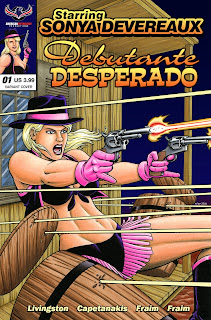
Starring Sonya Devereaux - a Series of Comic Book One-Shots

I'm a sucker for comic books that have a female lead. Now, I don't buy every single female-driving comic on the market (otherwise, I would be broke!), but when I see one that looks interesting in some way, I am willing to give it a try. So when a recent Previews had solicitations for a book called Starring Sonya Devereaux, with covers that parodied other comic book covers (such as Punisher, Tomb of Dracula, Walking Dead, etc.) and is described as a comic about a B-list actress who stars in really bad films, well, I certainly couldn't pass that up, now could I?

This is not an ongoing series, so each book is numbered as Issue 1 - thus, I did not realize until I got my first two copies that I actually had issues two and three - somehow, I missed the real first issue (which I will have to get off of eBay, I suppose, since I'm not finding it for sale on the American Mythology Productions website, other than e-reader version). But, that's okay, because these do not appear to need to be read in any particular order. Each book is a story within itself (which is a nice change of pace from so many 6 to 12 part stories in most comics today), and quite frankly, they are one heck of a lot of fun!

"Vampire Academy 4" opens with Shane, a stereotypical overweight long-haired geek from a website called scaredshitless.com, meeting our star, Sonya Devereaux, at her apartment for an interview. Sonya teases him a bit before sitting down and letting him watch her latest film, Vampire Academy 4. At this point, the comic switches gears, and the readers (like Shane) get to watch Sonya as Elsbeth, a young vampire who is getting ready to start her senior year at Bathory Academy (and if you don't know who Lady Bathory is, I'm not going to explain it to you). The "movie" has everything you'd expect from a less than B-list film: a group of mean girls; a super sexy teacher; a love interest for the main character (who she avoids biting or killing); a baddie who wants to kill the main character (and all of her friends and classmates); some gratuitous sex scenes (although they are tastefully drawn to avoid any actual nudity); a climactic battle; and a twist ending.  It crazy and kooky and will no doubt make you smile and even chuckle as you read it.

"Debutante Desparado" finds Sonya attending a screening of the final cut of her newest film, Debutante Desparado, The film itself - well, let's just say it is so bad, it is good! Four young girls in the old west heading out for spring break (uhm, don't think that was a thing back then). Sonya plays Prudence, a college student studying to be a school marm (really??). The girls' stagecoach is overtaken by bandits who take Prudence's three friends captive (where was Prudence? why, she had to use the outhouse!). Prudence follows them to town, where she meets the town cow hand (not because he tends to the cows, but because he actually was born with a hoof instead of a hand! I told you this was bad....) and gets into an argument with the town baron, Mr. Irving. With the help of cow hand, Prudence rescues her friends and sends them off, staying in town to help the people rid themselves of Mr. Irving's control. Hiding out at the local brothel, Prudence teaches the girls some of the finer things of being a lady, while they teach her ... well, they teach her other things (you can imagine - it is a whorehouse, after all). In true old west style, there is a huge shoot out, a country barn dance, an unexpected return from the dead, and a twist ending (which is apparently going to be a staple for these series of one-shots).

Authors Todd Livingston and Nick Capetanakis are clearly having fun with this series, poking fun at the various genres of films and giving readers a riotous romp through the memory of just how bad those B-films can be.  Artists Brendon and Brian Fraim (brothers? cousins?) provide a clean artistic style, which I find refreshing in a time when so many artists seem to be shying away from having people actually look like people (in other words - the art is not cartoony, it is not manga, and it is not abstract in any way). It is kind of a flashback to the '70s in so many ways, how could I not like it?

A fourth title is solicited (which I've already ordered), and I need to go back and find the first book; and hopefully, Livingston, Capetanakis, and the Fraims will continue creating more of these fun little one-shots for fans like to me to enjoy!

RATING:  9 blood-sucking decapitations out of 10 for keeping the fun in comics, for making parodies so enjoyable, and for creating a titillating character that doesn't have to get naked to sell it!