Showing posts with label Ted Wilford. Show all posts

Tuesday, July 29, 2025

A Ted Wilford Mystery, no. 14 - The S.S. Shamrock Mystery

With this fourteenth Ted Wilford mystery, I have reached the penultimate book in this series.  I have to say, when I started reading this books, I certainly never thought I would make my way to the end of the series, but here I am, just one book away from finishing it.  For the most part, the stories have been much more enjoyable than I ever expected.  Sure, some have certainly been better than others, but I think I like the fact these mysteries are more cerebral and less about adventure, as most boys' series are.  I also like the fact that Ted and his best friend, Nelson Morgan, have aged and matured through the stories, going from high school to college and expanding their knowledge and experience in the world of newspaper reporting.  The particular story definitely took the boys in an unexpected direction, and not necessarily for the better (in my opinion).
 
The S.S. Shamrock Mystery opens with the boys being hired, more or less, by one Mrs. Dundee, who runs a rather successful shipping company.  One of her ships, the Shamrock MI, has been having a number of small incidents happen lately that, by themselves, do not mean much, but when added all together, it raises the question of whether someone is trying to sabotage the freighter and keep it from completing its deliveries on time. Mrs. Dundee is afraid it is a competitor who is vying for some very important shipping rights, which, if she were to lose, could cost her company considerable money.  Ted and Nelson readily agree to assume a new role as sailors for a few weeks during the break from college and see if they can uncover anything while on board.  They are told only the captain and one crew member will know who they are and why they are really on board, so the must be discreet in their investigation.
 
Thus, within the first few pages of the book, author Norvan Pallas sets up the mystery that Ted and Nelson will be trying to solve.  The only problem I had with the story is that Pallas gets sidetracked way too often with his descriptions of the water routes taken by the Shamrock.  Not only do we get overly detailed descriptions of boating regulations in the shipping lanes, but explicitly outlined routes taken by the ship as it traverses the rivers around the Great Lakes.  Harriet Stratemeyer Adams could have taken a cue from Mr. Pallas when it comes to providing readers with some real-life facts about the setting of the story.  Unlike most of the other mysteries, Ted and Nelson do not take a very active role in solving this mystery.  Instead, they just seem to constantly ponder the things that happen around them - the missing crew member, the boat that appears without lights in the middle of the night, the seemingly random stolen items on board the ship, the false directives given to the communications officer, and so on.  Rather than taking the initiative to hunt down clues and ferret out information, they basically go over the same questions repeatedly until the answers fall in their lap!
 
Pallas does scatter a few obscure clues throughout the story to help the reader along, but the first three-fourths of the book reads more like a boys' adventure tale of life on the sea rather than a mystery.  It is not until the final quarter of the book that things start to really come to a head, and the mystery finally moves to the forefront.  At least then we start to get some excitement, as Ted and Nelson finally begin to do more than question everything and start to put the pieces together regarding the mysterious night boat, the missing crewman, and all of the other strange occurrences.  There is a rather clever misdirect involving a criminal that one crew member's father is investigating, as well as some doubt regarding another crew member's real identity.  The saboteur's true identity eventually comes to light, and Mrs. Dundee's ship and her contract are saved by the end (as if there were ever any doubt).
 
Interestingly, the scene depicted on the cover never actually occurs anywhere in the story.  I'm assuming the two boys are meant to be Ted and Nelson, and if so, at no time were they watching the Shamrock from a distance when they spot to mysterious boat making its way to the bigger ship. Every time Ted saw the night boat, he was aboard the Shamrock, looking out over the water.  Thus, I'm not sure why the cover artist drew the scene this way, but I suppose one can chalk it up to artistic license.
 
I was not overly thrilled with this story, and I hope the next, and final, book in the series gives readers a much better mystery to sign off on!
 
RATING:  6  tales of the Lake Superior sea serpent out of 10 for, at the very least, providing a uniquely different type of mystery for a series book like this.

Tuesday, January 21, 2025

A Ted Wilford Mystery, no. 13 - The Abandoned Mine Mystery

It was time to step back into the world of budding reporter, Ted Wilford, and his photographer best friend, Nelson Morgan.  This book marks the thirteenth book in the series, and it has been rather enjoyable watching Ted and Nelson grow up, graduate high school, and enter college, all while Ted has pursued his career as a reporter.  I have also liked the rapport between Ted and Nelson - like two best friends in the real world, they joke with one another, they support one another, and they encourage and compliment one another.  I think those are some of the reasons why I have truly liked this series, because the characters feel real and relatable, as do most of the mysteries and situations in which the boys find themselves (although, like any good series books, there are those instances of coincidence that would never happen in the real world, but, hey!  these young sleuths have to be able to solve their mysteries, don't they?).

The Abandoned Mine Mystery is set during the boys' summer break from college, as Ted is once again working for the Forestdale Town Crier, the town's local newspaper.   Editor Christopher Dobson sends Ted and Nelson to the small community of East Walton, a few hours away from their own hometown, to look into claims that an accidental mine explosion, which shut down the mine, may not have been accident at all.  East Walton had thrived while the mine was open, but now that it has been closed, its citizens were suffering.  The owner of the mine has kept it closed, waiting on federal aid, and the mine workers and their families cannot hold out without work much longer.  Ted must first make contact with the Town Crier contact in East Walton - one Phil Royce - to ensure he is not stepping on his toes before investigating the story, but before he can even reach the town, the mystery begins...

A news report about two missing children catches their attention on the way to East Walton, and wouldn't you know it - arriving at the edge of the town, they spot two children heading into what appears to be the entrance to a coal mine.  As a storm approaches, Ted and Nelson do what any responsible adult would do - head into the mine to try and find the children.  They manage to find them, but not before the storm breaks, forcing them to spend the night in the mine!  The next morning, they return the children to their mother and learn that the children had been trying to find their mule, Alice, who has a tendency to wander off.  While there, the mule is returned by a farmer on the other side of the river - and if you don't think that is a big clue that something odd is happening, since the children followed the mule into the mine, then you haven't been reading children's mysteries very long!  Leaving the children's home, they are stopped again before they can make it to town in order to assist a man named Patrick Sorrel, whose car has stalled by the side of the road.  As they drive him to town, they learn Mr. Sorrell is a real estate man who is attempting to build a new community on the other side of the river (hmmmm, now isn't that a coincidence?!), but the people of East Walton are not happy with him, believing he is taking advantage of them and the closing of the mine.  Now, the question becomes - how do either of these things tie into the actual closing of the mine?  Well, that is what Ted intends to find out.
 
Remember, Ted was sent to East Walton to uncover whether the mine explosion really was an accident.  He meets with correspondent Phil Royce, who is dealing with a break-in at his father's drug store, so he has no issue with Ted pursuing the story.  He also meets with the woman who wrote the letter to the Town Crier about the explosion, along with the man who owns the coal mine, the mayor, and several other people in the town, all of whom have been affected by the closing of the mine.  The common thread seems to be Mr. Sorrell and his intent to build a new community across the river.  Ted and Nelson daringly go into the mine several times to investigate, and they find it is a maze of paths - both Ted and Nelson devise their own ways to keep track of where they are going:  Ted draws a map as they go, while Nelson uses a piece of chalk to mark off their turns.  To be honest, I would not have any desire to go traipsing around in mine tunnels that go deeper and deeper into the ground - thinking about all of that dirt and stone above me would make me extremely uncomfortable (and I'm not claustrophobic at all!).  But Ted and Nelson brave the tunnels in order to figure out what is really going on - one time, they even lose both of their flashlights, leaving them completely stranded in the maze with no way to find their way back - until, that is, they hear a slight tinkling of a bell - one worn by a certain mule who has a tendency to wander off!  Yes, Alice returns to rescue out two heroes - how convenient is that!

The boys ultimately learn about the coal pirates, nearly get arrested when someone plants a stolen gun in the glove compartment of Nelson's car, are given false information to hurt their credibility, and discover a long closed-off tunnel that leads under the river, revealing a secret that could very well cost Mr. Sorrel quite a bit of money if people were to find out!  While the mystery did not involve ghosts or hidden treasures or lost wills or the such, it was actually still a very good read.  The topic of real estate swindles, blackmail, and political agendas reads more like an adult mystery than a children's series book; however, Pallas manages to keep it readable and enjoyable, and I'll give you a big hint - the real villain of the story is not who you think it is.

Sadly, there are only two books left to go in this series, and I almost hesitate to read them, because once I do, I know there will be no more.  I just hope when I do read them, they hold up as well as this book does.

RATING:  9 small orange-colored boxes out of 10 for a different kind of mystery that is a reminder that not every problem one faces will have an easy solution!

Saturday, April 20, 2024

A Ted Wilford Mystery, no. 12 - The Mystery of Rainbow Gulch

As I get nearer to the conclusion of the Ted Wilford mystery series, I am beginning to notice the stories are straying further away from Ted working on a story for the school or hometown newspaper and moving into standard mystery fare.  After the last book's focus on baseball, I was hoping this book would get Ted back to his newspaper work; but, alas, such is not the case.  Instead, we get probably the most convoluted mystery Ted and Nelson have faced to date.

The Mystery of Rainbow Gulch sees Ted and his best friend, Nelson, taking a much needed vacation.  The two young men head off to stay with Nelson's friend, Bob Fontaine, who lives on a farm with his parents and younger sister, Tony.  Oh, and their dog, Cougar.  And their horses - Starlight, Meadowlark, and Blaze.  And their new farm hand, Henry Cox. And we can't forget their neighbor, Mrs. Manners.  And we definitely must make mention of that old hermit who lives way out in the hills, in Rainbow Gulch, to be exact.  Author Norvin Pallas provides plenty of characters in this story, and with the numerous characters comes the numerous mysteries that fall into Ted's lap!

MYSTERY #1 - Ted learns that Bob's little sister, Tony, is not actually the Fontaine's daughter.  They discovered her in their front yard after someone dropped her off late one night and disappeared thereafter.  The Fontaines did all they could to find relatives of the girl, but she could not even remember her own name (she was too young at the time), and the only thing she could really say was "Tony," which is why they gave her that name.  They are trying to adopt her, but their lawyer says something is slowing the process down - and that something turns out to be the Fontaines' neighbor, Mrs. Manners (yes, that's really her last name!).  Despite her name, she has no manners at all, for she tells Mr. Fontaine that she intends to adopt young Tony herself, and there is nothing he or his family can do to stop her!

MYSTERY #2 - Soon after arriving at the Fontaines' farm, Ted and Nelson join Bob on a horseback ride, only to watch a plane crash over one of the distant hills.  They report the possible downed plane, and a ranger comes to the property and has them take him to where they think the plane went down.  They discover the pilot is dead, and it appears the plane had surveying cameras aboard - but for what reason, they do not know.  And Ted discovers some very strange footprints leading away from the plane, leaving them to wonder if someone survived the crash, or if someone came to the plane and took something away...

MYSTERY #3 - Ted and Nelson also learn that a nearby house burned to the ground not long ago, and there is an auction taking place for some of the livestock and other items that survived the fire.  Bob tells them the couple who rented the property - Mr. and Mrs. Franton - died in the fire, and no one could find any of their relatives to claim the remaining property.  Bob inadvertently bids on, and wins, an old stuffed chair, which, when Ted sits in it, he discovers a paper shoved into the cushion - a paper that contains a very strange coded message!

MYSTERY #4 - A young man by the name of Henry Cox shows up, looking for work as a farm hand.  Mr. Fontaine hires him, but Ted suspects there is something off.  Henry does not appear to know much about what he is doing, and his questions raise suspicions in Ted's mind.  Then Henry takes off one day, leaving no word, and the family discovers that before he left, he used more than one roll of film to take pictures of young Tony, asking her numerous questions about what she remembers from her past and her real family.  

MYSTERY #5 - And last, but not least, there is the mysterious old hermit the boys find living out beyond Rainbow Gulch.  He lives in a beat-up old shack that no one knew was there, and he talks incoherently to himself as he wanders around.  The boys cannot figure out if he is prospecting for something, or if he is simply seeking a solitary life.  And Ted can't help but wonder if he is the one who left the footprints out near the sight of the plane crash...

Five seemingly unrelated mysteries, and here Ted and Nelson thought they were going to have a relaxing, uneventful vacation!  Of course, Pallas doesn't wait long before he starts to interweave the mysteries, and the reader, alongside Ted and Nelson, begins to get pieces of what is really going on and who all the players really are.  The disappointing thing about the book is that Ted does not do any real investigating, except to question Henry Cox.  The revelations regarding the burning of the Franton's home, the real identity of Tony, the true motivation behind Mrs. Manners' actions, the reason for the plane crash, and the truth about the hermit out in Rainbow Gulch all come to light without any help from Ted at all.  I suppose it could be proffered that if Ted had not come out to the farm, none of these secrets would have come to light; however, he is simply a catalyst and not an actual reason.

That is not to say there is no excitement to the story.  There are some rather tense scenes building up to the climax, when Tony is kidnapped, and Ted joins Bob to go in search of her.  After they find her, they get trapped out in Rainbow Gulch as a fire begins to spread around them, trapping them with no way out.  The scene of them climbing the "rainbow" shaped rock formation in order to escape the coming flames is the cover scene for the book.  I rather liked how Pallas portrayed Ted and Bob in these scenes, as they are forced to remain calm for Tony's sake, so she does not become hysterical at the thought of the fire consuming them, and even when they believe there is no hope of rescue, they stay positive for the small girl.  That writing stays true to Ted's character in the series.

Not one of the better books in the series, but definitely not the worst.  With only three more books left in this series, I'm hoping they get better before it ends!

RATING:  6 cloths soaked in water from the stream out of 10 for crafting five mysteries that ultimately tie into one rather complex mystery to be solved!

Monday, July 17, 2023

A Ted Wilford Mystery, no. 11 - The Baseball Mystery

Up until this point, I have more or less enjoyed the Ted Wilford series.  While I'm not much of a fan of the "boys' mystery series" books, since first buying these reprints of the series written by Norvin Pallas, I have been pleasantly surprised by how good the books have been.  While not full of danger and adventure like the Nancy Drew or Hardy Boys series, the mysteries have been more cerebral, and the fun has been in following along with Ted and Nelson as they methodically follow up on clues and use their brains to unravel the truth.  But this eleventh mystery in the series left me feeling a bit let down.

The Baseball Mystery gave me the impression that Pallas was more interesting in writing a baseball story than a mystery.  There's very little mystery and more of Ted and Nelson trying to manage the statewide baseball tournament that is being held in their small hometown of Forestdale.  Between scheduling the games, arranging accommodations for all of the players of the various teams, setting up people for intake, tracking the scores, and taking photographs, Ted and his best friend are left very little time for anything else.  Especially when there are problems that arise that must be handled with delicate care so as to not offend anyone and give Forestdale a bad name.  

The small mystery that comes in to play starts with a break-in at the headquarters for Ted's team of workers.  Nothing is stolen, leaving Ted to wonder exactly what it was someone was looking for.  Then a couple of kids break the window to the local jewelry store, and once again, nothing is taken.  After that, a model airplane is stolen from a small show that takes place during the baseball tournament.  Everyone is convinced that some of the young men who have come to town to play ball are behind all of these crimes, but Ted isn't quite ready to blame the baseball players.  He thinks something else may be going on.  Of course, he has next to no time to really think about it or investigate, because all of his attention is spent monitoring the baseball games, ensuring all of the players have accommodations, and that complaints are handled quickly and efficiently.

For anyone who ever wanted to learn everything about baseball, this book is it.  Either Pallas was well-versed with the game and how it is scored and how the players' averages are determined, or he did considerable research - because he writes about all of it in excruciating detail in this story, making it somewhat difficult to read at times.  I'll be honest and admit that I skimmed over some of the pages when Nelson starts explaining how the averaging works for the various player positions.  I did not see how it was important to the story, and quite frankly, it wasn't.  Yes, the mystery was ultimately revealed to be about some men who were gambling, placing bets on the game and trying to control the outcome of the games in order to make more money - but the overly detailed facts about baseball where not truly necessary in order to enjoy the story.  I have to wonder if perhaps that was used as filler, in order to pad out the story to fill the page count.

Ken Kutler does make a brief appearance in the story, although it seems for no other purpose than to push Ted into suspecting the whole gambling side of things.  Margaret shows up in a scene or two as one of the people helping Ted check in the baseball players as they arrive in town.  Ted's mother is on hand to help house and feed a couple of the baseball players, and even Mr. Dobson, whose newspaper is the one that petitioned to have the baseball tournament held in Forestdale, is barely in the story.  It seems the entire supporting cast has been pushed aside to focus on the baseball (which is why, you'll notice, my post here is focusing on the baseball element of this book - I figure if the book can do it, then so can I!).

I will give Pallas some credit here - he does introduce two young boys that stay at the Wilford house, Larry Dodge and Cal Farmington, who manage to make their presence known throughout the story and play a part in the final revelation about the gambling element.  These two boys are rather likable, and it's almost a shame they won't be sticking around to be regular members of the supporting cast.

Not much else I can really say about this book, other than the fact that I'm glad it's behind me, and I can only hope the next book in the series will be better than this one.

RATING:  5 perfect little bunts down third out of 10 for at least changing things up a bit and not writing the same old mystery plot in each book.

Monday, December 12, 2022

A Ted Wilford Mystery, no. 10 - The Missing Witness Mystery

With this tenth book in the Ted Wilford mystery series, I am now two-thirds of the way through the 15-book series.  I still find myself surprised at how much I am enjoying this series, since normally, I am not a fan of series books with male leads.  But Norvin Pallas has offered up a genuinely "real" character with Ted Wilford - an intelligent young man who doesn't jump head-first into danger, he does not take unnecessary chances, and he uses his head to figure things out.  And his best friend, Nelson Morgan, is the perfect compliment to Ted - he's a bit rash, he puts forth some of the most wild theories for Ted to consider, and he's more ready for action than thinking.  

In The Missing Witness Mystery, Ted and Nelson set about to locate a bank teller that has disappeared and is wanted in connection with the embezzlement of funds from the state bank of nearby Stantonville.  At the same time, a college friend, Marty Blaine, pays Ted a visit while passing through Forestdale on his way to stay with his aunt, some forty minutes outside of town.  Just before Marty arrives, however, there is a squealing of brakes outside the newspaper office where Ted works during his summer and winter breaks - a large truck just avoids hitting a small dog crossing the road.  Three separate events, three people who seem completely unrelated, and before you know it, Ted finds himself trying to figure out just how and why these three events are tied together!

This book is definitely one of Pallas's more intricate mysteries.  While it seems pretty clear that the bank teller who disappeared right after the funds went missing from the bank is likely to be the one who took off with the money, Ted can't help but wonder if there is more to the story.  Nelson wants to hunt for the teller, who was last seen heading towards Forestdale, but Ted knows that is like looking for a needle in a haystack.  Instead, Ted wants to track down their friend, Marty, who it turns out may unwittingly hold some key information about the bank teller without realizing it!  The only problem is, Marty never told Ted his aunt's name, nor did he give him the address of where his aunt lives - only that it is about a 40-minute drive outside of Forestdale.  Add on the unusually heavy suitcase Marty had with him (that he refused to let anyone see what was inside) and the mysterious phone call Marty makes in the middle of the night while staying overnight at Ted's house - well, you get the picture.

I enjoy how the characters in this series work through their clues in deciphering what the mean and how to figure out where to look next.  I give Pallas credit for coming up with some very creative, yet very realistic, ways of finding solutions.  Such as how to locate a person without a name or an address!  Yet, Ted and Nelson manage to do just that, ultimately locating Marty, who, even when confronted about the boys' suspicions, still fails to come clean with them.  It's only when Marty's aunt comes home from the hospital do the boys learn the full story (well, almost the full story - the mystery regarding the suitcase does not get resolved until literally the end of the book!) - and discover that they have not one, but two mysteries on their hands!

I also loved the clue of the adding machine tape (which appears front and center on the cover of the book).  It turns out this little piece of paper holds a very big clue, and Ted's quick thinking ultimately reveals the importance of those numbers - which leads him, and the police, to catch the embezzler and solve that mystery.  And it's also nice to see Ted get the recognition he deserves for blowing this story wide open with a front page article in the Town Crier.  

One odd thing I noticed about this story is when Ted joins his rival reporter, Ken Kutler, to interview a number of witnesses regarding the incident with the little dog.  They spend an entire chapter interviewing witnesses - eight of them total - going from house to house and spending time talking with them.  Ken finally drives Ted back to the newspaper office so he can return to his own paper. Ted ends up helping the editor and his secretary with several jobs that need to be done - at which point, on page 32, it says that "Noon came...."  NOON?! Seriously?  What time in the morning did Ken and Ted go out and start interviewing these witnesses?  Because Ted met up with Ken at the police station (p. 22), and they chat for a bit before heading out to speak with the witnesses.  The first two witnesses are sisters and live together (p. 24); but the remaining witnesses are all individuals, requiring the boys to travel from house to house to speak with each of them.  Then, there is the drive back to the Town Crier, at which point Ted ends up running articles to the printer, typing up items, and answering phone calls.  I know in series books, the authors sometime play loose with time, but this seems a bit much for Ted to have accomplished all before noon!

An interesting thing I learned from this book was what a "sugar house" is (p. 84).  Ted and Nelson come upon a "sugar house" at the farm where Marty is staying with his aunt.  It is described as a building "where they boil the maple sap into sugar in the spring" (p. 84).  A quick online search reveals this to be the case (it is also called a sugar shack, sugar shanty, sap house, or sugar cabin).  Always great to learn something new when reading!

Thus far, this series has kept my interest with the stories and the characters, so I've got pretty high hopes as I head into the final five books.

RATING:  8 dented fenders out of 10 for giving readers a story that requires them to really use their brain to figure out the mystery!

Tuesday, July 5, 2022

A Ted Wilford Mystery, no. 9 - The Big Cat Mystery

Never did I imagine that I would find myself enjoying a boys' series as much as I am this Ted Wilford series.  Not every book is exceptional, but I give the author, Norvin Pallas, credit for writing some out-of-the-ordinary mysteries that are a bit more intellectual rather than adventurous (although, there are some books that are chock full of adventure).  I have been reading the reprints published by Wildside Press, as I've never actually seen any of the original books, either in someone's collection or out in the wild at a bookstore.  I am grateful that Wildside made the decision to re-publish these stories, as it has introduced me to a character and series of books that I otherwise would have never know!

The Big Cat Mystery is the ninth book in the series, and while the title is not exactly the most thrilling sounding, the story itself more than makes up for that.  Ted is working for the Town Crier during his summer break, when the paper receives a call about a possible leopard being spotted in the woods around Vanishing Lake.  Mr. Dobson, the paper's editor, is skeptical, but he sends Ted and Nelson out to the resort on Vanishing Lake to follow up on the call and see if it is just a prank, or if there really is a wild cat on the loose.  Ted and Nelson are soon at the lake, and the caller, one Mr. George Jackson, is insistent that he saw tracks made by a big cat, and he introduces them to Holly Jergens, who says she actually saw the leopard, and her brother Gerald, whose only interest at the resort is to play tennis.  Ted and Nelson listen to everything Mr. Jackson and Holly have to say, but they still have their doubts - even after Mr. Jackson takes them across the lake to the exact place were he found the cat's paw print!

The story builds slowly, as Ted and Nelson investigate the sightings; but, it seems other things get in the way.  First, there is a fire in which a young boy is nearly caught in a shed just before the fire reaches it.  Then there is a potential outbreak of typhoid, causing the health department to test the water in the area.  After that, Ted and Nelson discover a black cat in the trunk of their car - a cat that they discover has some unusual spots on it!  Could it be a black leopard?  Could it be connected to the leopard spotted in the woods?  Ted and Nelson make their own expedition into the woods to see if they can uncover the truth, but instead find a cabin that appears is being used for something, but the question is, what?   A traveling menagerie could very well hold the clue to whether the leopard is real or not, but when Ted and Nelson make a trip out to inquire of the owner, they end up having to help the owners and his employees stop an out of control blaze from destroying the entire show!  Was the fire set on purpose?  Is someone trying to keep the boys from uncovering the truth behind what is really going on at Vanishing Lake?

Pallas creates an engaging story that, although a bit obvious who the culprit is, still keeps you turning page after page to find out how the boys are going to get to the truth of the matter.  There is a very surprising (and heart-breaking) scene when the boys are at the traveling menagerie, as the owner ultimately has to shoot several of his big cats to save them from suffering as the fire burns their cages (and would have ultimately burned them to death in the process).  I'm actually surprised that this kind of scene would be placed in a book intended for young adults, as it is very blunt and, while realistic in nature, seems like a very harsh thing to add to a children's book.  It does, however, raise a very good point that the owner of the menagerie makes clear to Ted and Nelson - if people ever stop caring about animals, then the human race really wouldn't be worth saving anyway - and I agree!

Sadly, we, as readers, do not get to see what punishment the real culprit ultimately faces for his actions in the book, as the owner of the resort tells the boys he will take care of confronting the culprit.  The only resolution Ted and Nelson ultimately get to be a part of is that involving the fire at the traveling menagerie, as Ted figures out what really happened and manages to convince the owner of the truth, so that he can rebuild his show.  Nelson, who grew attached to the black cat over the course of the book, reluctantly turns the cat over to the local zoo, who promises to take good care of it.

This books turned out to be a much better story than the previous few, and it gives me hope that the remaining six books in the series will be just as good!

RATING:  9 meadows full of waving grass out of 10 for a great mystery and some great facts about leopards, cheetahs, and big cats in general!

Wednesday, August 18, 2021

A Ted Wilford Mystery, no. 8 - The Scarecrow Mystery

This eighth book of the Ted Wilford series is a bit odd for several reasons.  For one thing, the title is truly misleading.  For another thing, the story reads more like a news story than an actual mystery - however, it does lead one to believe that the author has actual knowledge on the subject matter, considering the amount of detail he covers in the book.  Finally, while the previous books have not always been overly adventurous and filled with danger, this one is rather dry when it comes to true adventure and mystery.  Yet, despite all of that, I found that I actually enjoyed the book overall.

I will start off by spoiling something - The Scarecrow Mystery is not actually a mystery about a scarecrow.  At least, not in the literal sense.  Yes, an actual scarecrow does eventually appear in the story, but it plays such a small part and holds very little connection to the mystery itself.  The mystery centers around a small orange canister that contains some microfilm (if you don't know what that is, Google it!).  A union leader is in possession of the microfilm, which must be presented to the Court as evidence in a case that has been brought by the trucking company employers.  However, on the way to Forestdale, Mr. Prentice's car is apparently run off the road.  Ted and his best friend, Nelson, manage to get Mr. Prentice to the closest town (Echo) so he can be checked by a doctor - and it's not until that night, when Ted gets a call from the union leader's attorney asking him to go out and search for the canister containing the microfilm.  Ted and Nelson do their best, but in the evening hours, they are unable to find it - they do, however, meet a young boy, who says he saw a scavenger looking around the car, so perhaps he might have taken it.  The boy promises to look for it the next day.

This sets off a chain of events that tie closely into the ongoing battle between the union and the trucking company.  There is a fierce battle about whether the union members will go on strike, and it seems neither side will budge.  Ted is stuck in the middle, trying not to take sides, and he and Nelson do their best to locate that missing microfilm, which seems to be at the very crux of the case.  And once they do locate the missing microfilm, things only go downhill from there.  The court battle culminates in a trial, to which Ted is called as a witness, and as a paralegal for many years, it was actually rather interesting to read the attorney's examination of Ted on the witness stand.  The writing here is exceptional, as the attorney's questions are well-crafted to elicit specific testimony, and poor Ted really gets put on the spot.  He's honest (or, at least, he thinks he is being completely honest) about the events that transpired, but the attorney puts a spin on things that makes Ted question himself.

Now, having worked in the legal field for as long as I have, the union battle and the courtroom questioning definitely had my attention - but I have to wonder if the average reader would find these legal battles as interesting.  It is somewhat dry reading, and without any background knowledge of unions or the law, some readers may find it quite boring.  One thing that was a bit disappointing for me is that Ted doesn't really solve the mystery, as much as it solves itself around him.  Without Nelson prodding him along, it is unlikely Ted would have figured out half of the clues he did uncover (leaving me to wonder if perhaps Nelson should be the top-billed character in the book).

As for the whole scarecrow thing (and this will be spoilers, so if you don't want to know what happens, do not read any further!)...

It turns out the scarecrow connection is nothing more than the fact it is a prop borrowed from someone Ted knows, and upon discovering the man's watch chain in a pocket of the scarecrow's clothes, a connection is made to some of the culprits who have been acting behind the scenes to push the feud between the union and the company men.  However, Nelson makes a passing comment earlier in the book about one of the men being a "scarecrow," meaning he was pretending to be something he was not to create the animosity.  I had never heard this kind of meaning attached to the word "scarecrow" before, so I looked it up - and sure enough, in legal terms, scarecrow (or "straw man") can refer to a person who has no interest in the situation, but merely acts as a stand-in for someone else or it can refer to an argument which is intended to distract the other side from the real issues or waste the opponent's time and effort (otherwise known as a "red herring").  Now, when taken in this context, perhaps the title to the book does actually apply to the union/labor dispute and the mystery associated therewith, because there are several characters who Ted and Nelson question their sincerity and veracity during the course of the book.

Overall, it was not a bad read, but it definitely was not one of the better books in the series.  Not sure if Pallas figured since Ted was aging in the books, the readers would also be aging and would enjoy more "adult" themed mysteries, but there is definitely a difference in the tone and direction of the story.  Next in line is The Big Cat Mystery, so we will see was that mystery has in store for us!

RATING:  7 baby pictures of the Mayor out of 10 for treating readers to a unique mystery that is likely to be unlike any other young adult mystery of its time!

Tuesday, October 20, 2020

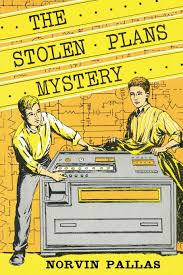
A Ted Wilford Mystery, no. 7 - The Stolen Plans Mystery

Time to take another trip into the small-town world of Ted Wilford and his best friend, Nelson Morgan.  I've never seen these books out in the wild, nor have I actually ever seen any of the original editions on eBay (although, to be quite honest, I haven't really searched too hard for them on eBay, ABE, or any of the other online used book sellers).  So, I am glad that Wildside Press has been reprinting the series - I just wish they reprinted the entire run, and not just select titles (more on that later...).

The Stolen Plans Mystery is the seventh book in the series, and as with the Judy Bolton series by Margaret Sutton, the main character in this series - Ted Wilford - and his friends age as the series progresses.  When I started reading the first book, Ted and Nelson were still in high school, and Ted worked for his school newspaper.  Now, in this seventh book, Ted and Nelson are returning home after their first semester in college, and although they are looking forward to the Christmas break and spending time with their respective families for the holidays, Ted can't help but hope there is some work for him at the Town Crier (the Forestdale newspaper).  And, of course, there is, as his somewhat newspaper nemesis, Carl Allison, is out of the office for the week, and Mr. Dobson (the editor for the paper) was hoping Ted would be willing to take over his regular work load.  This, of course, is what causes Ted to stumble onto his latest mystery.
 
Author Norvin Pallas provides his readers with a rather complicated mystery involving a brand-spanking new computer named "Lulu" (remember, this was 1959 when the book was first published!); the sudden resignation of the new circulation manager, Mr. Sawyer; the numerous toys and other items reported missing from the various stories involved in the newspaper's promotional contest for the holiday; and the jolly old man playing Santa, who seems to be more than what he first appears!  To be quite honest, it is a bit of a stretch to try and figure out how any of these things are connected; however, as the mystery plays out, and as Ted and Nelson investigate first the stolen items, and then begin surveillance on Mr. Sawyer's home, it begins to all come together.  And while there are not too many dangerous situations in this one, other than Ted getting locked in a freezing meat locker (from which he has a very ingenious way of escaping), the mystery itself is very engaging, and I found myself reading faster and faster.  Even though I had figured out many aspects of the mystery, it was still fun to follow along with Ted and Nelson, and their friend Cliff, as they worked out all of the clues and eventually helped reveal what was really going on!

I admit to being rather fascinated by the whole computer aspect of the story.  "Lulu" is a huge contraption in the back of the editor's office, and it works by being fed information so that it can calculate results at a faster rate of speed than if done by hand.  In the story, it is being used to sort through all of the contest submissions from the citizens of Forestdale, who are competing in a holiday contest set up by the newspaper (and which, to a small degree, plays a part of the mystery, since items are stolen from each of the businesses in downtown that are participating in the contest) and determine the winner of the contest.  By today's standards, this "computer" is very VERY old school - but in 1959, this was probably something very unique and new, and to a lot of people who read this book at the time, it was almost science-fiction in nature.

Sadly, this book appeared to be the last book reprinted (with the exception of The Baseball Mystery) - however, a look at Amazon.com just now reveals that Wildside has issued a number of other books in the series, including the next several books, up through book 14, in paperback!  So, now I can purchase those and continue reading the series in order without missing a beat!  Good news, indeed.

RATING:  7 coins stuck into a light socket out of 10 for making a complicated mystery not quite so complicated for its readers to enjoy!

Sunday, October 13, 2019

A Ted Wilford Mystery, no. 6 - The Counterfeit Mystery

This sixth Ted Wilford mystery was not overly exciting - however, it was definitely a product of its time!  Of course, the entire series is a product of its time (no cell phones, no computers, etc.), so when reading the books, I have to remind myself of that fact.  However, just because it is a story out of time does not mean that it can't be exciting, or that it shouldn't be enjoyable from the first page.  But I have discovered that these Ted Wilford mysteries are sort of hit and miss - some are really good, while some are not quite that good (and the mystery not overly engaging).  Sadly, this one falls into the latter category.

The Counterfeit Mystery is set during the summer following his graduation from high school and just before he is ready to leave for college. He doesn't have much work at the newspaper, and just when he thinks he will have a lot of free time the last few weeks of his summer vacation, he gets a call from Mr. Dobson, the editor at the town newspaper.  Along with newcomer Nancy Lindell (who happens to be he niece of the newspaper's secretary), Ted is brought into the editor's office to meet Mr. Woodring - a salesman set to introduce a whole new concept to Forestdale - trading stamps!  I had to smile when I read this, as I realized that most people I know today would have no idea what trading stamps are (and no, it doesn't mean collecting postal stamps and trading them as you would baseball cards or comics!).

For those who don't know, trading stamps were stamps that a person could collect every time they went shopping.  For every dollar you spent, you earned a certain amount of stamps.  You collected the stamps in books, and when you had a certain number of books, you could redeem them for various things - from dishes, to utensils, to pots and pans, to toys, to any number of items.  The more an item was worth, the more books of stamps were required to be redeemed to get it.  Additionally, you could purchase an item using both stamps and money - for instance, if you wanted a bicycle, and it cost you 250 books of stamps, but you didn't want to wait that long - sometimes, there was a special offer, and you could get the bicycle by redeeming 100 books of stamps plus $100 (that's just an example, so don't go trying to go search and see if that is accurate).  I can remember back in the day when I was a kid, my mom collected Green Stamps, but I don't remember if she ever had enough to redeem them for anything (she probably did, and I just never paid attention, as I was too worried about toys and Nancy Drew books LOL!).

In any event, Ted doesn't seem thrilled with the whole concept, but Mr. Woodring convinces the paper's editor, who agrees to endorse it.  Plus, Mr. Dobson has volunteered Ted's services to act as his assistant while he is in town trying to drum up business for the stamp sales. Ted chooses to use the opportunity to keep an eye on Mr. Woodring and make sure the entire thing is on the up-and-up.  It ultimately pays off, since the stamps that start showing up are a purple shade, while the original stamps that Mr. Woodring showed Ted and the others in Mr. Dobson's office were blue! Is Mr. Woodring counterfeiting the stamps, or is something else going on?

In the meantime, Ted gets to know more about Nancy and discovers that she has come to town for an ulterior motive. It seems her grandmother makes mention in some of her letters of a town named Freeport in the state, but it seems no one has ever heard of it!  Neither Ted nor Nancy can find any mention of it in the newspapers or other books in the local library, and even some of the older townsfolks have never heard of it.  How could a whole town disappear?

 The counterfeit stamps part of the mystery is rather tame, and the clues to that pretty much fall into Ted's lap without him actually having to look for them (except for when Mr. Woodring disappears, then Ted has to take action to actually hunt the man down).  His and Nancy's efforts to locate the ever elusive Freeport seems to find them doing active clue-hunting, but to no avail.  And, like pretty much every children's mystery story written, the two mysteries are eventually determined to have a connection, and solving one leads to the solution of the other.

The one element of this story I did find somewhat interesting was Ted and Nelson's trip to Hobotown, an area of the city where the hobos tended to congregate and set up temporary "homes." They are looking for Mr. Woodring, and the clues lead them to this community of hobos, and it was rather intriguing to see how author Norvin Pallas portrayed the people. Pallas wrote them as a tight-knit group of men who looked out for one another, had a code of honor, and did not tolerate outsiders; yet, the do decide to help Ted in his mystery, providing a very important clue to help him solve the case.

I only have two more books from the series - books 7 and 11.  While 8 of the books in the series have been reprinted in paperback editions, for whatever reason, the remaining 7 books are only available on e-readers, which I refuse to get.  So, once I read those last two books, then my reading of Ted Wilford mysteries will have reached its end...

RATING:  7 purple cows out of 10 for bringing back memories of my youth and my Mom with an outdated program that I hadn't thought of in years!

Thursday, October 11, 2018

A Ted Wilford Mystery, no. 5 - The Empty House Mystery

Like the Judy Bolton series, the Ted Wilford series finds its lead character (and his friends) growing older with each book. While so many children's mystery series have the protagonists at a stagnant age (forever eighteen in the olden days, and now it seems the lead characters are fifteen, fourteen, and or some cases, even younger!), author Norvin Pallas decided to allow Ted to age naturally, and in this fifth book of the series, Ted and his best friend, Nelson, are graduating high school with all of their classmates.

The Empty House Mystery actually has a really interesting, and surprisingly political, plot that kept me guessing. Pallas begins the story with Ted and Nelson helping a stranger search for his missing dog outside of the local theater - a stranger who oddly enough recognizes Ted and begins to ask him questions about a new highway that is being planned to come through the nearby town. Ted doesn't really have any information, but finds it strange the man knows him. When he follows up on it, however, he discovers the man doesn't exist!

And with that, readers are off to the start of a mystery that winds its way through the newspaper, where Ted is helping out for a few weeks while Mr. Dobson is in the hospital, to an empty house with a ringing phone, to an allegedly haunted house where Ted and Nelson get stranded, to a new housing development with yet another empty house and ringing phone. And be prepared, because it seems everyone in this story is harboring one secret or another. First, there's the stranger with no dog. Then there's the man who places an ad for a lost red leather notebook, followed by the nervous woman who turns in the lost notebook. Let's not forget the state auditor, who is filled with anger and sarcasm. And finally, there is the man from the Highway Department, who seems just a bit too authentic to be true. Poor, Ted - he's stuck in the middle of all of this drama, and one innocent attempt to be helpful by personally returning the lost notebook to its owner proves to be the catalyst that sets off a chain reaction of events like you wouldn't believe!

What I did think was a bit odd about the story, however, is that for all the sleuthing Ted and Nelson do throughout the book (I mean, let's face it - any good sleuth worth a grain of salt will stay in a haunted house overnight for the sake of solving a mystery!), it is ultimately not Ted at all who solves the mystery and figures out not only the importance of the stolen notebook, but also who was involved and why. Rather, it is Ted's newspaper rival, Ken Kutler, who makes the final revelation, in a several page monologue setting forth all the details. Of course, this isn't the first time that Ted did not solve the crime - in The Star Reporter Mystery, the story was centered around Ronald, Ted's older brother, and not Ted at all. This leads me to wonder if the author never intended for the series to be solely focused on Ted, but on the entire cast (almost like a soap opera).

In any event, it was still a really good mystery, smooth story-telling, and enjoyable characters. For someone who is not a huge fan of boys' mystery series, this one has really grown on me, and it's a shame the entire series has not been reprinted (as I have been purchasing the paperback reprints from Amazon and reading them).  If you like mysteries, then I would definitely suggest you check these out.

RATING:  9 mislabeled, penciled-in headlines out of 10 for reminding me just why the children and young adult mysteries of the '60s and '70s are still some of the best out there.

Sunday, March 4, 2018

A Ted Wilford Mystery, no. 4 - The Singing Trees Mystery

Ted Wilford is back in the saddle in this fourth book of the Ted Wilford mystery series.  While the last book found Ted's older brother, Ronald, off solving the mystery, this one finds Ted and his best friend, Nelson, trying to figure out who is vandalizing the local Y camp, where they will be serving as junior counselors for a week.  Could the answer lie in a treaty signed by a prior property owner many years ago with the Indians of the area, a treaty that has been missing for too many years?  Or does the answer really lie in a missing inheritance that has led many people to believe the fortune still lies somewhere on the Y camp property?  And just how does a serpent rock and a forest of singing trees factor into all of this?

Author Norvin Pallas weaves yet another satisfying tale with The Singing Trees Mystery.  While the actual singing trees play very little part in the overall mystery, they do make a unique background story that leads a young boy at the camp to disappear not once, but twice (leading to a very daring rescue in a snowstorm at night near the end of the book).  Ted and Nelson certainly have no intention of becoming involved in yet another mystery, but fate has other plans.  When they arrive at the Y camp, they discover that a number of the cabin's windows have been shattered, mattresses have been sliced up, and the canoes have been damaged beyond repair.  What is odd, however, is that nothing has been stolen.  All of the supplies that Mr. Blair (the director of the camp) and Mr. Krillman (the manager of the property) had brought into the camp was untouched.  Nelson believes it was simply the act of some juvenile delinquents; but Ted is not so sure.

Of course, when you factor in the appearance of a ghost in the middle of the night, as well as a warning message that appears and disappears and an air raid siren that sounds unexpectedly, it quickly becomes apparent that something else is going on.  When Mr. Krillman finds his office files rifled through, Ted is certain that some is looking for something in the camp.  An intercepted message meant for Ted's rival, Ken Kutler, confirms Ted's suspicions, and with Mr. Krillman's help, Ted and Nelson make several efforts to capture the ghost vandal.  Ultimately, though, it is young Joey, a rambunctious boy with a penchant for telling tall tales, who leads Ted to discover the who and why behind the vandalism and clear up a mystery that has been left unsolved for many decades.

Pallas continues to age his characters, as Ted and Nelson are now seniors, preparing to graduate and enter into the working world.  While not integral to the immediate mystery, but definitely a part of the ongoing tale of Ted's emerging reporter status, Pallas throws in a confrontation with Carl Allison, the reporter who took over Ronald Wilford's job when Ron moved to the big city.  There is also some development of the friendship/rivalry between Ted and Ken, who try to remain friends even while competing for the same stories for their respective papers.

One thing that definitely makes this book a product of its time (the mid-1950s) is the reference to "trailerites" and the transient nature of people who life in trailers.  In fact, one of Ted's fellow classmates is not allowed back in school due to his status as a "trailerite," which leads him to do some devious acts (which are not quite criminal, but definitely not in good fun).

And while I'm happy that Wildside Press is reprinting these books, I do wish a bit more care was taken in the editing and printing process.  The synopsis at the front of this book, while indicating it is The Singing Trees Mystery, gives a description of the next book, The Empty House Mystery.  Further, the acknowledgement at the front of the book still thanks Steve Romberger, "whose copy of The Secret of Thunder Mountain was ultimately used to create this edition...", despite the fact that Thunder Mountain was actually three books ago!  Of course, neither of these things actually affect the story itself, so I suppose I can't get too worked up over it.

I hope that Wildside continues to reprint more of this series, as I currently have only been able to obtain books 1 through 7, and book 11.  I'm not sure why books 8, 9, 10, 12, 13, 14, and 15 have yet to be reprinted.  Only time will tell...

RATING:  9 broken treaties of friendship out of 10 for giving readers a very likable protagonist who has believable self-doubt, but at the same time, a heart to help others!


Tuesday, August 22, 2017

A Ted Wilford Mystery, no. 3 - The Star Reporter Mystery

Riddle me this - when is a Ted Wilford mystery not really a Ted Wilford mystery?  Why, when Ted Wilford is not the one solving the mystery, that's when!

I enjoyed the first two books in this Ted Wilford series, and so I picked up this third mystery with the expectation that it would be just as good. I was surprised, though, when the story opened with not Ted, but rather, his brother Ronald.  Thinking this was simply a lead-in to Ted's latest mystery, I kept on reading, only to discover that no - The Star Reporter Mystery was Ronald Wilford's opportunity to shine and show off his reporting and mystery-solving skills.

While, not at all what I was expecting, the book was still a really good read, and the mystery was well plotted and rather intricate for a young adult book.  The story centers around the mysterious disappearance of Barry Knight, a fellow reporter at the newspaper where he works (the Cleveland Star). Ronald's boss asks him to look into it and see if he can't find the missing reporter.  Ronald starts with Barry's secretary, Carole Curtis, on whom he has a secret crush.  She is unable to offer much help, though. Ronald checks in at the boarding house where Barry lives, but find no clues there either (other than a violin case that appears to have been left behind).  With nothing to go on, he starts delving into the most recent stories Barry was working on - but even an interview with the man who was the subject of the last story reveals nothing new.

I have to admit, this mystery kept me guessing.  With Barry Knight, nothing is exactly what it seems.  The more Ronald delves into the mystery, the more twists and turns there are.  Ronald ultimately elects to follow up on a letter of recommendation that was the only personal item in Barry Knight's personnel file at the paper, in the hopes that uncovering elements of Barry's personal life and past life might shed some light on where he has gone.  The only problem is, the man who wrote the letter of recommendation is deceased, his wife does not recall Barry Knight, and the town high school and the local newspaper have absolutely no records of a Barry Knight having ever lived there or having gone to school there!

So this begs the question - just who is Barry Knight, really?

Ronald begins to pick up on clues that he gleans from the newspaper reports of a robbery at a local gas station in Barry's alleged home town, and ultimately he calls his brother, Ted, to come help him as he picks up on the trail of where Barry may have gone.  Along the way, Barry's father suddenly appears, hoping to locate his missing son, and the three of them head up into the mountains to a secluded hunting lodge, in the hopes of finding Barry.  It's a definite race against time, as not only are Ronald and Ted searching for Barry, but men working for a purported crime syndicate are also hunting for Barry, and a possible avalanche in the snow-filled mountains threatens them all!

Once again, Norvin Pallas has written an intriguing tale that is not obvious from the get-go, which makes for a very enjoyable read.  I am definitely thrilled that Wildside Press is reprinting this series that I (and probably countless others) would never have the opportunity to read, and I'm looking forward as more of the books are published!

RATING:  9 visits to Short Vincent out of 10 for keeping the mysteries surprising and fresh and proving that even a boys' mystery can be a great read.

Friday, September 16, 2016

A Ted Wilford Mystery, no. 2 - The Locked Safe Mystery

For someone who has never enjoyed reading mystery series with boy protagonists, I readily admit that the Ted Wilford series is holding my interest.  Author Norvil Pallas writes some fairly complicated mysteries, considering the age level at which these books are aimed, but the resolution at the end is always logical, believable, and somewhat obvious once revealed.

This is yet another series that I would highly recommend reading in order, as each story clearly builds from the one before.  The first book in the series found Ted's older brother being offered a job out of town, forcing up to vacate his reporter position with the local newspaper.  In this book, Ronald is already settled into his new job at the big city paper, and not only is Ted filling his shoes as editor at the Forestdale High School Statesman (the school newspaper), but he's also been offered a chance to write some articles now and again for the local newspaper.  Additionally, the young boy that Ted helped in the first book, Tim, has had the surgery necessary to allow him to walk, and school is starting for the new year.  Time clearly moves forward in this book (such as in the Judy Bolton series by Margaret Sutton), and the characters age and change.  And as much as I enjoy the Nancy Drew, Bobbsey Twins, and other ageless series, I have to admit, the fact that the characters grow and mature is a nice change of pace.

In The Locked Safe Mystery, Pallas once again puts Ted into the thick of things.  Ted is put in charge of ticket sales for the fall fundraising event at Forestdale High - but when the event is over, the cash is missing, and the assistant principal has skipped town, Ted feels a responsibility to find out what really happened.  Everyone, including the police, believes the assistant principal absconded with the money, but Ted feels otherwise.  He is determined to prove Mr. Clayton's innocence, and he even enlists the aid of his brother's former competitor, Ken Kutler (who is a reporter for another paper), to help uncover the truth.

What is interesting about this series (so far) is that the lead character, Ted Wilford, is not the one who puts together the clues and solves the mystery; rather, he simply follows along as others make the necessary connections and make the deductions to reveal the solution to the crime.  In this book, while Ted is determined to prove to everyone that Mr. Clayton is innocent, it is actually his brother and Ken Kutler who uncover the final clues that reveal what actually happened the night the money was stolen from the safe. Yes, Ted works hard, and he even sneaks out at night (twice!) to follow up on mysterious phone messages that lead him first to Thunder Mountain, and later to a train station in the dead of night - - and while he continues to seek evidence that will exonerate Mr. Clayton, it isn't until his brother brings Mr. Clayton home and Kutler reveals a secret he has been hiding during the entire story that the truth comes out.  Oddly enough, though, the fact that Ted doesn't actually "solve" the mystery does not at all detract from the enjoyment of the story - in some ways, it leaves the reader feeling a lot like Ted, being along for the ride, hoping desperately that somehow, in some way, Mr. Clayton's innocence will be shown!

Something I noted while reading the book is that the author is either very knowledgeable or has done some great research during his writing of this book.  The football games described in this book are very detailed, in the plays, the type of throws, etc.  And while I am the farthest thing from a football fan and (admittedly) skimmed some of those paragraphs, I have no doubt that readers who love the sport will find those potions of the story entertaining.  What I did find fascinating, though, were the courtroom scenes in chapters 19 and 20 were some of the most accurate portrayals of a courtroom decorum that I have ever read.  Even so-called "legal thrillers" always sensationalize the courtroom action to include unrealistic testimony and attorney tactics; Pallas, on the other hand, gave a very believable and honest depiction of the courtroom.  Pallas portrayed the objections properly, even going so far as to show Ted having to leave the courtroom when the attorneys argued over his cross-examination on the stand!  Having worked for lawyers for more than 20 years now (hard to believe!), I am excited to see such an accurate portrayal.

It goes without saying that, at this point, I am hooked on this series.  I have the next three books that have been reprinted, and I probably need to check on Amazon to see if any more have been reprinted.

RATING:  8 short combinations out of 10 for keeping it real, even in a book of fiction, and appealing to readers from all walks of life!

Friday, July 15, 2016

A Ted Wilford Mystery, no. 1 - The Secret of Thunder Mountain

Can't really recall who turned me on to this series (James Keeline, perhaps?), but I remember reading a post about it, so decided to check it out.  Found that these reprints were available on Amazon for a relatively inexpensive price, so went ahead and bought the first five in the series (definitely have high hopes in the series to do so!).  Originally published from 1951 through 1967, this fifteen-book series features Ted Wilford, a young high school student whose older brother is a reporter for the local newspaper in their small town.  He, and his best friend, Nelson Morgan, go on adventures and end up solving mysteries along the way.

The Secret of Thunder Mountain introduces readers to Ted and his older brother, Ronald.  We also meet Ted's best friend, Nelson, as well as Ted's love interest, Margaret Lake.  We  see the Wilford brothers' mother once or twice, but the only thing we learn about her is that she is more then consenting to her two sons traipsing off into the mountains on their own to search for a fabled gold mine.  Otherwise, she has no prominence in the story whatsoever, and one wonder why she is even in the story (except to perhaps show that the boys have at least one living parent).  Another character we learn a bit about is Ken Kutler, who is not only Ronald's competition in the reporting world (working for a competing newspaper in a neighboring town), but he is also an old friend of Ronald's.  In fact, Ronald is featured so much in this story, it begs the question - who is the true protagonist - Ted or Ronald?

Why do I say this? Well, the author has a tendency to switch points of view throughout the entire story, at some moments, within the same paragraph.  While the book is told in third person, there are times where we are reading the story through Ted's point of view (which would make since, since this is toted as being his mystery series), but there are nearly just as many times where we find ourselves readying the story through Ronald's point of view (and Ted isn't even in the picture). An early example can be found on page eight:

Ronald sat back in the large swivel chair. "Now what's on your mind?"

"Ron, I want to get an interview with Old Goldie for our school newspaper." Ronald's reaction was the same as Nelson's; he, too, whistled. "That's going to be tough. I suppose if you do find him, you think he'l tell you all about his mine, and everything else you want to know."

At first glance, it appears Ronald is doing all the talking (grammatically, at least, that is what it is). But, when you read it, you see that the second paragraph begins with Ted talking - the only thing is, the author not only doesn't identify Ted as the speaker, but in the same paragraph immediately switches over to Ronald.  There are a number of instances throughout the book where speakers change without warning in the same paragraph, causing a bit of difficulty in following who is saying what.

Now that I'm done critiquing the grammatical aspects of the book, let's look at the story itself. I'm the first to admit I'm not a huge fan of boys' mystery series.  For the most part, I find them more about adventure and less about the mystery, and quite frankly, I buy mystery series for the mysteries.  Admittedly, this book gets off to a slow start, and by all rights would have bored me to death (considering it clearly started out as a treasure hunt for the fabled gold mine of Old Goldie); however, the further into the story I read, the more I began to actually like Ted and his friend, Nelson, and I began to root for them to find the gold mine.  Sure, the mystery itself was more than just where is the gold mine - there was also who exactly was Old Goldie; how does the young crippled boy Tim fit into all of it; how does the photograph of the cabin and the strange coded message lead one to the gold mine; is that Indian sidekick of Old Goldie really back in town; and what exactly does Mr. Gumber really want?  The further into the story you get, the more the mysteries start to come into play and the more I found myself wanting to see this through to the end right along with Ted and Nelson.  The conclusion is logical and satisfying, and overall, I'd have to admit it was worth the read.

Apparently the author, Norvin Pallas, was a huge fan of puzzles, and as the author of several puzzle and code books, it should come as no surprise that there is a unique code within the mystery that plays an important part of discovering where the hidden gold mine is.  Otherwise, there is not much information out there about the author.


One thing that I thought was rather interesting - this book is not the only children's series to use The Secret of Thunder Mountain as its title.  There is a Tom Quest book that shares the same title (having never read this series, I can't tell you what it's about), and, oddly enough, there is a Hardy Boys board game based on the 1970s' television show that is titled The Secret of Thunder Mountain. Apparently, Thunder Mountain was a popular place to be, and it certainly held its fair share of secrets to be used in not one, not two, but three separate series!


On a final note, there is a rather humorous thread running throughout part of the book that involves Ronald's car (which seems to be an old jalopy).  Ronald and Ted have affectionately named the car "Jeremiah," but yet when they refer to the car by pronoun, it becomes "she" and "her."  The scenes and dialogue surrounding Jeremiah are cute and brought a smile to my face as I read them.

Do I recommend the series?  Based on this first book alone, I'd give it a good maybe.  After I read a few more in the series, we'll see what my answer is then.

RATING:  6 wiggling ears out of 10 for making me think that quite possibly these mystery stories for boys may not be all bad.