Showing posts with label comics. Show all posts

Friday, June 26, 2026

Short Lived Comic Series #37 - The Nurses (Gold Key Comics)

Gold Key Comics seemed to have a knack, back in the day, for publishing comic books based on various television shows out at the time.  Adam-12, Lost in Space, Bonanza, Happy Days, Family Affair, The Man from U.N.C.L.E., Star Trek, and many others (including my all-time favorite, Dark Shadows!).  Many of them only lasted a few issues, while some of them did manage to keep going for years.  One short-lived series that I was unaware of until recently only had three issues, and it was based upon a prime-time television medical drama that ran from September 1962 to May 1965.  It took me a bit of hunting to find all three issues of the series at reasonable prices and in fairly good condition, but I managed to finish the set recently and have been able to read it.
 
The Nurses
is based upon the CBS television show of the same name, the story of which centers around a young nurse named Gail Lucas (portrayed by Zina Bethune) and her older nurse mentor, Liz Thorpe (portrayed by Shirl Conway).  This appears to be the only show that either actress starred on a regular basis, although they both made appearances in other episodic television shows.  The Nurses takes place in New York City at Alden General Hospital, which is said to have been patterned after Roosevelt Hospital in the Midtown West area of NYC.  The show ran for three seasons and boasted a total of 98 episodes, and it even had a crossover in its third season with a companion legal series called For the People (starring none other than William Shatner, of Star Trek fame).  Interestingly, after the nighttime drama ended, ABC picked it up and continued it as a daytime soap opera, using the same name and characters (although the actors changed) and which ran from September 1965 to March 1967.  This three-issue comic series is based on the original prime-time show.
 
The comics did not give credit to any of the creators (as Gold Key was wont to do), but from what I was able to discover online, Paul S. Newman wrote the stories in all three issues.  Newman (not to be confused with the actor) was quite the prolific comic writer, with his earliest work being in the late 1940s for Dell, DC, and Fawcett, later adding work at Marvel, Western Publishing/Gold Key, and a number of other publishers, continuing to write well into the 1970s.  The stories in the first issue appear to have been penciled and inked by Jack Sparling, who also has quite the resume of work for DC, Dell, Marvel, and Western Publishing/Gold Key.  The art for the second and third issues remain uncredited.  Each of the three issues contains two stories about the nurses, with Gail Lucas being the primary character, and her mentor, Liz Thorpe, being the only continuing supporting character.  The rest of the cast changes with every story.  Each issue also features a short, 4-page story starring the "Emergency Crew," which is comprised of two men - Jim Friendly and Carl Blaker - who get called into help rescue people before the paramedics and/or fire department can arrive.  These short strips were also written by Newman, with art in the first issue by Sparling.
 
In the first issue, Gail and Liz are confronted with an old country doctor, Dr. Dart, whose patient is brought to the hospital to be treated in "Call of Duty."  Dr. Dart is old fashioned in his ways and wants no one - no resident, nor nurses, no one! - touching his patient except him.  When Liz offers to take the crotchety doctor home on a rainy night, they get into an accident, and Dr. Dart is forced to accept Liz' help with the other driver, who has been seriously injured.  By the end of the story, the doctor realizes his views are antiquated and changes the way he thinks about the nursing staff.  The second story brings the nurses "The Problem Patient," an overly controlling and paranoid chairman of a multi-million dollar company who is afraid everyone is trying to take his job.  He does not believe his wife, his business partner, or even his own secretary - but it takes Gail's innocence and ingenuity to prove to the man his fear and paranoia are only hurting him.  The four-page Emergency Crew tale has Jim and Carl saving a young boy who has fallen down a well.
 
The second issue starts of with a doctor following in "His Father's Shadow."  Young Dr. Hartly seems to be a prodigy when it comes to surgery, showing expert skill after only a month of internship.  But Liz and Gail quickly learn his superb skill only appears when he is working with his father, Dr. Tyler.  When Tyler is not around, Harty is afraid of doing even the most minor of procedures.  It is only when faced with his father on the operating table that Hartly is able to overcome his fears.  The second story, "Give Me My Baby," finds the nurses dealing with a woman who is deathly afraid to have her sick baby taken to the hospital.  Her first child died in the hospital, and she is scared if her second child is taken to Alden General, he will die as well.  Gail must convince the woman that the hospital is the only chance her son has to survive.  The four-page Emergency Crew story takes Jim and Carl to the docks, where they must help keep a man who has had a heart attack from a nearby oil fire that, if it hits the oxygen tank keeping the man alive, could kill them all.
 
In the third issue, Gail becomes a "Heroine in White," when she assists a doctor that witnessed a mugging and brings the injured man into the hospital to save his life.  But the muggers are out for revenge, and when Gail helps the newspaper snap a picture of the doctor, the criminals run his car off the road and into a ravine - a car in which both the doctor and Gail are riding!e e (As you might guess, this is the story from which the cover scene was taken.)  Gail must use all of her training to keep the doctor alive until help arrives, and it is her identifying the men that puts them behind bars.  The final story teaches an injured model that "All Scars Don't Show."  Following an accident that left her leg injured and scars to her face, a model refuses to walk, even though her leg is fully healed.  Liz takes center stage and with the help of a photographer, convinces the model that photos can be retouched to hide her scars, and her modeling career can continue - giving her the courage to get up and walk and get back to her life.  The four-page Emergency Crew story finds Jim and Carl racing against time to save the pilot of a crashed airplane from live electrical wires that could kill him at any moment.
 
The first two issues feature photo scenes from the television show on the front covers, with mini-posters of the two main actresses from the show on the back cover.  What is odd about the back cover posters is that the first issue has a photo of Zina Bethune with her character name, "Gail Lucas" over the picture.  The second issue, however, features a photo of Shirl Conway, but instead of her character name over the picture, it has her real name.  There is no explanation why they use the character name on one and the actress name on the other.  The third, and final, issue has a painted cover art, with small photos of the two actresses in the upper right corner on the front cover, and the same painted art on the back cover, but without any title words or photos interrupting the art.  There is no credit given to the cover art, and I was unable to find any information on the artist online.
 
Each issue also features a one-page text story that provides information about various medical people and moments from history.  In the first issue, "Angel of Mercy" provides some information about Clara Barton; in the second issue, "Lady with the Lamp" recounts the story of Florence Nightingale; and in the third issue, "Early Hospitals" gives an account of how hospitals, as we now know them, came into being.
 
While the main stories are 12 and 13 pages in length, and are obviously very fast paced, they are actually very enjoyable and provide some well-written characterization, even though the individuals who appear in each story only appear once.  The art, while some might think is very simple and plain compared to today's comic art, works perfectly for the stories, allowing the reader to focus more on what is actually happening then getting "awed" by the "pretty art."  All three issues were published in 1963 (cover dated April / July / October, respectively), and it's rather a shame it did not continue, especially since the television show lasted another two years (before switching to a daily afternoon soap).  Based on these comics, I'm going to have to try and track down any episodes of the television show and see how they compare!

RATING:  9 unsigned powers of attorney out of 10 for some great drama, not always of the medical kind, and some entertaining stories that make for great reading!

Thursday, January 1, 2026

The Legendary Lynx - a Mad Cave graphic novel

What better way to kick off the new year that with a brand new collection of "vintage" comic books!  But, wait! This graphic novel collects a comic book that never really existed.  Rather, as the back of this graphic novel says, this book comes from the meta-fictional world of Secret Identity, a novel by author Alex Segura about a woman named Carmen Valdez, who helped create a character named "The Legendary Lynx" for the failing comic company, Triumph Comics.  The book (Secret Identity) is more than just the tale of how this woman created a best-selling comic back in the days before women were big in comics, but it is also a murder mystery, a story of friendship and betrayal, and a romance story.  Throughout that novel, there were pages of the "comic book" created by the fictional Carmen Valdez that were supposed to have come from the "original" comics published back in the 1970s.  At the end of my review for that book, I asked the question:  when are we going to see The Legendary Lynx in a real comic?  Well, my review was posted back in 2022 ... and two years later, my question was answered!
 
The Legendary Lynx was published by Mad Cave Studios in November 2024, and it purports to collect the first four issues of the "vintage" comic book created by the lead character of Alex Segura's novel. Segura even goes so far as to have an introduction by J.M. DeMatteis (from the "Bwa-Ha-Ha-Ha" Justice League era) that talks about the comic as if it were really published back in the '70s from the small, failing company, Triumph Comics.  Everything about this book is intended to give the reader the feel and belief that The Legendary Lynx did exist as a comic book series, and that the real creator and writer of the series has remained a mystery until recent years, when speculation regarding Carmen Valdez as that creator and writer has become verified.  The packaging, the look, even the coloring of the comics would lead one to believe these are actual comics from back in the day, if one did not know any better.  (Although, to be honest, there is one big thing that gives away the fact this is not vintage at all - and that is the number of panels on each page - back in the '70s, comics boasted quite a bit of story and more than just 2, 3, or 4 panels per page - these four issues collected in this trade paperback are formatted the same as today's comics, instead of mirroring the format of comics 50 years ago - and, as with today's comics, this story that is told in four issues would have been told back in the '70s as just one or possibly two issues at the most...)
 
That being said, Segura and artist Sandy Jarrell (who also provided the illustrations in Segura's novel, Secret Identity) do breathe life into the Lynx and her alter ego, newspaper secretary Claudia Calla.  The stories are exciting and the characters fresh - and the story actually takes a much darker turn as it progresses (with one of the main characters being killed off before the end of the fourth issue!).  The origin story is somewhat fresh and unique - Claudia's twin sister is murdered, and she is not able to prevent it.  At her sister's funeral, Claudia comes in contact with a ghost who agrees to train her so that she can track down the man that murdered her sister and bring him to justice.  Thus was born the Lynx!  And she has her own male version of Lois Lane in the form of Simon Upton, a reporter who will do anything to get a story - and one who believes he has figured out that Claudia is really the Lynx!  But there is no romantic entanglement for these two, as the Lynx has a job to do bringing the criminal element to justice and stopping super-powered villains such as Diesel, Void, and others.  
 
The trade provides faux covers for the four issues, and the stories are credited to Harvey Stern as the writer and Doug Detmer as the artist, with Rich Berger listed as the editor and Jeffrey Carlyle listed as the President & CEO of Triumph Comics (all of these names coming straight out of Segura's novel).  The tone of the stories definitely has a dark feel to them, much along the lines of DC's The Phantom Stranger or Marvel's Dracula or Werewolf by Night - nowhere near as light-hearted as the typical superhero fare of the time, but still not so dark as to cause problems with the Comics Code Authority.  The art and colors definitely fit that darker tone of the story, but it's not gory or filled with sexual situations as so many of today's indy comics seem to be.  I give Segura credit for creating a unique character that may seem familiar on the surface, but believe me, the Lynx is unlike any comic character you've seen to date!
 
The one drawback about this trade is that the fourth issue ends on a major cliffhanger, and so readers are left wondering what happens next! In Segura's fictional world, a new creative team took over with the fifth issue of The Legendary Lynx, so it's rather doubtful we will ever see any more "reprints" of issues of this comic, since this one specifically ties into Secret Identity and its title character.  I do love this cross-promotion of sorts (both the book and this comic can be read separately without any problem, but if you read them both, you find they truly compliment one another beautifully and give you a fuller picture of both stories!).  A part of me almost wishes Segura would go ahead and just introduce a REAL comic series for The Legendary Lynx - bring her into the present time and give fans an ongoing series (or a series of mini-series), so we can really enjoy the world of Clauda Calla and her justice-seeking alter ego.
 
RATING:  9 razor-sharp claws out of 10 for allowing the Lynx to jump out of the pages of Secret Identity and into her own "real" comic for fans to enjoy! 

Saturday, November 8, 2025

Ripped to Shreds - a retro-'80s horror graphic novelization

I am a HUGE fan of '80s horror/slasher flicks.  Ever since I watched my first Friday the 13th film on cable TV back in the early '80s, I was hooked.  As the years went by, I watched every slasher film I could get my hands on - Friday the 13th, A Nightmare on Elm Street, Texas Chainsaw Massacre, Halloween, Prom Night, My Bloody Valentine, Terror Train, New Year's Evil, Silent Night, Deadly Night, Happy Birthday to Me, Final Exam, The Funhouse, Chopping Mall, and the list goes on.  Some were great, some were good, some were bad, and some were just plain awful. The love of this genre has continued on till today, with films like Scream, I Know What You Did Last Summer, Happy Death Day, Wrong Turn, and so on - but, honestly, nothing compares to the zany stories that made up those '80s films.  I mean, anyone who has ever seen the Sleepaway Camp films knows exactly what I'm talking about.  So, when I saw the Kickstarter for this graphic novel, there was no doubt that I was going to get it.
 
Ripped to Shreds
is a love letter to fans of those '80s slasher films.  In fact, it was originally supposed to BE one of those '80s slasher films!  Ripped to Shreds is based upon a screenplay written by Michael Johnson, which was initially advertised to begin filming in late 1980.  Unfortunately, the project remained in what is affectionately referred to in Hollywood as "development hell" for three years, and ultimately it was scrapped, thought to become just another in a long line of "lost" slasher films never to be made.  Flash forward more than forty years later, and a collector happened to come across the one and only surviving copy of the Ripped to Shreds script - a copy that Apostrophe Comics has brilliantly turned into a beautifully bound, fantastically drawn, and superbly scripted graphic novel that captures the true essence of the film and the genre!  Adapted by Scott Alan Gregory (writer), Thiago Motta (illustrator), and Karla Aguilar (colorist), the graphic novel is the ultimate must-have for die-hard fans of 1980s' slashers!
 
The story is actually a mix of elements that would have turned out an amazingly great film!  An opening flashback to a campfire, where teens are getting drunk, and where three girls take off in a car, only to pick up a lone hitchhiker - a man who slashes them with his metal claw, causing them to crash - and only one girl survives!  Years later (the present - 1980s), another group of teens are around a campfire, talking about the legend of the clawed killer and the fatal car crash.  Some people believe if you drive that same road at night, the ghost of the murdered girls will appear in your car and force you off the road.  Needless to say, one young couple have to put the legend to the test - and they pay the price for it.
 
The two main characters - Madeline (modeled after Lauren Marie-Taylor from Friday the 13th, Part 2) and Richard (modeled after Russell Todd from Friday the 13th, Part 2) set about to uncover the truth.  Is the legend true?  Is there a clawed killer our there?  Or did their friends merely die as a a result of a freak accident?  Like any good slasher movie, there are any number of suspects - the suspicious gardener who is uber-religious and is keeping his daughter (the only survivor of that original accident all those years ago) captive in her own home; the juvenile crime detective, who seems to have an unhealthy interest in the investigation and the teens; or even that girl who survived the original crash, whose mind is now fractured.  Before you can say "booze, sex, and drugs," the bodies start to pile up, ripped to shreds by that deadly claw (hence, the title!), and Scott and Vickie ... er, I mean Madeline and Richard have to work harder to uncover the truth.
 
Fans will enjoy the ultimate revelation and backstory, as you learn the truth about what really happened all those years ago and who was really at fault for the death of those girls.  Madeline gets a fantastic final girl battle against the killer in a darkened house, wearing nothing but a towel wrapped around her (she was, after all, in the shower when the lights went out!).  I love the ingenuity the character uses to lure the killer into a deadly trap, so just when you think he has her, she turns the tables and kills the killer!  There is a nice wrap-up scene as Richard accompanies Madeline in the ambulance to the hospital, explaining to her the truth about the killer identity and why the murders were taking place ... only to get that one final shock at the end - a surprising twist that would have left the door open for a sequel (of course, that would have necessitated the first film ever being made in the first place!).  
 
The hardcover book contains no only the full adaptation of the script, but plenty of special features in the back to make you feel like you were enjoying a DVD / BluRay version of the story.  From an interview with the original screenplay writer, Michael Johnson, to interviews with both actors (Russell Todd and Lauren Marie-Taylor) about their involvement in the project, to production designs of the killer claw, as well as commentary about the overall production of the graphic novel, character design pages, and a cover gallery.   
 
This book deserves the greatest of all accolades for successfully bringing back a 1980s film in a format that is both visually and artistically pleasing, and will satisfy any fan's appetite for a "new" '80s slasher!
 
RATING:  10 mutilated bodies hanging upside down out of 10 for a true '80s classic - the perfect horror / slasher flick that, sadly, was never made!

Tuesday, August 19, 2025

Street Wolf - a Blackthorne Publishing comic mini-series

The year was 1986, and I had been reading and collecting comics for just seven years.  I had only discovered the joy of comic book stores a few years prior, having spent my early years of collecting buying comics off the spinner racks at local convenience stores or on the magazine shelves in Waldenbooks and B. Dalton in the mall.  My fascination with direct market books (those comics marketed solely to comic stores and not sold in regular stores, by independent companies such as Pacific Comics, Eclipse Comics, First Comics, and countless others) was growing, and I was picking up any number of books from these companies that caught my eye.  I can remember seeing this particular book on the shelf, but as it did not have a female lead (of which nearly all the books I was buying had), I passed on it.  Besides, at the time, I had never heard of Blackthorne Publishing, and I was nor sure about the quality of their books.
 
Fast-forward nearly 40 years later (I cannot believe I'm actually writing that!!!!), and while on vacation recently, I happened across all three issues of the Street Wolf mini-series for just fifty cents each - so I said, what the heck. By this time, I was aware that Blackthorne Publishing was a small company that tried to fill the gap when Pacific Comics went under; however, Blackthorne was known more for their newspaper strip reprints, as well as their countless licensed 3-D books moreso than any original material.  Street Wolf is one of their few original series published, and after reading it now, I have to wonder if they might have survived had they published more quality work such as this.
 
Street Wolf is the name given to Nathan Blackhorse, who is a vigilante of sorts, waging a one-man war against crime in a "violent city" (unnamed in the three-issue series).  Writer Mark Wayne Harris does not open up with any origin story, and in fact, over the course of the three issues, readers learn very little about Blackhorse.  We see that he is an expert in martial arts and that he is well-versed in hand-to-hand combat.  We also discover that his mother passed away, but he refuses to talk about his father.  Other than that, Blackhorse is a mystery, which gives the character and the stories a certain mystique that leaves you wanting for more.  In the first two pages of the first issues, we are not only introduced to Street Wolf himself, but also to Joyce Prescott, a newspaper reporter intent on writing a story about the famous (or infamous, depending on who you ask) local hero.  Prescott quickly learns that Blackhorse has no interest in glory or fame, and he does what he does for the sole purpose of helping others.  In fact, she learns this first hand by the end of page five after he rescues her from being attacked by some thugs.  
 
The story follows Prescott as she pursues Blackhorse, her goal changing from getting a story to simply getting to know the man.  This is where we learn about his mother dying while he was just a young child, and he reveals to her (and the readers) that he was adopted by a woman named "Rose Tyler."  Now, I have to stop for a moment here, because when I read that name, I chuckled, since "Rose Tyler" was the name of the first companion Doctor Who encountered when the British television series started up again back in 2005 (nearly 20 years after this book was published!).  That's a funny coincidence - unless Russell T. Davies happened to read this comic and was inspired to name his first companion after Street Wolf's adopted mother!  (Yeah, I know, the likelihood of that are ... well, next to nothing!)
 
Harris did not shy away from writing about very controversial and sensitive topics when he wrote this series.  The stories address child prostitution, drugs, street gangs, and corrupt men who will kill to keep their power.  There are some horrific moments in the series (such as when a young boy who witnesses a crime is murdered by one of the gang members in order to prevent him from going to the police!), and there are no punches pulled.  In this aspect, the series reminds me a lot of Max Allan Collins' Ms. Tree series, which ran from 1981 to 1993 through four different publishers - but which was never afraid to tackle some of the most topical issues of that day.  Thus, Street Wolf could easily be considered a contemporary of Ms. Tree, addressing a lot of the same issues and not shying away from the gruesome nature of the real world.
 
The villains in these stories are true nasty pieces of work, and with the exception of one, they all get their just desserts in the end (although not always by Blackhorse's hand).  The one villain who does not face justice is one that has a direct connection to one of the main character - a rather shocking connection, I might add, that sadly never gets a follow-up.  Perhaps if the series had come back for a second run, we might have gotten to see how the characters would have reacted when faced with this villain's true identity - but, alas, we never got that chance.
 
The art and cover for the books are provided by Dennis Francis.  Francis seems to have had much more of a career in comics than Harris, having worked at Continuity Comics, DC Comics, Eclipse Comics, Valiant Comics, and, of course, Blackthorne Publishing.  Francis' work on Street Wolf is outstanding - the black and white art in the book is not extremely detailed, such as George Perez' or Phil Jimenez' work, but it is gritty and fits the mood of the book perfectly.  Francis also did work on a number of 3-D books for Blackthorne, as well as his own created comic, Starlight Squadron.  
 
It's a shame Harris and Francis were never able to continue this series.  I think it gave readers a nice break from all the typical super-hero fare of the day, and it provided engaging stories with characters who felt real and for whom you immediately developed an affinity.  But, as with so many comics from the '80s and '90s, Street Wolf had its five minutes of fame and is now relegated to the fifty-cent and dollar back issue bins at comic shops and comic conventions.
 
RATING:  8 bouncing basketballs out of 10 for a comic filled with hard-hitting stories and heart-wrenching moments, and a lead character that outshines the likes of Marvel's Punisher and DC's Vigilante.

Monday, November 4, 2024

Return to Romance: the Strange Love Stories of Ogden Whitney

Prior to reading this collection, I had never heard the name Ogden Whitney before.  Apparently, Mr. Whitney was a comic book artist and writer whose work mostly appeared in the golden age of comics, although he continued to work into the 1960s.  While I did not know the name, upon researching his work, I found I have heard of one of his more popular creations - Herbie (a comic about a "short, fat, deadpan young Herbie, constantly nursing a lollipop... [who was] one of comics' most powerful beings" - Herbie, by Ogden Whitney).  While I have never read an issue, I have certainly seen some of the comics at conventions and in comic stores over the years.  Surprisingly, though, I learned he provided art for issues of T.H.U.N.D.E.R. Agents and No-Man for Tower Comics, as well as for The Two-Gun Kid over at Marvel Comics.  But what this collection showcases is some of Whitney's work in the romance genre - particularly for My Romantic Adventures published by Best Syndicated Features in the late 1950s and early 1960s.

Return to Romance (The Strange Love Stories of ... Ogden Whitney) collects nine stories published between 1959 and 1964 in various issues of My Romantic Adventures (issues 97, 110, 112, 121, 127, 130, 131, 132, and 138, although not presented in that order in this collection).  While the title of the book identifies these romantic tales as "strange love stories," the back cover blurb describes the stories as "an unsettling vision of midcentury American romance as a devastating power struggle, a form of intimate psychological warfare dressed up in pearls and flannel suits ... his men and women scheme and clash dominate and escape.  It is darkly hilarious, truly terrifying - and yes, occasionally even a bit romantic."  The introduction by Liana Finck and the afteward by Dan Nadel (one of the editors of this collection) both attempt to explain how these stories are twisted versions of the standard romance comics on the stands at the time, and that they stand out as some of the weirdest romance comics ever.  Yet, after reading all nine stories, I have to say - I did not find the stories to be twisted or weird at all - in fact, I found the stories to probably be more grounded in reality than most of the romance comic stories I have ever read!

Take, for example, the first story in this collection - "Return to Romance" (which is obviously the story for which this collection is named).  It is the story of Stan and Astrid Franklin.  Stan is a photographer and Astrid is his formerly beautiful wife.  But married life has caused a certain amount of settling, and Astrid has settled into the role of housewife without thinking about her appearance.  She has let herself go to the point where Stan divorces her for a younger, more attractive woman.  But the story does not end there!  Whitney gives Astrid the insight to realize what has happened, so she sets about restoring her vitality and beauty, and by the end of the story, Stan once again only has eyes for his former wife!   In today's society, this story may seem to place emphasis on the wrong things (i.e., a woman must be beautiful in order to keep a man!), but I think it goes much deeper than that.  I think Whitney's tale gives the reader a much more important moral - just because you are married no longer means you have to work at the relationship - you should still take care and keep that romance and love alive, and obviously that includes the outer appearance (after all - how many women complain about their husbands who, once they got married, let themselves go and become fat and bald - let's face it, it goes both ways!).  Thus, I would not call this story strange, but rather, an object lesson.

And so it goes with the remainder of the stories ... "The Red-Haired Boy and the Pug-Nosed Girl" is a tale of misunderstandings and competition that any number of people will be able to identify with ... "The Brainless Type" reminds readers that one must not judge someone based on preconceived notions ... "I Want a Real Man" actually gives readers a role-reversal of sorts, with the man being the object of the story, having to come to terms with what kind of person he really wants to be ... "Beat Romance" is another story about preconceived ideas (this time about how a doctor views a younger generation) ... "It's Never Too Late to Love" is a soap opera-style tale of a woman whose niece sets about to steal her one true love ... "The Guy You Love" gives readers a chance to decide whether love is more important than security ... "Courage and Kisses" deals with bravery and cowardice and how both can affect love ... and "Hard-Hearted Hannah" tells the story of a young woman burned by love, who sets out to prove that she does not need anyone else to succeed in life.

While the stories do provide happy endings for their protagonists, they do not come through good fortune or pure luck; rather, they come through hard work, sweat, and tears on the part of the protagonists, and usually, those lead characters learn a thing or two about life itself along the way.  These are, honestly, some of the best romance stories I have read.  And the art is somewhat minimalist in nature, as many of the panels have little to no backgrounds at all - simply the characters against a colored backdrop.  Which, quite frankly, works for these stories, as it keeps the reader attuned to the characters and not distracted by overly detailed scenery or backgrounds.  While I admit, I do love finely drawn detailed panels in comics (look at anything by George Perez, or check out the Mary Perkins, On Stage strip), they would not fit in these stories.  These stories are about the characters, not their settings.  What is behind them is, in most cases, irrelevant.  It is the drama that is occurring between and among the characters that drives Whitney's stories, so all the rest is unnecessary.  

If you are a fan of romance comics, then this is one collection that is a must-have for you to read!

RATING:  10 snazzy French import dresses out of 10 for not-so-strange tales of romance and reality that will really stop and make you think!

Monday, September 23, 2024

The Simpsons / Futurama Crisis Crossover II - a Bongo comics mini-series

The only reason I picked up this mini-series is because I found out some time ago that Nancy Drew makes a brief appearance in the story - and let's face it, if it has Nancy Drew in it, I'm going to pick it up.  What's so funny is that it took me a while to finally find copies of the two issues at somewhat reasonable prices.  Not really sure why these are so high-priced, as I can't imagine they had low print-runs, nor can I imagine they are highly collectible, sought-after comics.  Yet, it seemed every time I found copies up for sale on eBay or other sites, people wanted $20.00 or more for issues that originally cost only $2.99 when they were originally published back in 2005.  Thus, when I finally found both copies up for sale for less than $15 for the two of them, I snagged them!  And while I'm neither a fan of the Simpsons, nor Futurama, I had to wonder, since I am a huge fan of parodies (and this was clearly, based on the title and the cover of the second issue, a parody), that I might actually enjoy reading this story.

The Simpsons / Futurama Crisis Crossover II is apparently the second comic book crossover of these two properties, the first having been published in 2002 and 2003 under the name The Futurama / Simpsons Infinitely Secret Crossover Crisis (clearly poking fun at the various names of big "crisis" series from the two major comic companies, DC and Marvel).  With this second Crisis mini-series, the Simpsons get top billing.  The story is written by Ian Boothby, who apparently wrote quite a number of Simpsons comics for Bongo, and drawn by James Lloyd (pencils) and Steve Steere Jr. (inker).  I can't say that I am familiar with either of them, but I do have to say that Steere's art definitely captures of the style of the Simpsons cartoon (as far as I can remember, since I only really watched the first season or so back in the day).  Whether Lloyd captures the essence of the characters, I'll leave that to real fans to decide!


The story is set in the Futurama universe, where the Simpsons are apparently fictional characters; yet, somehow, they apparently met once before and now here they are again crossing paths when Professor Farnsworth accidentally brings them (and pretty much ALL of the cast from the Simpsons television show) into their universe by creating a gadget that fractures the barrier between reality and the comic book universe based upon the TV show.  Before you know it, the citizens of Springfield are turned into human slaves for the citizens of New New York (the name of the city/state where the characters in Futurama reside).  The Simpsons escape by hiding out in Fry's apartment and pretending to be life-size action figures.  From here, the gimmick jokes start flying by page after page - Mo is tending bar and gets prank-called by Bart and Bender; Mr. Burns finds himself drawn to Mother; Apu is working at a convenience store; the Simpsons and Futurama cast end up on a frozen planet, hanging upside down in a Wampa cave; from there, they are fighting an Alien (yeah, figure it out) onboard a space ship; and by the end of the first issue, Bart and Bender mess around with the gadget that fractured the barrier and throw it out the window, where it ends up in the town's library - letting loose ever fictional character from every book ever written!  (No really!  Dr. Farnsworth says so on the last page of the first issue, so it must be true!)

And so, we ease on over to the second issue, where the fictional characters have taken over!  A martian from Mars Attacks is a newscaster!  Dracula is the mayor!  Hobbits and John Grisham lawyers have taken over Broadway!  The Complete Works of Stephen King are chasing the denizens of Futurama and Springfield!  And while all of this is going on, Mr. Burns and Mother watch with glee... Dr. Seuss characters hop on pop (er, that is, Homer), while Marge is surrounded by characters from the covers of romance novels ("take your time," she says to those who are coming to help her!).  And my favorite scene of all, which is the whole reason I bought these two comics, occurs on page 13 (hmmmm, my favorite number! a coincidence?!), when Lisa is trying to run away from Mr. Smithers' sword fight with one of the musketeers - and gets tripped by three of her favorite literary characters: Pippi Longstocking, Anne of Green Gables, and ... wait for it ... yes, our very own NANCY DREW!  In this one panel, America's favorite sleuth makes her first and only Simpsons' comic book appearance, with her original text blond hair and favorite color blue dress.  Sadly, she has no dialogue and does not appear in any additional panels (even though Pippi and Anne do! Not fair!).


I did find the DC and Marvel comic book hero references to be amusing, as all of the characters are kept in the shadows for "copyright protection," as the shadowed-out Spider-Man tells Bart.  And when the heroes are about to come after him, he outwits them with the best solution possible - pitting them in a battle against each other (DC vs. Marvel), because as any real comic fan knows, comic book heroes will always fight each other at the drop of a hat (which even Fry, in the far, far future, knows!).  So, how do they ultimately put a stop to the literary lunacy?  Why, with a giant Homer Simpson, taken straight out of the first Simpsons comic book published by Bongo, of course!  Remember, this is a comic book based on two comedy cartoons, so it doesn't necessarily have to make sense!

While I would not necessarily say these two issues were great reading, I would say there are some cute jokes, a few fun parodies, and a "gotcha" cliffhanger ending.  Regardless, it is another Nancy Drew collectible, so as far as I'm concerned, it was money well spent.

RATING:  5 spools of number three thread out of 10 simply for the Nancy Drew appearance, as well as a few literary jokes sprinkled in here and there...

Wednesday, September 11, 2024

Comic Book Implosion: An Oral History of DC Comics Circa 1978

I started collecting comics in 1979, and I remember the first comic books I purchased were 40 cents each.  I soon discovered there were a few $1 anthology titles from DC Comics (such as Superman Family, Detective Comics starring the Batman Family, Adventure Comics, World's Finest, among others), and I was excited to see comics with more pages and story.  In 1980, the regular line of DC Comics' 40 cent titles suddenly increased in price, going up to 50 cents - but with that 10-cent increase came eight extra pages of story and art, offering some unique back-up features that, quite frankly, I found more exciting than the actual main titles!  Wonder Woman offered a back-up featuring the Huntress, a character new to me that I immediately fell in love with and has since become my favorite comic character of all time; DC Comics Presents offered a back up asking the question, "Whatever Happened To ...?" that introduced me to a number of characters I had never heard of before!  The Flash had Firestorm added to its comic; The Super Friends had alternating stories of the Wonder Twins and the Global Guardians; and so many others in the numerous regular titles being published at the time.  I was in awe, having never seen an idea I thought to be so innovative!  Of course, years later, as an adult collector, I discovered that this was not the first time DC did this.  It seems back in 1978, DC expanded its books with an increased price and increased page count - an attempt that allegedly failed, resulting in what fans have called for decades the "DC Implosion."  I've only known what I've read and heard through the years about this so-called Implosion; heck, I even purchased copies of copies of the two Cancelled Comics Cavalcade that gave fans black-and-white reproductions of the various stories and comics that were supposed to be published in 1978, but ended up in desk drawers, unpublished, due to the Implosion.  But now, TwoMorrows Publishing has given fans a look back at that year (and the years surrounding it), to provide a more in-depth look at what really happened to DC Comics at that time...

Comic Book Implosion (Expanded Edition)
is written by Keith Dallas and John Wells.  The original edition was published back in 2018, but this expanded edition came out this year, and I was quick to purchase a copy.  Dallas and Wells do not just give readers a narrative discourse on what transpired over those several years of ups and downs at DC Comics; no, instead, after a brief introduction and prologue that set the stage, they break down the saga into three sections:  the pre-explosion years (1976-78), the actual explosion (1978), and the implosion (1978-80).  In each of these sections, the authors provide a chronological look at what took place through the eyes of creators, editors, publishers, fans, and other various sources.  Each section is filled with quotes from fanzines, journals, magazines, interviews, books, and other various sources that allow the reader to follow along the journey - from the build-up to that big explosion, when DC wanted to try something different and expand the page-count to coincide with the necessary increase in price ... to the actual explosion itself, when many titles suddenly jumped from 32 pages to 40 pages, with the price increasing from 35 cents to 50 cents ... to the sudden implosion just three months after it began, with more than just the page count being cut at the comic company.  Rather than a simple narrative, readers hear it directly from the mouths of those involved:  Carmine Infantino, Jenette Kahn, Paul Levitz, Mike Gold, Tony Isabella, Steve Englehart, Bob Rozakis, Martin Pasko, Roy Thomas, Jim Shooter, Al Milgron, Jose Luis Garcia-Lopez, Larry Hama, Len Wein, Jack C. Harris, Walter Simonson, and many others, including Mike Tiefenbacher, then editor of The Comic Reader fanzine.  I absolutely love this method of relaying the tale, as it allows those involved to relate it from their own perspective and experiences as it happened, and it also allows the readers to draw their own conclusions.

This book offers a lot of insight into not just the explosion/implosion, but it reveals considerable information about the publishing of comics themselves.  I learned quite a bit about why the prices increased in the way that they did, and how the sales of the books themselves did not always dictate a book's frequency or cancellation.  I never knew that at one point, the companies were limited in the number of books they could publish, which resulted in some titles being bi-monthly, so that they could still offer a large variety, alternating some of the books every other month so they could stay within the limit.  I also never realized the corporate ownership of DC played a big part of the implosion, that it was not necessarily to do with the sales themselves being low.  I was also surprised to learn that characters such as Bucky O'Hare and Ms. Mystic were originally considered by DC for publication, but after the implosion and the large layoff of creators, those characters went with their creators and eventually saw publication with independent comic companies.  Even Mike Grell's Starslayer, which I never even thought about the fact that it was basically a space-take on his Warlord character already being published by DC.

I also love the fact that Dallas and Wells intersperse some breaks in-between all of the quotes, offering up listings of the titles published in each year - from early 1976 offering up 47 different titles, to early 1977 increasing to 51 titles, to early 1978 (just before the explosion) with a slight decrease to 49 titles, to the summer 1978 explosion line-up that gave readers only 43 titles, but most of them with additional back-up stories that filled the additional eight pages (and listing nine titles that were cancelled or never saw publication at all), to the early 1979, post-implosion list of only 26 titles being published - talk about a huge cut!  And last, but not least, they provide a list of the titles being published in 1980, when DC once again increased the price from 40 cents up to 50 cents, offering eight additional pages of story and art (but not increasing the page count; rather, they reduced the ads inside to accommodate the new back-up stories), which, at the time, was a total of 30 titles.  This was shortly after I started reading comics, so I can still remember that excitement of seeing these additional pages (although not necessarily thrilled with the additional 10 cents I had to pay for each comic).

Another great thing the authors do in this book is provide a section towards the end devoted solely to indexing the Cancelled Comic Cavalcade (the two-issue, never-published collection of all the stories and art that were cut when the implosion took place).  Not only do they provide details about each issue and story of all the comics that were cut, but they also provide some of the unpublished pages of art.  There are also some preliminary cover art pages that show what some of the comic covers would have looked like had the 40-page comics not been cut (such as Wonder Woman 250, which would have had an ad in he bottom right corner for the extra "Tales of the Amazons" story, and Flash 268, which would have had a blurb about the Kid Flash back-up story planned for that issue).  There is also considerable information about the delays in the Superman: The Movie special magazine that had to be postponed every time the movie got pushed back; and also, the Superman vs. Muhammad Ali super-size comic, and the troubles that special faced.  And then, at the end of the book, Dallas and Wells provide readers with a chronological list of all titles cancelled by DC and Marvel both, from 1976 through 1980, and it is a bit jaw-dropping to see just how many wonderful books were cut during that brief period.

This book truly is a wealth of information, even if you are not at all interested in the DC Implosion.  There are tidbits about the Whitman reprints, information about the adaptation of Star Wars (which DC passed on!!!!), the controversy over Black Lightning in the comics vs. Black Vulcan in the Super Friends cartoon, details about DC's Direct Currents newsletter, the ongoing competition between DC and Marvel, how other smaller companies were affected by DC and Marvel and the price increases, and so, so, SO much more!  After having read this book, I have an entirely new take on DC Comics' history and understand now just how much the comics industry has suffered as a whole due to corporate ownership by people who truly have no appreciation for what the comic book medium is able to offer its fans.  I think we all owe a huge debt to Keith Dallas and John Wells for compiling all of these interviews, blurbs, quotes, commentaries, press releases, and other documented sources and organizing them in a logical order - the amount of time and research this much have taken is awe-inspiring - kudos to them both!

RATING:  10 of the most exciting super-heroes in comics out of 10 for giving readers the most detailed, most well-researched, and most informative history out there of one of the comic industries' biggest, and most infamous, "events"

Thursday, November 23, 2023

Mycroft's Dangerous Game - an Enola Holmes Mystery Graphic Novel

The Enola Holmes films on Netflix have been very well done.  I thought they did a great job of casting Millie Bobby Brown as Enola Holmes, as she fits the character well - she has the look, she has the spunk, and she has the acting ability to break the fourth wall, yet keep the story believable and in character. So, when I chanced across this particular story on Amazon, I thought perhaps it was a new novel based on the television continuity (since they have taken liberties with some of the stories) - but imagine my surprise when it arrived, and I discovered it was a graphic novel instead of a prose novel!  (Of course, had I read the Amazon description more carefully, I might not have been so surprised.)  But this was a pleasant surprise, as I love comics as well as books, so I placed it on my stack of graphic novels and then promptly forgot about it.  Until now...
 
Enola Holmes: Mycroft's Dangerous Game
was published in 2022.  Since the second Enola Holmes film did not come out on Netflix until the end of 2022, I have to assume this story takes place immediately, or not very long, after the first film. While the story is by original Enola Holmes author and creator Nancy Springer, the actual writing (dialogue, etc) is by Mickey George, a relatively newcomer to the comic world.  Despite being new, I would say George does an exceptional job of capturing Enola's personality and spirit within the story.  Reading this graphic novel, I could very easily see this story being transitioned to a film.  And, well, the art by Giorgia Sposito and Enrica Angiolini certainly helps - Enola, Sherlock, and Mycroft are all drawn so that they appear exactly like their actor counterparts from the film.  In fact, it's uncanny how much they look like the actors in each and every panel!  That shows some amazing talent on the part of the artists!

The story focuses on Mycroft, who still sees his little sister as someone who needs proper teaching and training, who needs to be more like a lady and less like their mother.  But despite his views, when Enola is trying to take back a book he took from her, and she accidentally witnesses her brother being kidnapped, she knows she has to step in and rescue him.  First, though, she has to figure out who took her brother, and why, and then she must take on the harder task of finding where they are keeping him.  Lucky for her, she has Viscount Tewkesbury to give her information; she has her mother's friend, Edith, to give her direction; she has Inspector Lestrade to point her to a police informant that sees more than people suspect; and she gains a new compatriot in Shag, a young boy who isn't afraid to jump into danger to help Enola rescue her brother.

Of course, the mystery turns out to be much bigger than just her kidnapped brother.  It seems a political group of terrorists is planning to set off a bomb in London to prevent Scotland Yard from opening up a new branch of detectives that could put a wrench in all of their plans.  It therefore becomes a race against time for Enola to get to Parliament Square and put a stop to the terrorists' plans before hundreds of people are injured or, worse, killed!

What I liked about this story is that it stays a bit more faithful to the books than either of the films.  In the films, Henry Cavill as Sherlock played a rather large part, while in the books, Sherlock was relegated to the background, and the stories focused solely on Enola.  This story does just that.  Sure, we get a couple of scenes of Enola's more famous brother, but they are irrelevant to the mystery, and he plays no actual part in Enola's investigation ... and other than being the kidnapped victim, Mycroft also has a rather minor role in the mystery.  And, thus, Enola is the star of her own book, as it should be.  (That's the problem with Hollywood adaptations - they often focus on the wrong things, all for the sake of promoting big name stars instead of the actual main character.)

Now that a third Enola Holmes film has been confirmed to be in the works, I'm hoping Legendary will do more of these graphic novels.  This was a great mystery that offers readers both the fun of the television show, while staying true to the source material, combining the best of both worlds!

RATING:  10 well-aimed sling-shots out off 10 for mystery, mayhem, and madcap adventure with an intelligent, yet fun female protagonist!

Friday, October 27, 2023

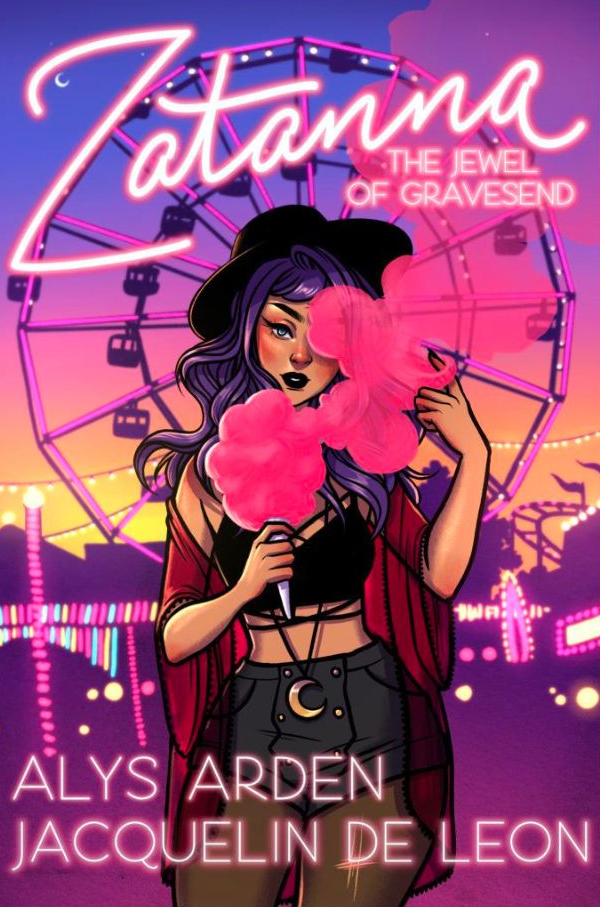
Zatanna: The Jewel of Gravesend - a DC Comics graphic novel

Zatanna has long been one of my favorite DC Comics characters (after Huntress and Power Girl, of course!).  I was never fond of her first couple of costumes, but truly fell in love with her when George Perez redesigned her costume in Justice League of America #187.  I also loved the fact that her magic spells were spoken backwards (of course, over the years, writers have not only done that in different ways - from keeping the words in the correct order, just spoken backwards to speaking entire sentence backwards), as it gave her something different than just a typical magic-user.  I've purchased all of her comic series (there haven't been many, and sadly, the never lasted long), and I purchased the previous graphic novels aimed at younger readers.  This latest graphic novel, though, is not aimed for children, and it provides a new, unique re-imagining of Zatanna's origin.
 
In The Jewel of Gravesend, written by Alys Arden with art by Jacquelin de Leon, Zatanna has been raised by Ezra and Lola Starr, stage magicians who were friends with Zatanna's parents.  Her mother died and her father is believed dead, and Zatanna is completely unaware of her parents' true magical abilities - Ezra has worked hard to keep that a secret.  But he has kept other secrets as well ... meanwhile, Zatanna has managed to live a somewhat normal life near Coney Island, New York, where her best friends, Izzy and Kenia, also enjoy the carney life.  Zatanna also has a boy who she loves - young Alexei.  The only problem is, his family is mafia, and they run a casino beneath the Golden Elephant where Zatanna lives with the Starrs (yes, the building really is shaped like a huge elephant!).  The main problem Zatanna has is Ezra's constant attempts to involve her in his magic shows.  She wants no part of them.

Until she and her friends check out the new magic and mermaid show, in which they find strange "mirror-script" along the wall.  Zatanna speaks the words, having no idea what they mean - and having no clue that her magical ability has been sparked, giving those words power and causing a near fatal accident! Suddenly, those words that appeared backwards look normal to Zatanna.  And so, her adventure begins as she starts to realize that she has the ability to cast spells and make things happen simply by speaking them backwards.  But someone else is aware of that ability, and that someone will do anything to get that power away from her.

Arden's re-imagining is a really good story.  There's an underlying Romeo/Juliet romance with Alexei and Zatanna ... there's the young girl coming into her own story of Zatanna discovering her powers ... there's the ultimately betrayal caused by the lies surrounding her past and her father ... and there is the unexpected surprise at the end that costs Zatanna way more than she could ever have imagined.  The origin story of most heroes begins with some kind of family tragedy, and this one is no different.  However, it is a far cry from Zatanna's original origin in the comics, and by the time the climatic moments hit, you will have found yourself so invested in the character that they are going to hit you, as the reader, as well.  I cannot deny that my heart broke for poor Zee, as she has to let go of everything in order to move forward to become the hero we all know she becomes.

The art on the book is very beautiful, and the colors are almost (dare I say it?) - magical!  The blues, the pinks, and the purples are brilliantly blended to provide an atmosphere very fitting for the story.  Yes, they are dark, but then, to a degree, so is the story.  While I doubt we will ever see any more stories with this version of Zatanna, I would love to see an ongoing series set in this world, just to see where Zee goes from here.  This is a story of love, magic, and family that is most definitely worth the read.

RATING:  10 blooming flowers out of 10 for a stunning new take on a beloved character that has everything a great story should have to make it an enjoyable read.

Thursday, July 20, 2023

Friday Foster - the Sunday Strips

I first heard about the character of Friday Foster when I discovered a one-issue Dell Comic that starred this African-American photographer from the '70s.  I've never been able to purchase the comic (as the prices for this one issue are astronomical!), but I always keep my eye out.  Then, one day, I discovered that David had recorded a movie on TCM called Friday Foster, starring Pam Grier in the title role.  Watching the film, sure enough, this is the same character that was in that comic book I wanted.  The movie was definitely a product of its time (known as the "Black Exploitation" era), but nevertheless, it had a pretty good story to it and was a lot of fun.  Little did I realize that Friday Foster was actually a comic strip before it was ever a comic book and movie - but I learned this when I purchased a collected edition of the Sunday strips, published by Ablaze Publishing.  The hardcover collection had more than just the Sunday strips, however - it also featured a LOT of extra material, including bios of and interviews with the creators - one of whom has a direct Nancy Drew connection!

So, let's start off talking about the strips themselves.  Friday Foster premiered on my very first birthday - January 18, 1970!  (I probably shouldn't reveal that, since it totally gives away my age!)  Syndicated by the Chicago Tribune, the strip ran for only four years (January 18, 1970 to February 14, 1974), but despite its short run, it definitely broke the mold when it came to newspaper comic strips.  While she was not the first black female character in a syndicated strip (a little known character named Torchy Brown holds that honor), she is the first syndicated strip to appear in non-black publications.  Created by James D. Lawrence, she was originally named Jet Jones before becoming Friday Foster in the actual published strip.  In the "Notes for a Biography" section of this collection, author David Moreu reveals that Lawrence was already writing other syndicated strips when he realized there were no African American characters in the comic strips - and he decided to do something about that.  The strip became the subject of a lot of talk in big cities, such as Los Angeles, New York, and others; but, apparently, all of that talk could not keep the strip alive beyond those four years.
 

To Lawrence's credit, Friday Foster was not a stereotype. She was not depicted with an afro that was so common in the '70s, and she was not only smart and sophisticated, but she quickly falls into her career as a photographer during her first storyline.  Before you know it, she's working for Shawn North, a famous photographer with whom she develops a very strong friendship over the four years of the strip.  Yet, despite moving up in the world, Friday never forgets her roots, and she's very protective of her little brother, Cleve (who is always running one scam or another).  Rounding out her supporting cast is Mame Van Clive, the editor of "She" Magazine; Simon Aubry, the art director; the enigmatic man known only as Blackhawk, who is a creative cat burglar; and Mwenye Nguvu, the mysterious Lord of the Jungle (a/k/a Slade King, former American football star) who makes more than one appearance during the run of the strip.  Each story ran, on average, eight weeks - and what is truly amazing is that even though this book only collects the Sunday color strips published from 1970 to 1974, there are no gaps in the stories.  Lawrence wrote them in such a way that even without the daily strips, the readers gets the entire story in the Sunday strips alone!  I didn't feel like I missed out on anything by reading only the Sunday strips.

Now, let's talk about those stories.  The strip begins with Friday working at The Club Senegal, a "swingin' Harlem nightspot," where Friday enjoys taking pictures of the girls, as well as the guests, hoping that some day, one of her pictures will help her crash the big time.  And wouldn't you know it?  One her photos does just that, because unbeknownst to her, one of her photographs has a couple in the background who do not want their outing to be made public.  The art director and editor of "She" magazine recognize the couple right away and put Friday in contact with Shawn North, a famous photographer - who just so happens to be engaged to the woman in the photo (who, incidentally, went to that Harlem nightspot with another man!).  This leads to a number of near-misses, subtle threats, and a fist-fight on a yacht!  This first tale is the longest storyline (as it serves to set up the characters and the series, in general), and interestingly, two of the Sunday strips (just before the last one of this story) do not feature Friday at all (which is daring for a strip to be missing its lead character for two weeks in a row!).  

The last panel of that first story sets up the next story, which involves the world's most famous "missing person" - Mike Morgan, a British pop-rock singer that supposedly died.  Friday and Shawn get pulled into the drama of Morgan's attempt to undergo plastic surgery to change his looks so he can disappear yet again - but a young woman following him may put a kink in those plans.  Just as the first story ended with a one-panel set-up for the next storyline, so does this one - and all that follow.  Lawrence basically created a formula, with eight to ten week stories ending with a lead-in to the next.  It worked well, as it kept the stories moving at a fairly fast pace, not allowing any lull that would bore the readers and turn them off of the strip.  And the stories varied greatly in subject matter - from rescuing a scarlet macaw from a man who wants to make it his trophy to a young hippie who decides she wants Shawn to be her man ... from a dangerous mission in Spain to kill a scientist to a small ivory elephant trinket that holds a very important secret ... from a fading model trying to stay relevant to a pair of star-crossed lovers destined to be kept apart ... from a stolen necklace and insurance scam to a Broadway actress determined to keep her son away from his father ... a family fighting over an inheritance ... a special effects make-up artist trapped in his own designs ... a crooked detective ... a haunted house ... a cursed idol ... a jungle bride .... and ultimately, a jealous editor from a competing magazine who wants nothing more than to take Friday out of the picture!  But, as the saying goes:  All's well that ends well!  And Friday Foster definitely ends on a high note.

It's truly a shame the strip didn't continue.  Jordi Longaron provided some truly beautiful art for the series (even if fill-in artists were occasionally used when Longaron was unable to get his pages to the publisher in time due to mailing days - remember, this was well before there was the internet!), and even though his backgrounds are not as detailed as those of Leonard Starr's Mary Perkins, On Stage strip (very few artists can do backgrounds as detailed as you'll find in that strip!), his characters and settings are such that your focus always remains on the story itself.  He is certainly a master of expressions - whether Friday is sad and crying or giving an admirer one of her "come hither" looks, or she's shocked by the discovery of a hidden room, Longaron's panels ooze with emotion that the reader can easily feel themselves.

As for the creator - James D. Lawrence - this is where the Nancy Drew connection comes in.  When I first got this book and saw "Jim Lawrence" on the cover, I didn't make the connection.  But the second I read the foreword to this collection, it dawned on me where I recognized the name from - the Nancy Drew books!  I knew that he wrote a number of the Wanderer books in the early 1980s (Race Against Time, Clue in the Ancient Disguise, The Silver Cobweb, The Haunted Carousel, and others) - but I was not aware that he had written comic strips, such as Buck Rogers, James Bond, and, of course, Friday Foster.  Lawrence was also the author of several Christopher Cool series for the Stratemeyer Syndicate, as well as Tom Swift, Jr. and rewrites for The Hardy Boys (I have correspondence from the New York Public Library between Mr. Lawrence and the Syndicate regarding his contention about creator rights to the Christopher Cool series).  So, it was with welcomed surprise that I discovered he was the creator and writer of this Friday Foster strip.  I did find it odd, though, that the book indicates Lawrence stopped writing for the Syndicate in the '70s, when the Wanderer Nancy Drew paperbacks he wrote were published into the 1980s.  (Thanks to a dear friend, Geoffrey Lapin, I have since learned that although Lawrence left writing for Syndicate for a while, he did go back in the '80s and wrote more books for them under a pseudonym so Harriet Adams did not realize it was him!  Yellowback Library, Jan/Feb 1986 No. 31, pp. 5-10).

Nevertheless, there is another comparison between Lawrence's work and the Nancy Drew connection.  After Friday Foster ended, Lawrence's children indicated in an interview that he wanted to keep the character alive, so he wrote a series of books with a very similar character called Dark Angel - a series of four books published by Pyramid Books through the book packager, Book Creations, Inc.  The painted covers for these books were done by none other than Friday Foster artist Jordi Longaron!  As can been seen by the covers, the title character in this series bears a striking resemblance to Friday Foster.  The interesting tidbit about the publication of these books is the book packager, Book Creations, Inc.  The essay about Dark Angel reveals that Book Creations, Inc. was formed by Engel in 1973 and dubbed "the fiction factory" because he and his editorial team "would sketch out ideas for series of books, contract authors to write them up, and then sell the rights to the series to published such as Dell, Pyramid, Belmont Tower, and so on" (p. 268).  Gee, does that process sound familiar?  Perhaps Engel took a cue from Edward Stratemeyer!

But, I digress!  This post is about Friday Foster, a unique character for her time and definitely a strip that is well worth the read.  While the one-issue Dell Comic was written and drawn by entirely different creators, I am still searching for a reasonably priced copy of that comic.  I already have a DVD  of the Friday Foster film, starring Pam Grier (which, by the way, is a fun movie and definitely worth watching!).  And who knows?  Maybe one day, someone will run a series of books collecting all of the daily strips - that would be something I would LOVE to see!  (Hint! Hint! Christopher Marlon, you did an amazing job with the Sundays - get us the dailies!)  Then again, I'd be curious to see what the character would be like in today's comic world.

RATING:  10 weaponized cameras out of 10 for breaking the stereotypes and providing a strip headlined by a strong, black female who could easily hold her own in a white male dominated market!

Tuesday, May 30, 2023

Short Lived Comic Series #26 - Soap Opera Romances (Charlton Comics)

While Charlton's other "Soap Opera" title only lasted three issues, this other "Soap Opera" comic book actually made it to give issues before it was cancelled.  And just as Soap Opera Love was a reprint title, so is Soap Opera Romances.  While Soap Opera Love reprinted stories from Charlton's earlier Just Married title, Soap Opera Romances reprinted tales of Nurse Betsy Crane, who had her own title some years prior.  Soap Opera Romances was actually the earlier of the two Soap titles, as it began its run in 1982, with its first issue boasting a July 1982 cover date.  It ran bi-monthly for five issues, ending with the March 1983 issue, which was just one month after Soap Opera Love premiered in February 1983.  Confused yet?  Well, it's obvious the comic world was not really open to romance titles in the early '80s, but I have to give Charlton kudos for least giving it a try.
 

Soap Opera Romances was headlined by Nurse Betsy Crane, a career nurse who seemed to have considerable difficulty when it came to romance.  Nurse Crane first appeared back in 1961 in My Teen Diary #11, and apparently was so popular, the next issue of that title was re-named Nurse Betsy Crane!  That book continued under her name from issue 12 all the way through issue 27 before it was cancelled in 1964.  She made a few appearances after that and then disappeared into comic book limbo until nearly 20 years later when Charlton tried to revive her stories and character with this book.

Because these are stories reprinted from the 1960s, they sadly do not provide the credits for writers and artists.  Some online searches revealed that Charles Nicholas provided pencils for some of the stories, and comic greats Dick Giordano and Vince Colletta provided some of the inking.  As far as the writing goes, that's a mystery.  Which is a shame, because the stories are not really all that bad (well, let me re-phrase that - the Nurse Betsy Crane stories are not that bad - some of the short stores and one-page tales are a bit over-the-top and cliche).  Yes, the stories feature standard romance comics fare, and they are fairly simple and straight-forward; but it's their simplicity that makes them enjoyable.

"Once in a great while ... there appears on the screen of life ... a person so exceptional ... so captivating ... so exciting ... that you can never forget her ... this is ...  NURSE BETSY CRANE"  This cover blurb on the first issue was obviously meant to draw readers in, advertising the main character of this series as an exciting, captivating person who could not possibly be forgotten.  And, perhaps, that is how the powers-that-be at Charlton felt, since this was a character that previously had her own series two decades prior.  Obviously someone at Charlton still remembered her, and with these reprints, hoped that they could bring the character back to life - or, simply cash on by reprinting old stories and not having to pay for new stories and art.  Whatever the reason, it obviously didn't work, as the cancellation after only five issues proves.

The first issue featured a 20-page lead story titled "Scratch of Death."  As many of the comic stories did back in the '60s, it opens with a splash page of danger - in this case, Nurse Diane Malvern bringing her boyfriend to Nurse Betsy Crane, holding him up as he seems about to collapse!  The next page flashes back to give readers the story leading up to that moment - an effective storytelling technique of capturing the readers' attention before providing the backstory that may not be as exciting as that moment.  In this case, we learn the story of how Diane met widower Jeff Wilson and his young daughter - and we see how Jeff gradually turns rude and downright mean, even to Diane, which seems quite out of character.  Of course, Nurse Crane is the one who realizes what is going on - Jeff has hydrophobia, which Diane recognizes as a symptom of rabies!  Nurse Betsy Crane saves the day, and Jeff and Diane walk into the sunset to live happily ever after.  This first issue also features a three-page promotion for nursing as a career, describing in text and pictures just how wonderful a career in nursing is for a woman (which goes to show just how outdated this reprint was, since by the1980s, men was entering the nursing career as well!).  The issue closes out with a one-page story titled "Lady in Distress," the art and story for which are so "totally" '60s, it makes the story comical.

Issue two features two, ten-page Nurse Crane stories:  "Rebound" and "Fight for Sight."  The first story finds Betsy falling for a doctor who is heartbroken when the woman he loves marries another.  Doctor and Nurse take off for Mussar for a tour of duty to help the natives in that far country, where he begins to fall for Betsy and even asks her to marry him! But Betsy is the one heartbroken when the doctor learns his former love's husband has died, and she is free to return to him.  "It's not easy to give up someone you love," Betsy thinks at the end of the tale, "but I have my life to live .. and now I must find a new love!"  The second tale finds Betsy working hard to help a nurse who only wants perfection in a man to see just how fortunate she is to have the love of a man who may be losing his eyesight - if only she could overcome her desire for perfection!  The stories are both very cliche, but definitely fit for the soap opera theme of the comic.  In this issue, we also get a three-page story about a married couple's first fight, as well as a one-page tale titled "destination Paradise" - which was actually rather cute, as it seems a bit stereotypical in the first couple of panels as a man and woman meet on a cruise ship and fall in love at first sight - but as the final panel reveals - it's a re-enactment of the couple's first meeting that they continue to celebrate every year.  I think in this one page there is more "romance" than any other story in the series!

The third issue definitely has my favorite cover (and probably my favorite story from this series).  With this issue, we return to the longer lead-in story, with Nurse Betsy Crane starring in a 20-page tale called "The Dark Closet."  The cover hearkens back to the old Gothic tales, with the shadowy figure coming in on Betsy, as she tries to help a man who is clearly troubled.  Even the cover blurb - "What was the secret of the Old Lange Mansion?  What terror lay hidden in The Dark Closet?" - is reminiscent of the Gothic comics of the past.  The story features Betsy heading up to the Lange mansion on a stormy night, alongside a young doctor (none of these stories have the same supporting cast - there are always different doctors and nurses with whom Betsy works), to provide medical attention to Mrs. Lange.  I found this melodrama at the beginning rather humorous, as the woman was merely having an asthma attack - and as one with asthma, I know what an attack can feel like, but I've never had one so severe that I needed a doctor and his nurse to come out to my house!  (Of course, the revelation about Mrs. Lange's illness at the end of the story explains the overly dramatic nature of Mrs. Lange.)  Nurse Betsy Crane remains at the house in case Mrs. Lange needs further help, and she quickly realizes something odd is going on between the woman and her son.  She eventually discovers that Mrs. Lange is faking all of these illnesses to keep her son at home and away from a woman he loves and wants to marry.  Betsy, as usual, opens everyone's eyes to the situation, and the son finally has the opportunity to chase after the love of his life.  The three-page tale in this issue is a bit weird - a flirtatious woman flirts with the wrong man; but even after he punches her boyfriend, she still walks off with him - and when she reunites with her boyfriend, instead of dumping her, he merely asks her to flirt with men his size so he has a fair chance to beat them up!  Definitely not a lesson you would want to teach young people about dating!  Even the one-page story is bizarre - "Happy Birthday" sees a women kissing the birthday boy - and when the date she came with tries to intervene, she brushes him off and returns to kissing the birthday boy!  Not sure what these writers were thinking, but the morals of these characters are definitely lacking!

Issue four has a rather interesting cover - instead of a single scene, it actually utilizes three panels from the story, dialogue and all!  Now, granted, it is a rather dramatic scene, with Nurse Betsy Crane and a military man trying to fight their way through a dangerous flooded area to rescue a man (lifted straight from page 15 of the story) - but it leaves me wondering if perhaps Charlton simply didn't have a cover for this issue in time for publication, so simply used the inside panels as a quick way of getting the issue out.  "Medals are for Heroes" is the 20 page story this time around, wherein Betsy and two other nurses head off to Harpersville to help out at an emergency center set up for the flood victims in the area.  Betsy, though, finds the problem is not with the victims or even the flood - rather, it is with Corporal Kalin, who spends more time distracting the nurses than anything else.  When she gets stuck with Corporal Kalin on a trip into town to help a young girl and search for her grandfather, Betsy learns there is more to Kalin than she first thought - and she ultimately helps him overcome a fear that has been causing him to act so recklessly.  This issue does not have the standard three-page and one-page tales; rather, it closes out with a four-page story titled "The End of Love."  With a title like that, one would expect a rather depressing tale (which it seems to be in the first three pages); however, the conclusion gives readers a great reminder that an ending of one story may only just be the beginning of a brand new one...

The fifth and final issue of this short-lived series has a story that is probably the closest to a soap opera storyline of any in this series.  "Memories of the Past" finds Nurse Betsy Crane acting uncharacteristically - because when she comes face-to-face with Dr. Gil Roberts, a man from her past, she doesn't know how to react!  Dr. Roberts is brought into the hospital where Betsy works with a life-threatening condition, and when Besty see him, her memories of him are triggered - and readers are treated to flashbacks of their whirlwind romance and how that relationship ended when they each had to chase after the careers of their dreams.  Now, with Dr. Roberts back in her life, Betsy isn't sure what to do.  The one thing she can do (and does!) is locate donors with his rare blood type so that he can undergo surgery to save his life.  Once he recovers, Betsy talks with him, and they both come to realize that despite their past love, they have both grown up and moved on, and that they both found happiness in their careers - which is a good thing for that hospital, because as the head nurse thinks in that last panel, "I don't know what I'd do without that girl..."  We see a return of the three-page and one-page back-up tales in this issue - the three-pager is nothing spectacular, with a girl from the States falling for a Londoner, who reveals in the end he is heading for the States and they can have a relationship there.  It's the one-pager, "Never Again," that features a great little moral - don't be too quick to judge someone's actions, because it might not be what you suspect!  

And with that, Charlton's first (second?) soap opera title reaches its conclusion.  At least this title, unlike Soap Opera Love, featured one-off tales and did not have an ongoing tale that was left unfinished (well, technically not unfinished, since I could go back and find the original comics from which those stories were taken and read the rest of the stories).  Nurse Betsy Crane kind of reminds me of Cherry Ames, a children's series (1943-68), which featured a nurse that job-hopped from one nursing position to another.  I'm not sure about the original Nurse Betsy Crane comics, but based on these few stories, it seems Betsy follows in that same tradition.  

It's a shame these titles didn't take off.  I can only guess that Soap Opera Love and Soap Opera Romance where an attempt to cash-in on the popularity of soap operas in the early to mid '80s (what with General Hospital, Santa Barbara, All My Children, and the others).  I'm not sure how many soap opera fans were actually reading comics in those days, and with all the super hero comics hitting the shelves at that time, as well as the rise of independent publishers and direct-market comics, these two titles really didn't stand much of a chance.  I would love to find out who authored these stories, just to see if we could get any insight as to whether the writer was just churning out stories for a paycheck, or if he (or she!) was writing stories he actually enjoyed writing.  I guess at this point (more than half a century later!) we will never know.

RATING:  7 infected scratches out of 10 for at least attempting to revive the romance genre in a time when superheroes had cornered the market!