Showing posts with label comic books. Show all posts

Friday, June 26, 2026

Short Lived Comic Series #37 - The Nurses (Gold Key Comics)

Gold Key Comics seemed to have a knack, back in the day, for publishing comic books based on various television shows out at the time.  Adam-12, Lost in Space, Bonanza, Happy Days, Family Affair, The Man from U.N.C.L.E., Star Trek, and many others (including my all-time favorite, Dark Shadows!).  Many of them only lasted a few issues, while some of them did manage to keep going for years.  One short-lived series that I was unaware of until recently only had three issues, and it was based upon a prime-time television medical drama that ran from September 1962 to May 1965.  It took me a bit of hunting to find all three issues of the series at reasonable prices and in fairly good condition, but I managed to finish the set recently and have been able to read it.
 
The Nurses
is based upon the CBS television show of the same name, the story of which centers around a young nurse named Gail Lucas (portrayed by Zina Bethune) and her older nurse mentor, Liz Thorpe (portrayed by Shirl Conway).  This appears to be the only show that either actress starred on a regular basis, although they both made appearances in other episodic television shows.  The Nurses takes place in New York City at Alden General Hospital, which is said to have been patterned after Roosevelt Hospital in the Midtown West area of NYC.  The show ran for three seasons and boasted a total of 98 episodes, and it even had a crossover in its third season with a companion legal series called For the People (starring none other than William Shatner, of Star Trek fame).  Interestingly, after the nighttime drama ended, ABC picked it up and continued it as a daytime soap opera, using the same name and characters (although the actors changed) and which ran from September 1965 to March 1967.  This three-issue comic series is based on the original prime-time show.
 
The comics did not give credit to any of the creators (as Gold Key was wont to do), but from what I was able to discover online, Paul S. Newman wrote the stories in all three issues.  Newman (not to be confused with the actor) was quite the prolific comic writer, with his earliest work being in the late 1940s for Dell, DC, and Fawcett, later adding work at Marvel, Western Publishing/Gold Key, and a number of other publishers, continuing to write well into the 1970s.  The stories in the first issue appear to have been penciled and inked by Jack Sparling, who also has quite the resume of work for DC, Dell, Marvel, and Western Publishing/Gold Key.  The art for the second and third issues remain uncredited.  Each of the three issues contains two stories about the nurses, with Gail Lucas being the primary character, and her mentor, Liz Thorpe, being the only continuing supporting character.  The rest of the cast changes with every story.  Each issue also features a short, 4-page story starring the "Emergency Crew," which is comprised of two men - Jim Friendly and Carl Blaker - who get called into help rescue people before the paramedics and/or fire department can arrive.  These short strips were also written by Newman, with art in the first issue by Sparling.
 
In the first issue, Gail and Liz are confronted with an old country doctor, Dr. Dart, whose patient is brought to the hospital to be treated in "Call of Duty."  Dr. Dart is old fashioned in his ways and wants no one - no resident, nor nurses, no one! - touching his patient except him.  When Liz offers to take the crotchety doctor home on a rainy night, they get into an accident, and Dr. Dart is forced to accept Liz' help with the other driver, who has been seriously injured.  By the end of the story, the doctor realizes his views are antiquated and changes the way he thinks about the nursing staff.  The second story brings the nurses "The Problem Patient," an overly controlling and paranoid chairman of a multi-million dollar company who is afraid everyone is trying to take his job.  He does not believe his wife, his business partner, or even his own secretary - but it takes Gail's innocence and ingenuity to prove to the man his fear and paranoia are only hurting him.  The four-page Emergency Crew tale has Jim and Carl saving a young boy who has fallen down a well.
 
The second issue starts of with a doctor following in "His Father's Shadow."  Young Dr. Hartly seems to be a prodigy when it comes to surgery, showing expert skill after only a month of internship.  But Liz and Gail quickly learn his superb skill only appears when he is working with his father, Dr. Tyler.  When Tyler is not around, Harty is afraid of doing even the most minor of procedures.  It is only when faced with his father on the operating table that Hartly is able to overcome his fears.  The second story, "Give Me My Baby," finds the nurses dealing with a woman who is deathly afraid to have her sick baby taken to the hospital.  Her first child died in the hospital, and she is scared if her second child is taken to Alden General, he will die as well.  Gail must convince the woman that the hospital is the only chance her son has to survive.  The four-page Emergency Crew story takes Jim and Carl to the docks, where they must help keep a man who has had a heart attack from a nearby oil fire that, if it hits the oxygen tank keeping the man alive, could kill them all.
 
In the third issue, Gail becomes a "Heroine in White," when she assists a doctor that witnessed a mugging and brings the injured man into the hospital to save his life.  But the muggers are out for revenge, and when Gail helps the newspaper snap a picture of the doctor, the criminals run his car off the road and into a ravine - a car in which both the doctor and Gail are riding!e e (As you might guess, this is the story from which the cover scene was taken.)  Gail must use all of her training to keep the doctor alive until help arrives, and it is her identifying the men that puts them behind bars.  The final story teaches an injured model that "All Scars Don't Show."  Following an accident that left her leg injured and scars to her face, a model refuses to walk, even though her leg is fully healed.  Liz takes center stage and with the help of a photographer, convinces the model that photos can be retouched to hide her scars, and her modeling career can continue - giving her the courage to get up and walk and get back to her life.  The four-page Emergency Crew story finds Jim and Carl racing against time to save the pilot of a crashed airplane from live electrical wires that could kill him at any moment.
 
The first two issues feature photo scenes from the television show on the front covers, with mini-posters of the two main actresses from the show on the back cover.  What is odd about the back cover posters is that the first issue has a photo of Zina Bethune with her character name, "Gail Lucas" over the picture.  The second issue, however, features a photo of Shirl Conway, but instead of her character name over the picture, it has her real name.  There is no explanation why they use the character name on one and the actress name on the other.  The third, and final, issue has a painted cover art, with small photos of the two actresses in the upper right corner on the front cover, and the same painted art on the back cover, but without any title words or photos interrupting the art.  There is no credit given to the cover art, and I was unable to find any information on the artist online.
 
Each issue also features a one-page text story that provides information about various medical people and moments from history.  In the first issue, "Angel of Mercy" provides some information about Clara Barton; in the second issue, "Lady with the Lamp" recounts the story of Florence Nightingale; and in the third issue, "Early Hospitals" gives an account of how hospitals, as we now know them, came into being.
 
While the main stories are 12 and 13 pages in length, and are obviously very fast paced, they are actually very enjoyable and provide some well-written characterization, even though the individuals who appear in each story only appear once.  The art, while some might think is very simple and plain compared to today's comic art, works perfectly for the stories, allowing the reader to focus more on what is actually happening then getting "awed" by the "pretty art."  All three issues were published in 1963 (cover dated April / July / October, respectively), and it's rather a shame it did not continue, especially since the television show lasted another two years (before switching to a daily afternoon soap).  Based on these comics, I'm going to have to try and track down any episodes of the television show and see how they compare!

RATING:  9 unsigned powers of attorney out of 10 for some great drama, not always of the medical kind, and some entertaining stories that make for great reading!

Wednesday, April 22, 2026

Short Lived Comics Series #36 -The Young Lawyers (Dell Comics)

This 2-issue comic book series is something I chanced upon some time ago at a local convention.  I happened across the second issue for a relatively cheap price (the comic was not in perfect condition, mind you), and I could not pass it up.  As a paralegal myself, having worked for lawyers for some time, I am always drawn to comic books set in the legal realm.  With the photo cover, the identification of the actors on the cover, and the copyright to Paramount Pictures Corporation and Crane Productions, Inc. down in the bottom right corner, I assumed it was based on a television show - and I was right!  So, after some time, I finally found the first issue at a comic shop.  With both issues now in hand, I sat down to read them, and was pleasantly surprised to find out how much I really liked the stories.  With that in mind, I had to go back and see what I could find out about the old TV show...
 
The Young Lawyers
was issued in late 1970, early 1971 with cover dates of January 1971 (issue 1) and April 1971 (issue 2).  It was based upon a vintage television show that ran on ABC from September 21, 1970 to March 24, 1971, for a total of twenty-four episodes.  The comic, like the television show, centers on a legal aid center in Boston, called the "Neighborhood Law Office" (or NLO for short), established to help those in need who cannot afford legal help.  The three central characters are David Barrett (as portrayed by Lee J. Cobb), an established lawyer who gives guidance to young law school students who gain experience by representing real cases while they are going to school; Aaron Silverman (as portrayed by Zalman King),  a zealous student with lofty ideas of helping all of the underprivileged and always rooting for the underdog; and Pat Walters (as portrayed by Judy Pace), an African-American woman studying law in an effort to break stereotypes and do some good in the world.
 
As with pretty much all of the Dell Comics published at the time, there are no credits given for writers, artists, colorists, letterers, editors, or anyone else associated with the comic series; however, the Grand Comicbook Database website (The Young Lawyers) indicates Jose Delbo, who is probably most recognized for his work on DC Comics' Wonder Woman title for quite a long run in the 1970s and early '80s, as well as Thundercats and Transformers for Marvel Comics.  The art does strongly resemble Delbo's work, and it is clear the same artist did both stories in both issues, because the characters appearances are consistent throughout.  I would love to know who the writer was, though, because the stories are very much in sync with the stories from the television show - very topical and very much in line with the "buck the system" thinking of the time.
 
The two stories in the first issue are "Team Spirit" and "Kids are People."  The first story is about a young football player (whose name happens to be Jimmy Carter - who was not our President until seven years after this comic came out!) who is injured during a game and may be paralyzed.  The boy who tackled him is being accused of purposefully injuring him the previous day so that he can get the spotlight with the talent scouts who are at the game.  Aaron goes to bat for the accused boy, and with Pat's help (since the injured boy happens to be African-American), they are able to broker peace between the boys and get them both back on the field.  The second story involves a young boy named Angel Rivera who is accused of stealing a typewriter by a store owner.  The boy's reputation is being ruined, and his chance at getting into a prestigious school is lost because of the rumors.  Barrett, Aaron, and Pat all learn a lesson in this story, as they are not so quick to believe the boy's story, and when the truth does come out, it is the three lawyers who are eating crow!
 
The second issue features two more stories:  "Under the Skin" and "Explosive Justice."  In the first tale, a biker is unjustly and unfairly treated by everyone, no matter where he goes, and he comes to the NLO with the hopes of suing "the People of the United States" for denying him his rights under the Ninth Amendment.  Aaron goes for a bike ride with the man who calls himself Captain Freedom, and he sees first hand the way he is treated, merely because of his appearance - long hair, sunglasses, biker clothes.  Even the police are seen to hassle the man.  Aaron believes there is some cause for a lawsuit, but before it can be filed, Captain Freedom takes off, thanking the NLO, and Aaron specifically, for proving there were still good people in the world.  In the second tale, the NLO is the victim of a vicious bomb attack (thankfully at night, when no one was there), and our three main characters must sift through the firm's history to determine which client may want to seek vengeance.  Aaron is attacked one night when he goes back to the office, and the next day, a file is missing - the file of a former client who the NLO defended for allegedly bombing a government office!  As it turns out, that was a red herring, and the real culprit is someone much closer to home!
 
After reading these two issues, I was curious about the television show, so I did some searching and found some episodes available on YouTube.  The original pilot movie aired in October 1969, a year before the actual series began, and it featured Jason Evers as Michael Cannon, a corporate lawyer who leaves his firm to become the director at the NLO.  Zalman King plays Aaron, but Judy Pace's character is named Anne, and there is an additional law student, David Harrison (played by Tom Holland - no, not THAT Tom Holland).  The set up for the show is pretty much the same, but the story definitely gives ample time to both the legal story and the individual characters' characterization.  By the end of that pilot film, you actually have a feel for all four of the main characters.  In the first episode of the ongoing show, which aired in September 1970, Evers and Holland are gone, and Lee J. Cobb is in as new director, David Barrett.  There is absolutely no explanation for the change in characters, no reference at all to Cannon or Harrison.  Comparing the two, I honestly liked the initial pilot film far better than I did the first episode of the ongoing series.  The show is available on DVD on Amazon, so I'm going to buy that and watch the remaining 23 episodes to see if the characterization gets better as the series progresses (I know at some point a fourth main character is added to the series - Chris Blake, as portrayed by Philip Clark.
 
The comic series only features the main three characters from the regular series - Barrett, Aaron, and Pat.  However, in the second story of the first issue, someone got confused, because Barrett refers to Pat as "Anne," which was the character's name in the original pilot film.  They only use that name once, and, in fact, they never call the character by her name again in the entire story.  By the second issue, both stories refer to her as "Pat," her given name in the television series.  Otherwise, I thought both issues were pretty much flawless, capturing the feel and the look of the TV show, and providing some interesting, thought-provoking stories that today may seem dated, but back in the early 1970s would have been considered quite progressive. 
 
Definitely a series worth reading, and it's a shame it only lasted two issues.
 
RATING:  10 tell-tale band-aids on the chin out of 10 for well-written, beautifully drawn comic stories based on a little-known show that is definitely worth a second glance! 

Friday, March 20, 2026

Short Lived Comic Series #35 - Pyschoblast (First Comics)

Now here's a comic series that I do not remember coming out back when it was first published.  At the time, I was buying titles from First Comics (such as Whisper and Evangeline), so I likely saw house ads for this series; but it apparently did not strike my fancy at the time, so I never gave it any thought and let it disappear from my mind altogether.  The series debuted in July 1987 (the first issue featuring a November 1987 cover date) and lasted only nine issues, ending in March 1988 (its last issue sporting a July 1988 cover date).  The series was written by Steven Grant, who was also the creator and writer of First Comics' Whisper series, as well as countless other series for Marvel, Malibu, Dark Horse, Image, DC, Chaos, BOOM!, and any number of independent comic companies.  
 
Psychoblast
(quite the unusual name!) is not only the name of the title character, but it is also a term (in fiction, at least) to describe a massive, concentrated mental energy attack.  Back in the late 1800s, the word was actually used in certain scientific realms in reference to a "germ" or "cell" relating to the development of the mind or psyche, but it is now obsolete.  Grant manages to take that term and utilize it for Brian Burke, a young man we first meet as a drifter, working in a church as a janitor.  Taryn St. Jude has been sent to find Burke, unaware that the person who sent her on that mission has a secret agenda.  By the end of the first issue, Brian and Taryn find themselves running from some military men, and when all hope seems lost, Brian suddenly unleashes a psychic ability that not only changes his appearance (giving him that blue and silver costume and the lightning bolt over his left eye) but also allows him to, literally, crush his opponents with one hand - albeit a very LARGE hand!
 
The first story arc encompasses the first three issues, as readers learn a bit about Brian's powers - how they pretty much come into play only when Brian himself is unconscious, meaning that "Psychoblast" is an entirely different being that shares Brian's mind!  Readers also find out that the military men chasing Brian are working for a mysterious woman who has mental powers of her own - but they take their toll, aging her quickly, and she requires fresh human psyche to pause that aging process and give her vitality - and she wants Brian because she believes his psychic powers are the answer to her staying young forever.  Grant gives us one heck of a battle of the minds, as well as the startling revelation that this villainous vixen is not Brian's mother (as we are originally led to believe through visions experienced by Taryn), but actually Brian's sister, Arrabella, who supposedly died six years prior (but, let's face it - no one in comic books ever says dead, do they?).
 
The remaining six issues of the series delve more into Brian's origin as "Psychoblast" and his integration into the New Order - with a team of powered individuals known as Transmuter, Phaseshift, Interface, and Anomaly.  From the get-go, however, the reader can see this is no ordinary super team.  These characters are at odds with one another, and one in particular (Anomaly) believes himself superior to the rest, especially Psychoblast, and the tensions between them ultimately results in some pretty powerful psychic battles. Along the way, we meet a research scientist named Caren Price, who inadvertently leads the evil D.S.X. Machina to Psychoblast's location - and a series climax that reveals their connection and the true extent of Psychoblast's mental abilities!
 
This is, by far, anything but a "super hero" series. Psychoblast is a reluctant hero, as Brian does not know how his powers work, how to trigger them, and more than anything, how to keep this alternate personality from coming out and destroying everything and everyone around him.  D.S.X. Machina is a villain without restraint, who kills civilian and hero alike, leaving very few of the main cast alive by the end of the ninth issue (although, oddly enough, Caren survives the killing blast D.S.X. sends her way, hinting at a potential future story that readers never got to see, as i is clear Caren has some powers of her own and some secrets that never get revealed).  The battles are less about good vs. evil and more about survival and coming to terms with the circumstances of the life one is given.  Grant, as he did with the Whisper series, provides readers with a character-driven saga, and although we only get nine issues and just the tip of the iceberg regarding Brian's origins and Psychoblast's powers, it is easy to get drawn into this world and want to see where the characters are headed.
 
The art in the series is provided by Robb Phipps (pencils) and Al Vey (inks), with some assistance from Karl Story and Jim Bauer in a couple of the later issues.  Phipps and Vey also drew all of the covers.  Since there are only nine issues and no change in artists during that time, the art remains consistent for the entire run, which was a nice change of pace for me.  In today's comics, with so many rotating artists and writers, sometimes within the same storyline (one of the biggest mishaps of this kind was DC Comics' Thriller series, which lost the original artist and writer, and it changed the entire tone and course of the series, leading to its early demise), it is jarring to me when the art style changes mid-stream.  This kind of artistic consistency helps develop the characters, settings, and stories in the reader's mind without having to pause and adjust to another creator's interpretation of those same characters and settings.  Phipps and Vey had some usual imagery to work with, considering the amount of psychic displays that took place throughout the nine issues, but they did an amazing job bringing them to life with a sense of realism for a very fictional idea.
 
Sadly, the series did not even survive its first year, likely due to low sales (which plagued a lot of independent titles in the late '80s and early '90s), which is a shame.  I think the series had a lot of potential, and there were plenty of sub-plots developing that never got to see fruition.  I wonder what comic fans would think of the character today, if Grant were to revive Psychoblast and continue the series today (nearly 40 years later...)?
 
RATING:   9 giant glowing hands in the sky out of 10 for giving the comic world a unique character and creative concept that, unfortunately, never had the chance to reach its full potential.

Wednesday, January 28, 2026

Short Lived Comic Series #34 - The Big Prize (Eternity Comics)

Before I get started with this post, let's go ahead and address the elephant in the room. The author of this 2-issue comic series published back in 1988 got into trouble in 2016 and ended up being sentenced to six years in prison for a horrible crime.  This post is not about the author, and it's not about my thoughts of the crime he committed.  This post is about the two-book comic series that was published by Eternity Comics (a division of Malibu Comics) back in 1988, and how much I enjoyed the story.  I'm not looking to discuss the writer; rather, I'm looking at discussing the work itself, and quite frankly, it was worth the read.
 
The Big Prize (The Timedrifter's Odyssey) was intended to be a six-issue mini-series, the first of several mini-series that would tie together to tell the story of Willis Austerlitz.  Unfortunately, "best laid plans" and all that ... Eternity, for whatever reasons, decided to not move forward with the planned series, and the comic ended after its second issue.  Which is a shame, as the premise was fun, and the set-up in these first two issues definitely provided some wonderful fodder for future stories to come.  It is kind of a mix between Quantum Leap and Back to the Future, and it features some fun characters.  Although the author indicates in that second issue his hope to find a way to bring the series back under another title or a different publisher, sadly, that never happened.  Thus, we are left with only these two issues to tease us with the time-traveling odyssey of Willis Austerlitz.
 
The first issue introduces readers to our main character, a data entry clerk who daydreams about his favorite era - the 1930s.  Unfortunately, that daydreaming causes problems at his job.  He is an insecure, glasses-wearing nerd who has trouble with girls.  Walking home from work one day, his destiny literally falls right on top of him in the form of a plastic credit card with a full color hologram of a grinning man.  Approached by a man desperate for change, Willis stuffs the card in his pocket and rushes home.  He sits down to watch an old film, but falls asleep.  He awakes to discover he missed recording a show, and to make matters worse, he finds that card in his pocket.  And that is where things start getting weird.  While talking to his mother on the phone, the man whose face is on the card suddenly materializes right before his eyes, congratulating him as the "lucky winner!"  Willis learns this is his chance of a lifetime, as this three-dimensional hologram says his "Big Prize" is one 24-hour journey to any point in space and time.  He could actually go back in time to the 1930s and experience his favorite era live and in person!  Only, the trip back is not what he expects.  As soon as he and Glint Sparkle (roving emcee for The Planetary Lottery) reappear in his apartment, albeit in 1934, things go from bad to worse.  A woman is being threatened in the next room, but when Willis goes to her aid, he finds himself at the mercy of men with guns!  Glint disappears, Willis takes off running, and the adventure in time begins!  Matters become even more complicated when, on the last page of this issue, Willis finds out Glint has been killed - and he is now stuck in the past with no way home!
 

The excitement does not let up with the second issue.  Willis is driven by these fanatics up to where the Hollywoodland sign looks down on Los Angeles, where they are preparing to dump Glint's body and silence Willis permanently.  Willis manages to come to his senses and convince the men he is from the FBI, and that he is looking for bigger fish then them.  Once they take off, Willis ponders his predicament - only to have Glint come back to life (after all, he is only a hologram, and as such, he cannot really die).  Willis convinces his benefactor to allow him to stay in 1934 for the full 24 hours before returning to his own time, so he can experience more of life in the '30s.  He hopes to aid a certain damsel in distress, meet an actress who was involved in a huge scandal back then, and unintentionally gets involved with some very mob-like men who have plans for him.  Willis gets more than the experience he was hoping for, and once he has had enough, he heads for the place Glint told him holds the jump point for them to return home - Union Station.  There's only one problem - in 1934, Union Station is still under construction and will not be completed until the next year!  And Glint Sparkle is nowhere to be seen!  "It finally begins to sink in," Willis thinks, "I was going to be here for a long time..."
 
The art for the two issues is provided by Bryon Carson and Mike Roberts, who do a great job of creating a sense of that 1930s film style for the book.  The black and white pages, the shading, the action sequences, the looks of the various characters.  I think I actually prefer the interior art to the full-color covers by Tim Hamilton and Scott Bieser (issue 1 colors) / Brooks Hagan (issue 2 colors).
 
This comic turned about to be a surprising little gem, as I had never heard of it prior to stumbling across both issues at a local toy store that had a few boxes of comics in the back.  It is a shame the story was never allowed to continue, even with another publisher. I, for one, would like to have seen where Willis Austerlitz would have gone from here.  (Plus, loved his excitement at being able to pick up first printings of some now-valuable pulps and magazines when they were first hot-off the presses!)  But, I suppose like Sam Beckett from Quantum Leap, he will be forever left without an ending.
 
RATING:  9 time-drifting, 1930s-loving nerds out of 10 for a different kind of time-travel tale with some great art and fun geek-loving antics!

Thursday, January 1, 2026

The Legendary Lynx - a Mad Cave graphic novel

What better way to kick off the new year that with a brand new collection of "vintage" comic books!  But, wait! This graphic novel collects a comic book that never really existed.  Rather, as the back of this graphic novel says, this book comes from the meta-fictional world of Secret Identity, a novel by author Alex Segura about a woman named Carmen Valdez, who helped create a character named "The Legendary Lynx" for the failing comic company, Triumph Comics.  The book (Secret Identity) is more than just the tale of how this woman created a best-selling comic back in the days before women were big in comics, but it is also a murder mystery, a story of friendship and betrayal, and a romance story.  Throughout that novel, there were pages of the "comic book" created by the fictional Carmen Valdez that were supposed to have come from the "original" comics published back in the 1970s.  At the end of my review for that book, I asked the question:  when are we going to see The Legendary Lynx in a real comic?  Well, my review was posted back in 2022 ... and two years later, my question was answered!
 
The Legendary Lynx was published by Mad Cave Studios in November 2024, and it purports to collect the first four issues of the "vintage" comic book created by the lead character of Alex Segura's novel. Segura even goes so far as to have an introduction by J.M. DeMatteis (from the "Bwa-Ha-Ha-Ha" Justice League era) that talks about the comic as if it were really published back in the '70s from the small, failing company, Triumph Comics.  Everything about this book is intended to give the reader the feel and belief that The Legendary Lynx did exist as a comic book series, and that the real creator and writer of the series has remained a mystery until recent years, when speculation regarding Carmen Valdez as that creator and writer has become verified.  The packaging, the look, even the coloring of the comics would lead one to believe these are actual comics from back in the day, if one did not know any better.  (Although, to be honest, there is one big thing that gives away the fact this is not vintage at all - and that is the number of panels on each page - back in the '70s, comics boasted quite a bit of story and more than just 2, 3, or 4 panels per page - these four issues collected in this trade paperback are formatted the same as today's comics, instead of mirroring the format of comics 50 years ago - and, as with today's comics, this story that is told in four issues would have been told back in the '70s as just one or possibly two issues at the most...)
 
That being said, Segura and artist Sandy Jarrell (who also provided the illustrations in Segura's novel, Secret Identity) do breathe life into the Lynx and her alter ego, newspaper secretary Claudia Calla.  The stories are exciting and the characters fresh - and the story actually takes a much darker turn as it progresses (with one of the main characters being killed off before the end of the fourth issue!).  The origin story is somewhat fresh and unique - Claudia's twin sister is murdered, and she is not able to prevent it.  At her sister's funeral, Claudia comes in contact with a ghost who agrees to train her so that she can track down the man that murdered her sister and bring him to justice.  Thus was born the Lynx!  And she has her own male version of Lois Lane in the form of Simon Upton, a reporter who will do anything to get a story - and one who believes he has figured out that Claudia is really the Lynx!  But there is no romantic entanglement for these two, as the Lynx has a job to do bringing the criminal element to justice and stopping super-powered villains such as Diesel, Void, and others.  
 
The trade provides faux covers for the four issues, and the stories are credited to Harvey Stern as the writer and Doug Detmer as the artist, with Rich Berger listed as the editor and Jeffrey Carlyle listed as the President & CEO of Triumph Comics (all of these names coming straight out of Segura's novel).  The tone of the stories definitely has a dark feel to them, much along the lines of DC's The Phantom Stranger or Marvel's Dracula or Werewolf by Night - nowhere near as light-hearted as the typical superhero fare of the time, but still not so dark as to cause problems with the Comics Code Authority.  The art and colors definitely fit that darker tone of the story, but it's not gory or filled with sexual situations as so many of today's indy comics seem to be.  I give Segura credit for creating a unique character that may seem familiar on the surface, but believe me, the Lynx is unlike any comic character you've seen to date!
 
The one drawback about this trade is that the fourth issue ends on a major cliffhanger, and so readers are left wondering what happens next! In Segura's fictional world, a new creative team took over with the fifth issue of The Legendary Lynx, so it's rather doubtful we will ever see any more "reprints" of issues of this comic, since this one specifically ties into Secret Identity and its title character.  I do love this cross-promotion of sorts (both the book and this comic can be read separately without any problem, but if you read them both, you find they truly compliment one another beautifully and give you a fuller picture of both stories!).  A part of me almost wishes Segura would go ahead and just introduce a REAL comic series for The Legendary Lynx - bring her into the present time and give fans an ongoing series (or a series of mini-series), so we can really enjoy the world of Clauda Calla and her justice-seeking alter ego.
 
RATING:  9 razor-sharp claws out of 10 for allowing the Lynx to jump out of the pages of Secret Identity and into her own "real" comic for fans to enjoy! 

Friday, December 5, 2025

Short Lived Comic Series #33 - Judge Colt (Gold Key Comics)

I am by no means a fan of westerns, whether it be television, movies, books or comics.  I remember watching The Rifleman with my mom every Saturday afternoon, and I can remember being bored to tears, waiting desperately for the episode to be over so we could watch Alfred Hitchcock Presents.  Back in the '80s, when comics increased in price from 40 cents to 50 cents, and DC Comics added those 8-extra page stories, I did pick up Jonah Hex, mainly because at the time, I was trying out pretty much everything.  I did not buy a lot of issues, as the western tales could not keep my interest.  Flash forward 40 years (yowza!  has it really been that long?), and while at a local comic convention, I stumbled across three issues of a Gold Key title about a "hangman judge" in the Old West.  They were cheaply priced for the good condition they were in, so I picked them up, figuring I could find the fourth issue at some point.  And that I did.  So, with all four issues in hand, I sat down to read them, wondering if they would hold my interest any better than past westerns had done...
 
Judge Colt
was published back from 1969 to 1970, with cover dates of October 1969, February 1970, May 1970, and September 1970.  While the indicia indicated a quarterly schedule, as one can see from the cover dates, that schedule was very flexible.  Cover priced at just 15 cents, with beautifully painted covers by Steve Grass (first issue only) and Richard Green (possibly for issues two, three, and four), the comic was promoted as the story of "The Hangman Judge" - following the adventures of Mark Colt, a judge who is reknowned for issuing harsh sentences and hanging criminals more often than not.  But, as is made clear in the first issue, Judge Colt harbors a secret - he has a reason for the decisions he makes, and his travels have a purpose other than just dispensing justice throughout the towns of the American frontier.  All four issues were written by Leo Dorfman, who authored a number of Superman-related titles for DC Comics, but also writing some stories for Dell, Fawcett, and Gold Key comic companies.
 
ISSUE 1 - "The Hangman Judge" is told in two chapters, Part I being "Trial by Sixgun" and Part II being "The Justice of the Noose."  According to the Grand Comic Database, the story was written by Leo Dorfman, with art possibly provided by John Celardo.  The issue opens with Judge Colt traveling west in the 1870s, drifting across the Arkansas territory.  He happens across a fierce gun battle between a gang of thieves and military men safeguarding the army payroll.  The leader of the gang is the Tattoo Kid, and Colt takes it upon himself to track him down and bring him to justice.  He ultimately brings the criminal, along with several others, to justice, sentencing them to death by hanging.  Throughout this first issue, there is a subplot, as Colt unmasks every criminal, obviously looking for someone specific.  Plus every time Colt is forced to use his gun for any reason, his hands shake uncontrollably, and he seems incredibly frightened.  I rather liked the fact they did not reveal all in that first issue, but dangled some plot threads for the reader to learn about in future issues (which, thankfully, there were...).
 
ISSUE 2 -  "Death Writes the Verdict" is another two-part story, with Part I as "Justice Stands Trial" and Part II as "Twilight of the Chiefs."  This issue is one again written by Leo Dorfman, but the artist is identified as either Jose Delbo or John Celardo.  Oddly enough, Judge Colt looks considerably older in the art of this issue, from a young man of maybe 30 or so in the first issue to a man who appears to be in his late 40s in this issue.  The story finds Judge Colt in Indian territory, where he rescues an Indian accused of stealing from being hanged. He quickly learns there is a war brewing among the Indian tribes, and when Colt works to aid the Indian he rescued, he makes enemies of a warring tribe. In the end, though, Judge Colt sees justice served and heads on his way.  While we do not learn anything more about the man he is searching for, we do see him continue to shake every time he is forced to use his gun.
 
ISSUE 3 - "Time of the Assassin" features yet another two-parter, with Part I titled "A Man with a Mission" and Part II titled "The End of the Masquerade."  Written by Leo Dofrman, this issue is said to have art by Jose Delbo, although like the previous issues, it is unsigned and uncredited.  This time around Judge Colt helps a missionary group, who is being threatened and robbed by a group of criminals posing as actors.  It is finally revealed that Colt is searching for the men who killed his wife Maria on their second wedding anniversary - "I'll remember their faces! I'll hunt them down, Maria, if it takes a lifetime" he promises his dying wife.  And I was pleasantly surprised by the twist ending, which really caught me off-guard - and made for a great read!
 
ISSUE 4 -  "Trial by Fury" is the final story, with Part I ("Medals of Death") and Part II ("The Final Reckoning") providing readers with the last adventure of Judge Mark Colt.  The art is once again provided by Jose Delbo.  In this final tale, Judge Colt must track down a serial killer who leaves a Civil War medal pinned to the chest of each of his victims.  Colt uncovers a list of victims and races to save the next person on the list, coming face-to-face with the killer - the last person he would have suspected!  After sentencing the man to justice (death by hanging, of course), Col rides off into the sunset, wondering, "Am I any better...? Is it justice I'm handing our, or retribution?  Maybe someday I'll find the answer."
 
Unfortunately, neither Judge Colt nor readers of the comic got that answer, as the series came to an end with that fourth issue.  I was surprised at how much I actually enjoyed reading the series.  Perhaps that is because Judge Colt was not your typical western lawman, and while there were certainly some stand-offs and some gunfights, it was clear that the character only turned to violence as a last resort.  The underlying plot thread of Colt searching for his wife's killers added some depth to the character, and to the stories, and gave it a near soap opera feel to the story.  While each issue featured a different location, different villains, and a different supporting cast, one almost got a feel of "David Banner" from The Incredible Hulk television show - a loner, wandering from town to town, facing criminals and ne'er-do-wells while at the same time trying to resolve his own internal struggles.  The western aspect of the series was merely the setting.  Dorman's storytelling is what made the series a good read.
 
I would have to say this is probably a very underrated series.  Gold Key is probably more popularly known for its Walt Disney comics, as well as its Twilight Zone and Boris Karloff horror titles, as well as a number of licensed properties, such as Buck Rogers, Dark Shadows, The Man from U.N.C.L.E., Star Trek, Battle of the Planets, and others; however, the exceptional writing of this book, along with the art of comic great Jose Delbo, definitely serve to make this book more than just a typical Old West title.  Even for those, like me, who are not fans of the western genre, I would recommend picking up this title, if you can find inexpensive copies.  The stories are well-plotted and perfectly paced, the characters are far more than the stereotypical, cardboard cut-outs - they have depth, and Judge Mark Colt especially tugs at your heart strings as you keep hoping he is going to find those men who forever changed his life.
 
More and more, I'm discovering that Gold Key comics, from Western Publishing Company, was way more than a sub-par comic company.  They offered up some fantastic titles, such as this, that far surpass the stories that are being told in today's comics (I mean, let's be realistic - each of these single story issues would be dragged out over six-issued each in today's market!).  I'm glad now that I picked up these issues, and I certainly will take a closer look at other Gold Key titles I happen to run across while combing through back issue bins as comic conventions!
 
RATING:  8 ever-tightening hangman nooses out of 10 for offering up way more than just western action in through-provoking, moving stories about a man with a broken heart and a true sense of justice! 

Sunday, October 12, 2025

Short Lived Comics Series #32 - Super Heroes (Dell Comics)

Dell Comics is not particularly well-known for their superhero comics - in fact, I was not even aware until recent years that Dell actually published any comics with superheroes in them.  Sure, I had heard of Brain Boy (of which I have all but one issue), but I never really considered him a superhero; I saw him more as just a science fiction type tale.  To me, Dell was famous for a lot of licensed material, such as Walt Disney World comics and old Western comics.  In fact, I have some of their books, such as Gil Thorp, Ellery Queen, Friday Foster, Johnny Jason Teen Reporter, Mary Perkins On Stage, and The New People.  But it was not until I stumbled upon a couple of issues of this title that I found a whole susbset of titles from Dell that offered superhero fans some new characters and stories.  I was pleasantly surprised and definitely curious enough to pick them up and give them a try!
 
Super Heroes
, as it was so generically titled, was a four-issue series published in 1967 featuring a team known as the "Fab 4."  One might think this is a cheap rip-off of Marvel's the Fantastic Four (the name is even very similar), which first hit the stands back in 1961; however, other than the name similarity and the fact both teams has four members (with only one female), the two books are very different.  While Marvel's "World's Greatest Comic Magazine," as it promoted itself, featured a family dynamic, the Fab 4 is actually made up of four teenagers who, through unexpected circumstances, wind up with the ability to transfer their consciousnesses into four amazing robots with superhuman abilities:  Dan Boyd can become "El," with light-based powers; Polly Wheeler can become "Polymer Polly," with speed and heat resistant powers; Tom Dennis can become "Hy," with sonic powers; and Reb Ogelvie can become "Crispy," with cryogenic powers.  Although not very original, each character's costume has the first letter of their name on the chest (with the except of "El," who has a huge "L" on his chest, I'm guessing because his name is actually pronounced simply as "L").
 
Each issue features three chapters, with some connecting and some simply stand-alone tales.  The first issue,  cover dated January 1967, opens with a 12-page origin story (yeah, let's see any of today's comics tell an origin story in that few pages!), followed by a second chapter that finds our new heroes battling a nuclear powered robot, and a final chapter that brings the Fab 4 versus the rampaging robot story to a chilly conclusion (yes, that's a pun - read the story to find out why!).  The story and plot are pretty simple and straightforward, but I do think the author managed to capture some of the nuances of what it would be like for teenagers to suddenly find themselves able to control super-powered robots.  The only problem is, like Negative Man in DC's Doom Patrol title, when they transfer their essence, their actual bodies basically become comatose; so, they must be sure their bodies are in a secure location before they transfer over to the Fab 4.
 
The second issue was released three months later, with a cover date of April 1967.  This issue features three different tales, as our Fab 4 face off against various villains.  In the first chapter, the kids go up against "The Clowns," a group of dastardly circus men who use their clown disguises take advantage of attendees and steal their valuables - with their ultimate goal of cleaning out the city!  Of course, the Fab 4 manage to round them up and take them down.  The second chapter is the story of "Nutt's Revenge," as an engineer is determined not to see his creations displayed at the Great Fair (a/k/a the World's Fair in our world) destroyed by others - so he decides to take them out himself, until the four kids get in his way, and they have to use their fabulous alter egos to save their bodies!  The final chapter find El enslaved by a criminal who learned electronics in prison - and he uses El to go after the police that put him away.  It's up to the remaining Fab 4 to save their friend and bring him to his senses.
 
Which brings us to the third issue, in which our fabulous foursome must face the threat of the Coalman, an underground creature that gets hotter and more deadly the more the kids throw at him.  The four heroes then face the hypnotizing spells of the Mad Magician, who uses hypnosis to steal from his guests, leaving them with the impression they enjoyed the show and not caring about their lost valuables!  The four have to put their heads together to stop the madman from hypnotizing the entire city and robbing it blind.  In the last chapter, the gang goes up against Nepto of the Reef, an underwater villain off the coast of Florida (yay!  my state!) who, like Aquaman, is able to get the help of marine life to aid him in his tasks - only Nepto's tasks are criminal, and the Fab 4 go underwater to put an end to his crime spree.
 
The fourth and final issue of this series, cover dated June 1967, foretells its own demise, with a cover blurb that proclaims: "The End of The Fab 4!"  Like the first issue, it features three chapters that are interconnected, but these final tales alter the lives of our heroes in an unexpected way.  While the first chapter provides a simple mission of stopping missiles that were somehow controlled to drop on the city, it is the second chapter that changes everything - when the four teens throw their consciousnesses into the heroic robots, only to have an explosion merge them, so that the teens no longer need the robots!  Instead, they find themselves now possessing the powers of the robots, giving them the chance to fight crime in their own physical forms - something they do in the third and final chapter as they face off against Mr. Mod, a hippie musician with the power to influence things around him.  It was he who directed the bombs to be dropped on the city, and it was he who caused the explosion that changed the Fab 4's lives forever.  And it takes some quick thinking and cooperation on their part to bring Mr. Mod to justice at last.
 
And with that final battle, Super Heroes and its tales of the Fab 4 came to an end.  After only four issues and eight battles of good versus evil, the adventures of these powerhouse teens came to a conclusion.  As far as I have been able to find, these four heroes have remained in comic book limbo (with the exception of a short story in InDELLible Comics first issue of Popular Comics, published in July 2017).  I actually found the concept for these heroes somewhat different, and they certainly would have been the perfect fit for comics published back in the 1960s and 1970s; however, I wonder if the fact they were published by Dell, who did not seem to have the same popularity as DC or Marvel Comics, hurt their chances of succeeding.  InDELLible Comics, headed up by David Noe and Jim Ludwig, seems to be bringing some attention back to all of these old Dell Comics characters, so who knows?  Perhaps someone will get inspired and get the rights to bring these characters into the 21st century!
 
There is some dispute about who wrote these four issues of Super Heroes for Dell.  While some websites credit Don Arneson as the writer, the Grand Comics Database indicates that "[i]n an e-mail to Jim Ludwig August 2013, DJ Arneson states that he did not write this series."  Thus, the writer remains a mystery.  The art, however, has been credited to Bill Ely on pencils (according to Martin O'Hearn's blog) for the first two issues and Bill Molno on pencils (according to Martin O'Hearn's blog) for the last two issues, with Sal Trapani on inks on all four books.  The covers for all four issues are credited to Sal Trapani on inks, as well as possibly the pencils.  The art is not overly impressive, with many panels simply featuring the characters against single-colored backgrounds, I did enjoy it for the simple fact that it was not overpowering.  The pages provided backgrounds where necessary, but it focused more on the story and less on flashy splash pages as today's comics do, which definitely was a plus in my book!  Simple stories of good guys vs. bad guys without all of the needless personal crises and forced continuity - just plain old fun!
 
One thing I did notice about the Fab 4's costumes - the letters on each of their chests could have spelled the word H-E-L-P (because the "c" on Crispy's chest could easily be mistaken for an "e"), and I wonder if that was intentional, since these kids / heroes were determined to help keep the world safe?  Just a thought...
 
Now the hunt begins for some of Dell's other super hero titles, such as Nukla, Frankenstein, Dracula, Wereewolf, and any others I can discover in my hunt! 
 
RATING:  8 circus-battling, undersea-fighting, robot-defeating, mad-magician stopping adventures out of 10 for giving comic fans a creative new crew of heroes (it's just unfortunate they did not last!). 

Monday, September 15, 2025

Short Lived Comics Series #31 - Little Archie Mystery (Archie Series)

There is a story behind how I came to possess these comic books, since I am not really an Archie Comics fan. My mom grew up reading and loving Archie comics, but I have never been much of a fan, the humor in these books simply not my cup of tea.  However, I did learn to appreciate their "Red Circle" cast of heroes (such as The Shield, Jaguar, The Fly, Black Hood, etc.), and in recent years, I have discovered current versions of Young Dr. Masters (who had a two-issue series published by Archie many decades ago) and Fran Frazer, a female photographer/reporter/detective who had a regular feature in Top Notch Comics back in the early 1940s.  Well, being a mystery fan, when I discovered a cartoon on one of our streaming networks titled Archie's Weird Mysteries, I was curious. The cartoon was rather kooky, and when I looked it up online, I discovered there was also a comic book series that evolved from Archie's Weird Mysteries to simply Archie's Mysteries. Thus, it was while I was looking for issues of those comics while vacationing in Kentucky earlier this year that I chanced upon the second issue of this series...
 
Little Archie Mystery
is a two-issue series published by Archie Comic Publications, Inc. back in 1963 (featuring cover dates of August and October).  This was apparently a spinoff of the Little Archie series that had begun publication back in 1956 (which a previous spinoff titled Little Archie in Animal Land having been published from 1957-58).  Both the scripts and the art for these two issues were provided by Bob Bolling, who was the original designer of the Little Archie characters, as well as the writer and artist for the regular series when it began.  Bolling stays with the Little Archie universe of titles until 1965, when he was replaced by Dexter Taylor, while Bolling was moved up to some of the regular Archie Comics titles.  Bolling's art style for these two issues strays a it from the comical appearance of the regular Archie Comics characters - although Little Archie himself is drawn in a similar appearance to his teenage self, the rest of the cast and the backgrounds have a more realistic comic book feel to them.  Perhaps it was because of the mystery element to the stories, or perhaps the series was aimed at a more serious audience than the typical Archie Comics.
 
It's actually a shame the series only lasted two issues - both issues offered up some good stories, with fun mysteries mixed with just a touch of humor (after all, this is an Archie comic).  The only thing I felt was missing from the two stories was Archie's supporting cast (i.e., Veronica, Betty, Jughead, etc.); instead, Little Archie interacts only with adults in both tales, making it a bit awkward that an elementary school age child would be accepted and permitted to tag along with adults as they investigate crimes in the city!  Maybe if the series had continued, we might have eventually seen Little Betty or Little Veronica show up - but, as it stand, we only get these two mysteries, of which Archie was not truly the main "detective" solving the case.
 
In issue one, we get the "Egyptian Goddess Mystery," which finds Little Archie teaming up with Peggy Drake, a wanna-be detective who has "taken a correspondence course in criminology" and has a diploma to prove it (p. 2)!  There have been a series of bank robberies in town, and Peggy is determined to find the crooks and stop them (with Little Archie tagging along).  Readers are introduced to Chic Cooper (any relation to Betty??), who is Peggy's somewhat boyfriend that she mainly uses as a driver to take her where she needs to go to investigate her cases.  We also meet Police Captain O'Brien, who refuses to listen when Peggy tells him she's determined the criminal mastermind behind all of the robberies is a woman.  As the story progresses, we learn that old Professor Hadley is working on a special project with two assistants - but his house and his project have been overtaken by a mad woman who thinks herself to be an Egyptian goddess, hoping to restore her jewels and great fortune by stealing it from others.  Of course, Peggy interferes with their plans, and Little Archie manages to bring Chic there in the nick of time to save her and the Professor and stop the criminal from escaping in their boat (Little Archie actually drives Chic's delivery truck off the wharf and into the boat, sinking it, the treasures, and the criminals!  How he was ever able to reach the gas pedal - well, that's a question that will probably never be answered...)
 
In the second and final issue, we read about "The Strange Case of the Mystery Map, with a cover that is basically repeated on the first splash page when you open the book.  Readers are given a brief hint of things to come by the announcement that the home of Caleb Warfield is the only home in all of Riverdale that does not subscribe to and receive the Riverdale Record each morning.  The scene then quickly shifts to an antique store that is about to be robbed.  An elderly woman is purchasing an old diary, and when the thieves break in, Little Archie happens to be watching when the old woman beats up the two criminals, sending them running off down the street.  Little Archie happens to be hanging out with Jimmy Lee (hmmm, makes me think of Jimmy Lee Holt from General Hospital, but this was well before that character made his first appearance on the show...), who works for the Riverdale Record and wants to do a story on the old woman's amazing feat.  She refuses, and when Jimmy and Little Archie follow her, hoping to convince her to give him a story, she shakes them in a very unusual way - by turning into a young woman!  Jimmy pitches a story about the woman to Parker Penbinder, the editor of the Riverdale Record, but it's a no go. While readers learn that the woman is actually the niece of Caleb Warfield, who wanted the diary because it belonged to an old relative and reveals the whereabouts of a family treasure, poor Jimmy is determined to learn the woman's secret (with Little Archie tagging along, of course).  The mystery culminates during the town's Civil War re-enactment, when Caleb and his niece locate the missing map (gee - an old diary, a missing map - sounds rather familiar, doesn't it?) and Jimmy and Little Archie locate them!  It turns out the map reveals the family treasure is actually in New York City - under the Empire State Building!  The final panel shows Caleb Warfield sneaking off to the train station with the final words, "The End?"
 
Unfortunately for us, that was the end, and we'll never know if Caleb Warfield did find the treasure in New York, where the map showed it to be, and whether he kept his promise to donate whatever treasure her found to the town of Riverdale,  That is a Little Archie Mystery that will forever remain unsolved...
 
Even with the small amount of participation of Little Archie in the actual mystery-solving process, both issues were pretty enjoyable.  Unlike most of the Archie Comics, both issues featured full-length stories (although, the first issue did include a four-page story at the end entitled "A Love Story," in which Little Archie learns a lesson on how much more love can accomplish than yelling and screaming).  And since both issues featured entirely separate casts of characters, there is no actual continuity between them.  But that is okay, because they are simply fun reads, and after all, isn't that what an Archie comic is supposed to be?
 
It would have been interesting to see the characters of Peggy Drake and Jimmy Lee used more in the Archie universe - although I did discover that the Riverdale television show had a character named Jillian Drake, who was an ATF Agent - maybe she was inspired by Peggy Drake?  Jimmy Lee, unfortunately, never appeared again and had no characters appear with a similar name.
 
Once I manage to track down all of the issues of Archie's Weird Mysteries / Archie's Mysteries, then we'll find out just how that more modern series compares to this!
 
RATING:   9 maps hidden in a bottle out of 10 for fun and creative mysteries that make for a very enjoyable read!

Tuesday, August 19, 2025

Street Wolf - a Blackthorne Publishing comic mini-series

The year was 1986, and I had been reading and collecting comics for just seven years.  I had only discovered the joy of comic book stores a few years prior, having spent my early years of collecting buying comics off the spinner racks at local convenience stores or on the magazine shelves in Waldenbooks and B. Dalton in the mall.  My fascination with direct market books (those comics marketed solely to comic stores and not sold in regular stores, by independent companies such as Pacific Comics, Eclipse Comics, First Comics, and countless others) was growing, and I was picking up any number of books from these companies that caught my eye.  I can remember seeing this particular book on the shelf, but as it did not have a female lead (of which nearly all the books I was buying had), I passed on it.  Besides, at the time, I had never heard of Blackthorne Publishing, and I was nor sure about the quality of their books.
 
Fast-forward nearly 40 years later (I cannot believe I'm actually writing that!!!!), and while on vacation recently, I happened across all three issues of the Street Wolf mini-series for just fifty cents each - so I said, what the heck. By this time, I was aware that Blackthorne Publishing was a small company that tried to fill the gap when Pacific Comics went under; however, Blackthorne was known more for their newspaper strip reprints, as well as their countless licensed 3-D books moreso than any original material.  Street Wolf is one of their few original series published, and after reading it now, I have to wonder if they might have survived had they published more quality work such as this.
 
Street Wolf is the name given to Nathan Blackhorse, who is a vigilante of sorts, waging a one-man war against crime in a "violent city" (unnamed in the three-issue series).  Writer Mark Wayne Harris does not open up with any origin story, and in fact, over the course of the three issues, readers learn very little about Blackhorse.  We see that he is an expert in martial arts and that he is well-versed in hand-to-hand combat.  We also discover that his mother passed away, but he refuses to talk about his father.  Other than that, Blackhorse is a mystery, which gives the character and the stories a certain mystique that leaves you wanting for more.  In the first two pages of the first issues, we are not only introduced to Street Wolf himself, but also to Joyce Prescott, a newspaper reporter intent on writing a story about the famous (or infamous, depending on who you ask) local hero.  Prescott quickly learns that Blackhorse has no interest in glory or fame, and he does what he does for the sole purpose of helping others.  In fact, she learns this first hand by the end of page five after he rescues her from being attacked by some thugs.  
 
The story follows Prescott as she pursues Blackhorse, her goal changing from getting a story to simply getting to know the man.  This is where we learn about his mother dying while he was just a young child, and he reveals to her (and the readers) that he was adopted by a woman named "Rose Tyler."  Now, I have to stop for a moment here, because when I read that name, I chuckled, since "Rose Tyler" was the name of the first companion Doctor Who encountered when the British television series started up again back in 2005 (nearly 20 years after this book was published!).  That's a funny coincidence - unless Russell T. Davies happened to read this comic and was inspired to name his first companion after Street Wolf's adopted mother!  (Yeah, I know, the likelihood of that are ... well, next to nothing!)
 
Harris did not shy away from writing about very controversial and sensitive topics when he wrote this series.  The stories address child prostitution, drugs, street gangs, and corrupt men who will kill to keep their power.  There are some horrific moments in the series (such as when a young boy who witnesses a crime is murdered by one of the gang members in order to prevent him from going to the police!), and there are no punches pulled.  In this aspect, the series reminds me a lot of Max Allan Collins' Ms. Tree series, which ran from 1981 to 1993 through four different publishers - but which was never afraid to tackle some of the most topical issues of that day.  Thus, Street Wolf could easily be considered a contemporary of Ms. Tree, addressing a lot of the same issues and not shying away from the gruesome nature of the real world.
 
The villains in these stories are true nasty pieces of work, and with the exception of one, they all get their just desserts in the end (although not always by Blackhorse's hand).  The one villain who does not face justice is one that has a direct connection to one of the main character - a rather shocking connection, I might add, that sadly never gets a follow-up.  Perhaps if the series had come back for a second run, we might have gotten to see how the characters would have reacted when faced with this villain's true identity - but, alas, we never got that chance.
 
The art and cover for the books are provided by Dennis Francis.  Francis seems to have had much more of a career in comics than Harris, having worked at Continuity Comics, DC Comics, Eclipse Comics, Valiant Comics, and, of course, Blackthorne Publishing.  Francis' work on Street Wolf is outstanding - the black and white art in the book is not extremely detailed, such as George Perez' or Phil Jimenez' work, but it is gritty and fits the mood of the book perfectly.  Francis also did work on a number of 3-D books for Blackthorne, as well as his own created comic, Starlight Squadron.  
 
It's a shame Harris and Francis were never able to continue this series.  I think it gave readers a nice break from all the typical super-hero fare of the day, and it provided engaging stories with characters who felt real and for whom you immediately developed an affinity.  But, as with so many comics from the '80s and '90s, Street Wolf had its five minutes of fame and is now relegated to the fifty-cent and dollar back issue bins at comic shops and comic conventions.
 
RATING:  8 bouncing basketballs out of 10 for a comic filled with hard-hitting stories and heart-wrenching moments, and a lead character that outshines the likes of Marvel's Punisher and DC's Vigilante.

Saturday, May 3, 2025

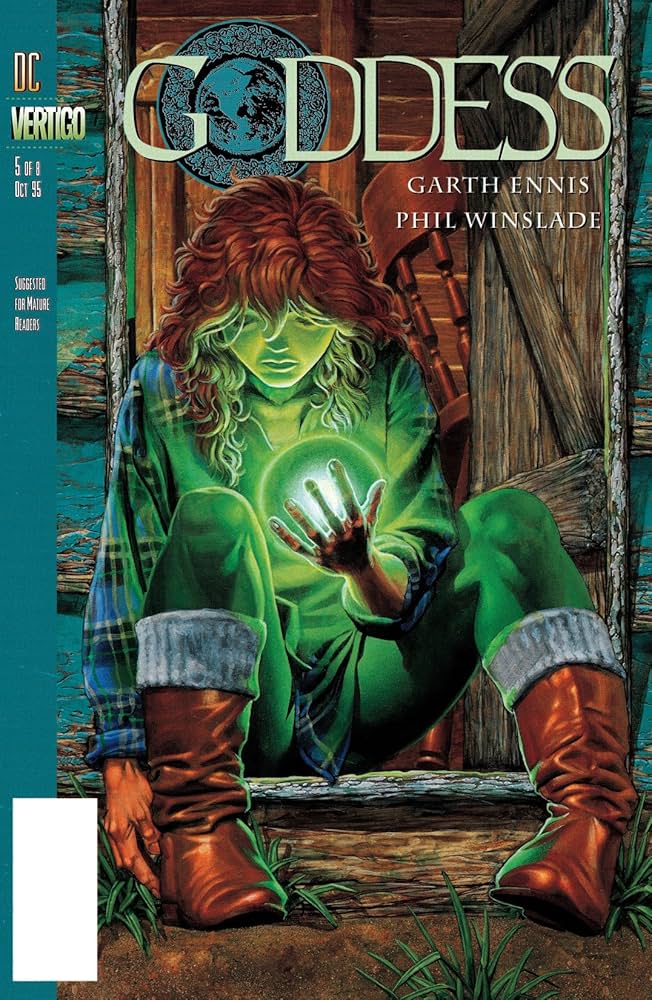
Goddess - a Vertigo comics mini-series

I vaguely remember this series being solicited back in the mid-90s when it was originally published; however, it was not something that fit within my "likes" of comic reading back in the day, so I passed on it.  A few weeks back, a local comic store was having a huge sale on back issues, $1.00 each or 50 for $25.00.  A friend and I went and managed, between the two of us, to find 50 comics that would cost us only $0.50 an issue!  Included in those 50 comics was the full eight-issue run of this series - I figured since they had the entire run, and at only $0.50 per issue, I might as well pick them up.  After all, my taste in comics have moved far beyond just superheroes these days, and if it turned out I didn't like it, then I could always just trade them in somewhere later on.  Well, the comics are staying in my collection, so that should tell you what I thought of them!
 
Goddess
was the creation of writer Garth Ennis and artist Phil Winslade. I was familiar with Ennis, having read some of his work on The Boys, Hellblazer, Crossed, and others; but I had never heard of Phil Winslade.  Or so I thought.  It turns out Winslade provided the art for DC's Wonder Woman: Amazonia graphic novel from back in the day (which I have), but I suppose I never paid attention to the artist's name when I read that book (either that, or it's simply been so long that I had forgotten it).  In any even, both of these creators have some magnificent work out there, so just imagine combining the two for an eight-issue mini-series!  And Ennis being who he is, you know the book is going to have a certain level of violence - which it does!
 
While Goddess is definitely the story of Rosie, a beautiful, young Scottish redhead who has unbelievable powers that she cannot seem to control - such as literally ripping her own country in half or blowing the heads off of government agents or even calming a ferocious tiger to save a young boy's life.  However, it is also the story of Mudhawk, Samantha Flint, and Jeff - a tough guy, and even tougher girl, and a weak-kneed man who may just be in love with Rosie.  Sure, they may only be the supporting cast in the story, but without them, Rosie would never get where she needs to go - she would never figure out who she really is - and she would never be able to make the decisions she does to put things right in the world again!  Oh, and we certainly can't forget the government agent who will stop at nothing get his hands on Rosie and her powers, even if that means killing anyone and everyone who gets in his way.  

Jeff in the narrator of this tale, so it might be a little slanted from his google-eyed point of view.  But through his eyes, the reader is able to see all of the characters for who they really are.  None of them are perfect by any means, but each of them has heart in their own ways - even Mudhawk (whose real name turns out to be "Walter Gaylord"), who manages to save this motley crew on more than one occasion.  And while Jeff points out the flaws of everyone, he also manages to give readers a clear delineation of who the good guys are, who the bad guys are, and, well, there quite literally is no in-between.  And as the story progresses, we get to see Rosie become stronger and more confident, gaining more control of her powers, and ultimately making her way to the top of the world where she discovers the truth about her identity, her powers, and her destiny.  The question is - will she fulfill the destiny established for her, or will she create her own path?  (Let's just say, I love the answer to that question!  And if you are really wondering who she is, well, quite honestly, the answer is right on the cover of each issue, staring you in the face!)
 
The art is absolutely stunning.  Winslade paints some beautiful long-rage shots of the planet earth, while also some superb close-ups, with character expressions that provide clear insight into the characters and their motivations without the need for any dialogue whatsoever (although, Ennis certainly provides plenty of that).  From the bloody shark attack in the first issue, to the full-page window-breaking scene near the end of that same issue, to the gorgeous panels of Rosie's first meeting with the spectral "Jenny," to the otherworldly scenes in the final issue - Winslade proves that he can give readers a visual experience they will never forget.  I think he was the perfect fit for Ennis' story here, since it goes from peaceful beauty to bloody violence in just a matter of panels or pages, and then slides into normal, everyday life scenes before once again turning right back to some graphic violence.  Winslade does it with apparent ease, keeping the story moving without any jarring breaks at all.  That's not an easy feat for any artist, but Winslade succeeds, and then some!

I was not sure what to expect with this series, but I went into it with an open mind and came out of it with the satisfaction of knowing I had just read something well worth the read.  

RATING:  10 giant water horses out of 10 for a different kind of story with a different kind of heroine for a different kind of comic reader!