Showing posts with label ski. Show all posts

Tuesday, February 24, 2026

Whitman Mystery Stories - Brenda Starr, Girl Reporter

This is one of the Whitman Authorized Editions that I have been wanting for quite a while.  While I never had the opportunity to read the original comic strip in the newspaper, I do have an edition of the collected dailies and Sunday strips from 1940 - 46 (Brenda Starr Newspaper Strips), as well as the one-issue Dell Comic published back in 1963 (Brenda Starr Comic Book), plus the collected editions of her original comic book series from Four Star Publications and Superior Publishing back in 1947 - 49.  The ones I still don't have are the Charlton Comics series published in 1955.  I have enjoyed reading her adventures, which are outlandish to say the least - this amazingly gorgeous, redheaded reporter that every man loves on sight manages to get in the most unbelievable situations - yet, with her looks and ingenuity, she manages to get herself and those around her out of every scrape and, along the way, scoops the story for her newspaper, the Flash.  So, I was overjoyed when a close friend of mine sent me this book (along with a Sunday color newspaper page featuring Brenda Starr paper doll with outfits!), and I could not wait to sit down and read it.
 
Brenda Starr, Girl Reporter
gives credit to the main character's creator, Dale Messick, as the author of the story, as well as the artist for all of the internal illustrations and full color cover.  I think this is only the second Whitman based on a comic strip that I have read, which is actually written and drawn by the creator of the strip (although, there is some question as to whether Messick actually penned the novel or just the plot - more on that later) - the first was a book based on the Boots and Her Buddies comic strip (Boots - Whitman Mystery), the authorship for which was credited to the strip's creator. What I found interesting is that the title page says "An original story based on the Famous Newspaper Strip 'BRENDA STARR'." Thus, I was expecting a brand new story featuring Brenda and her supporting cast. Little did I realize that was not going to be the case.
 
The story begins innocently enough, with Brenda being sent off to the slopes of Colorado (which is funny, since the most recent Zebra Mystery Puzzler that I read was also set on the slopes of Colorado - Murder by the Book) on a mysterious assignment.  She does not know exactly what the story is or what the work will entail - all her editor told her was to go to the newspaper there and ask for Larry Nickels.  When she arrives, she finds the "newspaper" feels more like a posh hotel, and the "employees" seem to do nothing but lounge around and ski all day!  When she asks for Mr. Nickels, she finds he is out on the slopes, and his secretary - Flurry Snow (p. 19 - and, yes, that really is her name!) - informs Brenda that she is to meet him out on the slopes.  Brenda is somewhat nervous, as she is a horrible skier and that fact is proven when she goes out to meet him, but ends up falling backwards down the slope (p. 24).  He rescues her, much to her dismay, and she learns that the "Cloud" (the name of his newspaper) is nothing more than a hobby, and he asked her out there to breathe some real life into his newspaper.  That story turns up pretty quickly, when Nickels points out to her a nearby lodge, described as "a vast, sprawling building with many towers and gables.  Despite its many windows and entrances, it possessed a look of strangeness and complete isolation" (p. 45).  Nickels tells her the lodge is a mystery, because people go in, but not a single soul has ever come out!  Brenda senses a big story, which is only confirmed when Nickels tells her about the man who operates the lodge: "a queer old duck who calls himself 'Professor Squell'" (p. 46).
 
Now, it is at this point, I started to sense something strange as well.  Not about Professor Squell or his lodge, but about the plot itself.  It felt extremely familiar.  So, I pulled out that collection of newspaper strips I had read before, and sure enough, there it was!  The same exact story I was now reading in prose form I had read three-and-a-half years ago when I read those newspaper strips!  Before Brenda Starr had even been published in the newspapers for a year, she was on a plane, dreaming about the blond-haired mystery man who had kissed her on New Year's Eve - exactly as she did on the opening pages of the first chapter of this book.  In fact, the dialogue was lifted straight out of the newspaper strip and used word-for-word in the book.  Now, obviously, a lot of exposition and additional dialogue was added into the book in order to flesh out the story, the characters, and the page count (otherwise, it would have ended up being a very short book, indeed!).  But if you read the book, side-by-side with the newspaper strip panels, you will see that it is literally a full adaptation of the story written and published back in 1941 and not an original tale at all.  Therefore, I'm at a loss to explain why the publisher refers to this as an "original" story based on the comic strip, when it is in actuality an "adaptation" of a story from the comic strip.
 
The story follows Brenda as she watches first Flurry, and then Nickels, go into the strange lodge and never come out.  A reward offered sends quite a few of the men from the village into the house, none of whom ever come out, and before you know it, Brenda is in hot water, being blamed for sending the men to their doom.  So, what else can she do, but go into the lodge?  Meanwhile, reporter Tom Taylor and photographer Pesky head out to rescue Brenda - and thanks to an anonymous warning, Tom knows enough to wear a gas mask before he goes into house, which saves him from the gas that takes control of all who enter - but does NOT save him from the mysterious man who knocks him out from behind.  From here, the story gets even more wild, including a basement laboratory, underground caverns, a room of pirate booty, and an impromptu wedding between Brenda and the "queer" professor who is holding everyone captive under ground.  And while the collection of newspaper strips ends with Brenda, Tom, and Nickels getting out and rescuing everyone, the book goes beyond and jumps into the next storyline involving a missing detective, a mysterious doppelganger, and a secret surprise.  This story moves much quicker than the first and take up only the last few chapters of the book.  Since I did not get to read the newspaper strips for this tale, it was completely new to me.
 
Now, some have speculated that Messick did not actually write the book, but, rather, it was simply ghostwritten as an adaptation of the strips - and since Messick wrote the newspaper strips, she was given credit for writing the book.  Whether this is actually the case or not, I have no idea.  What I do know is that Messick provided brand new illustrations for the book - 19 of them to be exact.  While some of the scenes do seem to mirror those from the strip, there are differences, which provide proof they were not merely reproduced from the art of the strip.  Messick also provides the art for the endpages, which depict the professor's planned wedding to Brenda, with Tom and Nickels standing behind her and Pesky off to the side, down in the caverns. 
 

What is odd about these endpages is that, in my copy at least, the pages are reversed in the back.  In the front, Pesky and the professor are on the left side, with Tom, Brenda, and Nickels on the right (which appears to be the correct positioning, based on the smoke drifting overhead); however, in the back of the book, Tom, Brenda, and Nickels are on the left side, while Pesky and the professor are on the right - supposedly looking at each other, but because of the repositioning of the pages, they are looking away from each other!  I wonder if this production malfunction was only in this one printing, or if all copies of this book have this error.
 
Despite the story not being original, I still enjoyed it - Brenda is a fun character to read, and her antics are always guaranteed to bring a smile, if not a full laugh, to the reader's face.  The gorgeous Messick art is only an added bonus!  Rather a shame they did not adapt more of the stories into book form - would have made a great series.   
 
RATING:  8 hats that resemble flipped over pancakes out of 10 for a fun-filled romp in the snow, under the ground, in an Easter parade, and in the clubs of Washington, D.C. - all in a day's work for Brenda Starr, Girl Reporter! 

Friday, January 24, 2025

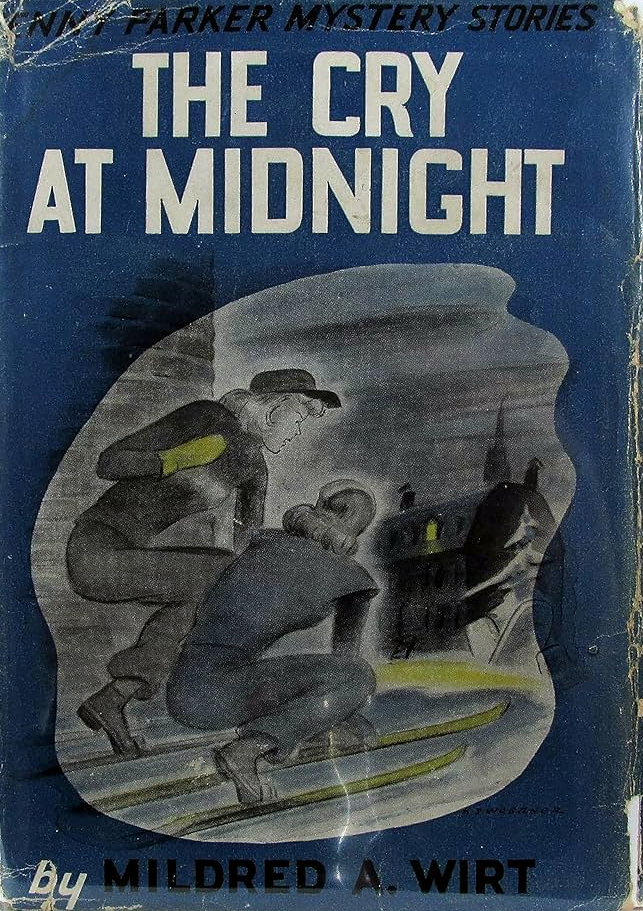
Penny Parker Mystery Stories No. 17 - The Cry at Midnight

And at long last, we've reached the seventeenth and final Penny Parker Mystery Story.  It is a bittersweet feeling, because I've been anxious to see just how this series was going to end, while at the same time, I'm disappointed to have reached the final Penny Parker story.  A seventeen-book series that was published from 1939 to 1947 at two each year (except for 1945, in which only one Penny Parker book was published), the series has offered up some very interesting stories that gradually became more and more dark and intense as the it progressed.  This final book has probably the darkest story in it, and one has to wonder if perhaps the story is a reflection of everything the author had experienced in the years leading up to the printing of this last volume.

The Cry at Midnight opens with a somewhat cheerful winter scene, as Penny Parker and her (boy) friend, Jerry Livingston, are getting ready to ski down the slops of Knob Hill.  Now, anyone familiar with series books from this era, and more certainly, anyone familiar with Mildred Wirt Benson's work is going to stop right here and say:  Knob Hill?  Where have I heard that name before?  Well, it just so happens that the final book in the Penny Nichols series, written by Benson under her pseudonym Joan Clark, was titled The Knob Hill Mystery (you can read my review of that book by clicking on the link).  The Knob Hill in that book was not a hill for skiing, however, nor was the mystery set in the dead of winter; however, it did feature a youngster who was being held captive in a house, similar to the captives in this book.  I suppose it is fitting that Benson ended both of her "Penny" series with a mystery set on or around a place named "Knob Hill."

The story takes a darker, more gothic tone as Penny and her best friend, Louise Sidell, are walking back to their car when they pass by the supposedly haunted Abbington Monastery and they hear a "shrill, piercing scream" from inside the monastery (p. 7).  This, of course, immediately piques Penny's interest, as she immediately sees there is a story to be uncovered here.  The monastery is described as a "structure of moldy stone enclosed by a high brick wall" with a graveyard just inside the wall (p. 4), and that there is a "deserted garden beyond the gatehouse" where "several statues [are] covered with soft white shrouds" (p. 6), giving the reader an imagery of ghostly figures.  When they discover the gate is open, Penny convinces Louise to go inside, where they meet "a grotesque, deformed human figure," and they see "silhouetted against the gray stone walls ... a hulk of a man with a large head and twisted back made unsightly by a hump" (p. 10).  The man who now owns the monastery, when he first appears, is said to be a "very tall man" wearing a "dark hooded robe" (p. 12).  These details are clearly intended to set the mood for the story - a dark, foreboding house inhabited by cloaked and grotesque individuals, which definitely provide the set-up for a good gothic tale!

Jay Highland, who calls himself Father Benedict (p. 14) tells Penny and Louise that he has no secrets within the halls of the monastery, and the only thing they will find are "serene faith and hope for a better world" (p. 14).  Penny has seen enough charlatans by this point to recognize one, and it is obvious to her something is not right here.  And one has to smile at the author's choice of names for the Father - "Benedict" could easily be a reference to the Benedictine monks who used to live in Abingdon Abbey (which is the name of the REAL abbey located in Oxfordshire, founded in 675 AD and dis-established in 1538 - like the Abbington Monastery in this book, the real Abingdon Abbey has some walls and buildings remaining, but a number of the buildings have only a few physical remains on the land).  

From here, Benson introduces another character into the story, who may be a greater mystery than the scream at the monastery.  As Penny and Louise are driving home, Penny nearly hits a young girl walking down the road with a suitcase (p. 16).  They have to literally beg her to get her to enter the car and allow them to give her a ride (but not before they debate the safety of picking up a hitchhiker on page 17 - which is a funny coincidence, as part of the mystery in that last Penny Nichols book also involves a hitchhiker, only in that story, it is a male, not a female), and she refuses to disclose any personal information, including her own name.  She insists she be let out on the docks in Riverview, and it is there that she disappears right at the river's edge (p. 23).

Well, yet another mystery falls into Penny's lap when she gets home to find her father meeting with James Ayling, an investigator for the Barnes Mutual Insurance Company (p. 30).  It seems that one Mrs. Hawthorne and her granddaughter Rhoda have gone missing, and the insurance company is concerned about the extremely valuable star sapphire that they insure - they are afraid she may lose or give away the cursed jewel, leaving the insurance company to pay out!  And, yes, the jewel does come with a curse.  According to the story the star sapphire was set in a necklace worn by a king who met a violent death; since that time, every owner thereafter has had bad luck, with several of them dying in strange ways (p. 31).  Mr. Ayling is worried the older woman may believe in the curse and get rid of the jewel.  Now, this whole segment of the mystery definitely has some interesting things to point out.  First, it is said Mrs. Hawthorne's husband was Nathaniel Hawthorne!  You may recognize that name as the great American novelist and short story writer (1804-1864). What's more coincidental is the real Nathaniel Hawthorne wrote House of Seven Gables while living just outside of Lenox, Massachusetts, a city that was settled by one Jonathan Hinsdale, whose daughter's name was ... Rhoda!  And if that weren't enough, a little digging reveals that the real Hawthorne had a cousin whose name was Rhoda Campbell Morgan (1819-1867)!  Whether Benson used these names because she was aware of the connection, or whether it is simply one huge coincidence, I suppose will remain an unsolved mystery...  And, with regard to the "cursed" sapphire, it turns out there really was a star sapphire with a supposed curse to it.  The Delhi Sapphire is sad to have brought terrible misfortune and financial ruin to anyone who possessed it!

Penny's intuition serves her well in this story, as Father Benedict is easily seen by the reader as a charlatan.  While he proclaims his followers lead lives of poverty, with no desire for worldly possessions, Penny and Louise discover his office within the monastery is furnished with "thick velvet carpet ... a large mahogany desk, a sofa, two easy chairs, and a cabinet filled with fine glassware, gold and silver objects, and a blue glass decanter of wine" (p. 40).  He then informs the girls that collecting art treasures is a hobby of his, explaining the decanter "is a piece of Ching-Hoa porcelain and very rare," while also showing them a Byzantine amulet and golden goblets recovered from a European church destroyed a century ago (p. 42).  But the clincher is when Penny spots the crystal ball supported by the claws of a bronze dragon (p. 40).  One might remember in the very first Penny Parker mystery, Tale of the Witch Doll, features a medium who is scamming people.  Thus, when Father Benedict suggests Penny stare deep into the glass (the frontis piece!), she sees nothing at all (p. 44-45).  Father Benedict says she simply does not believe, to which Penny quips, "Guess I haven't got enough of the witch in me" (p. 45)!   This is one of my favorite things of the Penny Parker series - Benson gave Penny some sarcastic wit that comes out to play now and again and is a joy to read!

While the mystery is not really too hard to figure out (I mean, come on, who didn't immediately figure out that the young girl walking down the street, away from the monastery, was actually Rhoda?), it is following along with Penny as she figures it all out that is half the fun.  And the gothic elements abound within the story - there is a closet that offers a peep hole that allows one to spy into the chapel room (p. 144); there is a secret tunnel from the basement to the graveyard (p. 81); a lift that lowers the canopied bed in the chapel room own into the cellar by secret mechanism (p. 113); and even a crazy old woman (p. 13) who continually warns Penny away from the monastery (p. 38), but who ultimately aids her in her quest to uncover the truth about what is going on at the monastery!  This story could easily transition into one of the gothic novels published in the 1960s and '70s that populated bookstore shelves so heavily during that time.  It has the perfect premise and setting, that's for sure!

One final observation in this book concerns the ceremony given by Father Benedict.  While he starts the ceremony by chanting in Latin, he also recites a somewhat lengthy quote (p. 133) from The Monastery, a novel by Sir Walter Scott published in 1820.  He is reciting a quote of the White Lady from the novel, a character that is a supernatural figure who guides some of the other characters in the story.  Scott's novel, as clear from the title, is centered on a monastery that is based on the real Melrose Abbey in southeast Scotland.  I would love to know what promptly Benson to use this quote for the story, and whether Scott's novel itself gave her some inspiration for the final Penny Parker mystery!

While not the strongest mystery in this series, I would have to say that The Cry at Midnight provides readers with a satisfying conclusion to the Penny Parker Mystery Stories.  That final statement by Penny on page 207 pretty much sums up her future, had the series continued:  "Writing this story will be duck soup compared to digging up the material.  Just lead me to a typewriter!"  And with that, the stories of plucky teen-sleuth Penny Parker came to an end, and we are left with a legacy of great stories by which we will always remember her!

RATING:  9 cheap silver colored rings with a red glass tone out of 10 for sending Penny Parker off into the annals of history with a solid, 17-book legacy that could truly be enjoyed by fans of any age in any decade!

Monday, January 6, 2025

A Zebra Mystery Puzzler #11 - Death on the Slopes

With the eleventh Zebra Mystery Puzzler, we are treated to a new author to the series, Norma Schier.  This is the first of four books Schier writes for this series, all of which feature the young assistant district attorney, Kay Barth.  From what I have been able to learn, Norma Scheir was the author's actual name, and aside from these Zebra Mystery Puzzlers, Ms. Schier has also authored some very unique short stories over the years in which she parodies well-known mystery writers, using anagrams throughout her tales.  In fact, many of the pseudonyms used for these short stories are anagrams of actual authors, many of which are collected in Schier's book, The Anagram Detectives (for more about this, see Norma Schier - Anagam Detectives).  However, other than these Zebra mysteries and the short stories, I was unable to find any other books by Schier.

Death on the Slopes
was published at the end of 1978, just one year prior to her book, The Anagram Detectives - leading me to believe that her short story fiction was published prior to her first Zebra Mystery Puzzler (and those stories may have been why Kensington asked her to write some of the mysteries for this series).  The book opens in rather unique way, with readers being dropped into a scene just moments before the murder occurs, as seen and heard through the eyes and ears of a witness who does not come back into play until considerably later in the book.  We even get our first interior illustration in that barely three-page prologue - but it is definitely enough to set the stage for all that comes after!

The first six chapters introduce readers to the vindictive, self-absorbed victim, Valerie Mayne, as well as the large cast of suspects - from Jason Ryder, newly transplanted from New York to Colorado to teach as the college in Aspen; to Drew Courtney, the tenured professor who will determine whether Jason is hired; to Alicia Courtney, the professor's wife who spends more time in the bottle than anywhere else; to Tammie Courtney, the professor's daughter, who is not thrilled her boyfriend is paying more attention to Valerie than her; to Anton Duval, a Frenchman who is a member of the ski patrol and thinks himself quite the ladies' man; to Charlie Winstead, the head of the ski patrol on the Aspen slopes, who is still getting over the fact his wife left him - with the exception of Valerie, who showed up on his doorstep in New York claiming to be an old friend of his dead wife who was in need of a place to stay before following him to Colorado. Jason knows none of these people.  When Valerie turns up dead, and Jason is the prime suspect, he can't help but wonder if one of these people is the real killer?

And that is the very question to which Kay Barth, the young assistant district attorney with shiny black hair that tumbles to her shoulders, wants to find an answer!  Our protagonist of the tale finally makes her appearance in chapter 7, well after the other characters, the murder, and the setting are all established.  Schier provides readers with a very strong female lead, one who goes up against the chief of police, Mark Field, in an effort to solve this murder.  She quickly realizes that Jason Ryder is not the killer, but Field thinks it is only because she has developed feelings for the guy.  Determined to show Field that she is more than just a pretty face (and the mother of a young girl), Kay sets out to uncover the truth about what happened to Valerie Mayne - the only problem is, Valerie Mayne doesn't exist!  None of her back story that she told Jason checks out, and no one has come to claim her body, despite news reports showing her picture all over the place.  Kay realizes that in order to solve the murder, she is going to have to figure out who Valerie Mayne really is!

The mystery is very well written, and Schier does manage to throw out there a number of clues that will lead the reader in different directions.  However, when Kay ultimately tracks down Valerie's real identity and begins to put the pieces of her past together, there is one piece of that puzzle that made it clear for me who the killer was (and yes, it is definitely one of those suspects listed above - only not the one you would expect!).  And I found it interesting that Schier changes point-of-view a number of times throughout the book, switching between Jason and Kay, and even among some of the other cast as well - but she is careful not to give away anything too early in the story, which makes for a great read.

The internal illustrations are nicely done, but one again, no credit is given, and there are no signatures on any of the drawings.  They are quite detailed, reminding me a great deal of Ruth Sanderson's work in the Nancy Drew books published by Simon & Schuster back in the early 1980s.  (And speaking of which, as an aside here, Schier does manage to sneak in a Nancy Drew reference in there, when Kay tells her daughter she is investigating a crime, and her daughter asks, "Like Nancy Drew?" [p. 83])  I just wish the books had given a list of the "clues" that were supposedly in the illustrations, as I looked at all eight internal illustrations, and I honestly did not see any clue at all in them.  The cover, on the other hand, does have one rather subtle clue.  And speaking of the cover, Bruce Emmett (who painted the covers of the Marcia Blair books in this series) provided the art for this book - which gives this book another "Nancy Drew" connection, as Emmett provided the second cover art for Nancy Drew 68 - The Elusive Heiress.  (I won't even mention the "Ski Jump" sign in the internal illustration on page 85, which made me immediately think of Nancy Drew 29 - Mystery at the Ski Jump!)

This ranks among the best in this series, and it makes me look forward to Schier's future entries into the Zebra Mystery Puzzlers.

RATING:  9 blue Pontiac Bonnevilles out of 10 for mixing murder and mystery in the snow-covered mountains of Colorado and introducing readers to a great new sleuth!