Wednesday, January 4, 2023

Ticket to Danger - A Cassandra Mystery #1

Sometimes you come across a series, and despite your promises not to pick up any new series, you just can't help yourself.  This series is one of those times.  I came across the first book at a used book store, and the cover art and the lettering of "A Cassandra Mystery" caught my eye, and the description seemed too good to pass up.  And after a quick search online revealed there were only four books in the series, I figured I might as well.  Needless to say, it didn't take me long to find the other three books on eBay, and I now have the complete series.  So, I figured it was time to start reading them.

Ticket to Danger is the first book and introduces readers to Cassandra Best - an eighteen-year old girl whose real name is Cassandra Best Jones.  "Cassandra Best" is the identity she has created for herself while writing to her pen-pal in England, a fellow teenager by the name of Alexandra Bennett (a name that we will look more into later).  Alexandra's family is quite wealthy, having their own estate, and Cassandra wanted to create a life where she was of similar stature in society - it's not like she was ever going to cross the ocean and meet her pen-pal face-to-face.  Until, of course, Alexandra invites her to England to attend her debut ball, set to take place in just a few weeks!  Cassandra is debating on how to tell her new friend the truth, that she can't afford the trip, when Alexandra sends her a round-trip ticket (first class!) to England, along with some cryptic messages about a possible mystery afoot!  Cassandra desperately wants to go, but she is afraid the truth will come out and her pen-pal will hate her for lying.  Her grandmother convinces her to take the trip, so off she goes, hoping she can pull off the performance of her life as Cassandra Best!
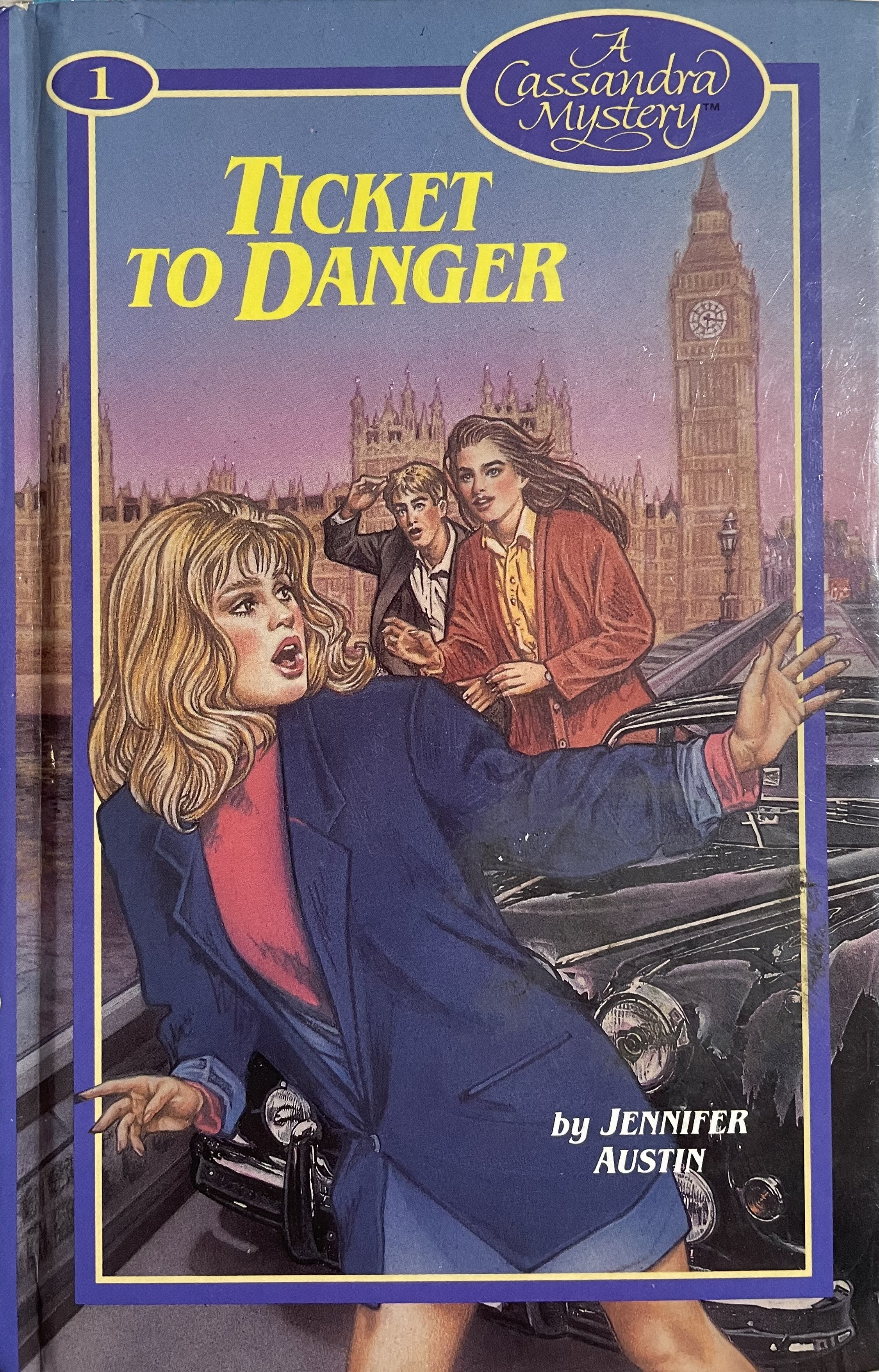
The mystery comes into play immediately upon Cassandra's arrival, when she learns that Alexandra has gone missing, not long after Cassandra talked to her on the phone to confirm she was coming!  Her father, grandmother, aunt, and cousin have no idea what has happened to her, and her friend, Peter Wentworth, who writes for Mr. Bennett's newspaper, is also concerned about her disappearance.  Cassandra finds herself suddenly thrust into this strange, new world, with people she's never met in a castle-like manor filled with hidden passages and bumps in the night!  Sound familiar?  (More on that later....)

The author creates quite a Gothic element to the story, with the young woman far from home, placed in a completely new setting where shadows and danger lurk around every corner, and where she has no idea who she can trust.  The book shows the author as Jennifer Austin, but nothing online verifies this is an actual person.  Jennifer White's blog lists the name as a pseudonym (Series Books for Girls), and since there seems to be nothing to be found on this "author," I'm likely to agree.  It would be interesting to find the creator and/or author of this series, as there are some elements to it that could potentially be homages to other series - such as the Inspector from Scotland Yard is "Inspector Crandall" - and Crandall is the last name of the headmistress from the Dana Girls series (another series for girls published by Grosset & Dunlap previous to this).  
 
But an even greater homage is the name of Cassandra's pen-pal - Alexandra Bennett.  In the original Dark Shadows television show, which was a Gothic soap opera in the late '60s about a young woman who travels to a place she's never been, to meet people she's never seen (see - I told you it sounded familiar!) and ends up in a castle-like manor with plenty of dark shadows around every corner, the main character was portrayed by actress Alexandra Moltke - and the matriarch of the family in that show was portrayed by actress Joan Bennett.  So, when I see the name "Alexandra Bennett" connected with a story about an old English manor where a young woman has shown up and must solve the mystery involving the disappearance of an heiress, well, it's only natural that I would question whether the author was a fan of Dark Shadows!

All of that aside, the mystery itself was quite engaging.  Like any good British mystery, there are secret panels, hidden passages, characters that take an instant dislike to Cassandra, a skittish groundskeeper, an Inspector who wants Cassandra to stay out of the investigation, and plenty of cultural differences to keep Cassandra just a bit off-balance as she tries to figure out what happened to Alexandra and how it connects to the family's heirloom - a ruby and diamond necklace that once belonged to Anne Boleyn!  The author manages to throw in some great misdirection, and with several possible suspects and motives, it is not an easy solve.  There are a number of typical foibles (Cassandra gets knocked out, she gets run off the road, she gets kidnapped, etc.) and plenty of danger and excitement (Cassandra drives a car directly into the path of an oncoming plane in the hopes of preventing it from taking off!) before she manages to find Alexandra, locate the stolen necklace, and bring the criminals to justice.

This series seems to follow on the footsteps of other attempts to create new female detectives around that time period, such as Susan Sand (eight books published from 1982-84) and Diana Winthrop (six books published from 1983-85).  But, as with the other two series, it was not destined to last, and it only managed to see four books published.  The writing is not bad, and the main character is actually rather unique (basically coming into being as a detective through a fantasy-life created for a pen-pal).  Unlike so many young adult detectives, who either have lost one or both of their parents, Cassandra has a full family - mother and father, as well as a younger sister and a grandmother - to support her.  But, for whatever reason, the series did not make it, and we are left to enjoy the ones that we have.

Something I did enjoy about the book is that there were internal illustrations (similar to the Susan Sand books).  Ann Meisel provided the cover art and the interior illustrations, and she IS a real artist, who is still around today.  The black and white penciled interior illustrations remind me of Ruth Sanderson's work in the Nancy Drew books from the early '80s, insomuch as they are very full and detailed, and there are no harsh angles or lackluster backgrounds that some of the later Nancy Drew and Hardy Boys books published by Grosset & Dunlap featured.  
 
I'm curious to see if the remaining three books of the series are as enjoyable as this first!
 
RATING:  8 servings of Yorkshire pudding out of 10 for introducing readers to a unique, new amateur sleuth in a great first mystery!

Sunday, January 1, 2023

Senorita Rio - Volume One (a Golden Age Classic)

Ah, the joys of the Golden Age of comic books.  Back in the early days of comic books, there were a plethora of choices for the young fans of comics - from westerns to superheroes to science fiction to war stories to adventure stories to crime/detective stories - just about every genre one can imagine was depicted in comic form.   While I am familiar with most of the superhero titles from back in the '30s and 40s, I am still learning just how little I know about the various other genres that were being published at that time.  Thankfully, PS Artbooks has been offering fans like me a chance to delve into those various other books from back in the day.  Not so long ago, I purchased and read the two volumes of Phantom Lady that PS Artbooks published, collecting the various stories of the original Phantom Lady published by Quality Comics and Fox Feature Publications (as well as later by All-Top Comics and Ajax-Farrell Publications).  I was already familiar with the character from DC Comics (who acquired her when they purchased the Quality characters), so it was interesting to see those pre-DC stories.  So, I've kept an eye on the PS Artbooks offered through Previews, and when I saw a solicit for a new collection of stories starring "Senorita Rio," well, I knew I had to give it a try.

Senorita Rio is the code-name for actress turned secret agent, Rita Farrar (not to be confused with the actress turned weird superhero, Rita Farr, who became Elasti-Girl in the Doom Patrol over at DC Comics).  Senorita Rio first appeared in an eight-page story in Fight Comics #19 (cover dated June 1942), published by Fiction House.  From what I can find online, the character appeared in quite a number of issues of Fight Comics, starting with issue 19 through issue 68, then making her final appearances in issues 70 and 71.  The page-count for the stories varied, starting at eight pages, then increasing to ten pages, then reducing back to nine pages (and that is just within the first sixteen stories represented in PS Artbooks first volume of Senorita Rio).  According to the introduction to this collection, Senorita Rio is one of the first female and Latin characters in American comics, and she is the first female character to appear on the cover of Fight Comics.  (NOTE - Wonder Woman made her debut over at DC Comics in October 1941 in All-Star Comics #8, so it was a little less than a year later that Senorita Rio made her debut in Fight Comics #19 in June 1942).  Thus, this character plays an important role in comic book history!

Our sultry secret agent was created by none other than Nick Cardy (who comic fans will recognize as the artist of the the original Aquaman series in the early '60s and all 43 issues of Teen Titans series back in the late '60s).  Cardy provided the art for the first eleven stories, from June 1942 through December 1943.  He both pencilled and inked the first nine stories, while Art Saaf provided the inks on the last two tales drawn by Cardy.  The stories were signed as "N. Viscardi," which was his real last name (later shortened to simply Cardy for his professional work).  When Cardy left, the art was taken over by Arnold HIcks, and then Alex Blum, and the Lily Renee.  The writing of the stories are credited to "Morgan Hawkins" (although the first tale indicates it is "by Joe Hawkins"), but this does not necessarily appear to be a real person.  I find conflicting information when I research the name - some websites credit Nick Cardy as the author of the Senorita Rio stories under the Hawkins pen name, while other sites credit Max Elkan as the real name for Morgan Hawkins.  I suppose this is a mystery lost in time...

The stories are very fast-paced (which they would need to be, since they are only eight to ten pages in length!) and pretty much follow the same format - Senorita Rio received a mission to stop a German / Nazi operation, she heads out to a South American location, she gets captured or kidnapped, and she escapes and defeats whatever operations the Germans / Nazis are up to and saves the day.  While the stories are pretty simple and straight-forward, they are enjoyable in the fact that the men in these tales greatly underestimate Rio's ingenuity and skills.  She's a sharpshooter and excellent hand-to-hand fighter, and her feminine wiles beguile many a lusting man.  She is also quite handy with a knife, for in the August 1944 issue (#33), Rio manages to take down a wild jaguar who is ready to attack a fellow agent!
 
A number of male supporting characters do end up getting killed or severely injured in the stories, but Senorita Rio manages to escape them unscathed and triumphant, reinforcing the idea that good always overcomes evil, although not always without a cost.  And since these stories were published during a time that the United States was at war, it is likely they were written to encourage the youngsters reading them that good would eventually overcome the evil of the Nazi menace.  Rio's stories extended well beyond the end of World War II, so I am curious to see what kind of adventures the sultry spy went on after the war ended.

Readers who hope to see the first story tell the origin of this mysterious spy will be disappointed - there is no lengthy origin story, such as those depicted in today's comics; rather, Senorita Rio's origins are told gradually throughout those initial stories, with small tidbits dropped here and there that readers will have to put together.  The second panel on page 3 of that first story provides probably the largest part of her tale, with a small newspaper article telling how motion picture actress Rita Farrar leapt to her death while traveling by ship to Rio de Janeiro for the opening of her latest film.  The snippet says the actress was depressed following the death of her fiance at Pearl Harbor.  Otherwise, readers never actually see how Rita Farrar becomes Senorita Rio - instead, readers are simply thrown into the action of Rio's latest adventure (it is clearly not her first), wherein she assumes the identity of a countess in order to steal some forged papers that could destroy relations between the U.S. and Brazil. 

One thing I love about this collection is that it includes four pages of house ads that Fiction House published to advertise their new character.  "Sing a song of sudden death..." headlines one ad - - "Senorita Rio ... svelte, daring ex-Hollywood starlet turned U.S. Secret Agent..." describes another - - "Senorita Rio ... daring, glamorous U.S. spy queen, fights the tarantula web of axis treachery" advertises another - - "Senorita Rio: The World's Most Devastating Secret Agent! Nightmre of Axis Operators ... Toast of Latin America's Gay Caballeros!!" exclaims the fourth!  The only thing missing from this collection are the covers to each of the issues in which Senorita Rio appears.  Even though she may not have appeared on the actual cover, it would have been nice to see the covers for these issues.

As a final note - Senorita Rio (Rita Farrar) first appeared in June 1942.  Elasti-Girl (Rita Farr) of the Doom Patrol over at DC Comics did not appear until June 1963 in My Greatest Adventure #80, some twenty years later.  It must be more than a simple coincidence that the characters have similar names (Rita Farrar / Rita Farr); both characters have the same career (actress / actress); and both characters were in a foreign country when their lives changed (South America / Africa).  This makes one wonder if perhaps Arnold Drake, who created Elasti-Girl, was a fan of Senorita Rio and his creation was an homage to the earlier character...

RATING:  9 white gods of Inca legend out of 10 for some wonderfully action-packed stories featuring a strong, sexy female lead!

Wednesday, December 28, 2022

Driven - A Rita Mars Thriller (#1)

This book was recommended to me by my very good friend, Geoffrey Lapin, who happens to know the author personally.  He hadn't yet read the book, but he asked me to read it and provide my review of the book, so how could I say no?  I mean, after all, it's a mystery, it features a female protagonist, and with the last name "Mars" - eh, Veronica Mars, anyone?  I LOVED that show!  And better yet, I didn't even have to buy the book - Geoffrey sent me a copy as a gift.  So, I moved it to the top of my reading pile and dove right in.

Driven is the first Rita Mars thriller written by Valerie Webster, and, from what I gather, Ms. Webster's first published novel, period.  The postscript in the book indicates that book two is coming, so this novel is only the beginning of the series.  Webster does a wonderful job of giving us a different kind of sleuth.  Rita Mars is not your typical private investigator.  She's a former investigative reporter turned P.I., with a secretary named Beverly Hills (more on her later!), who lives in the country but maintains an office in the Washington, D.C. area.  She carries a lot of baggage - from an alcoholic father who killed himself to a line of disastrous relationships - but when she sets her mind to something, nothing and no one can stop her until she finds what she is looking for!  In a word - she is driven!

The mystery is a rather topical one - it involves a considerable amount of behind-the-scene deals within the government, on a very high level, that could very well be (and most likely is!) going on in the real world.  Only, in this mystery, the stakes are high enough that someone is willing to kill to keep their secrets from coming out.  What I did find a bit odd was that the mystery opens with Rita Mars going to visit a fellow journalist with whom she used to work alongside - but instead of finding him waiting for her, she finds him dead!  That's not the odd part, though.  With such a cryptic, shocking opening, I was expecting the mystery to focus on who killed Bobby Ellis and what story was he working on that was important enough that someone would kill him; however, the story suddenly moves over to a woman who comes to Rita's detective agency for help - her ex-husband is stalking her and threatening, and she is afraid for her life.  Rita reluctantly takes the case, and soon enough finds herself a target of the ex-husband, who is an ego-maniac that loves to play games and loves to prove he can get away with anything!

So, that begs the question - is this mystery about the death of Bobby Ellis, or is it about the stalking of Karin Van Dreem?  Well, ultimately, it turns out to be about both.  And before you think this is just like a Nancy Drew mystery, where the two very different mysteries suddenly merge and become one greater mystery, don't go there.  This is definitely not Nancy Drew, and the two mysteries are wholly separate monsters all on their own.  Both mysteries put Rita's life in danger, and while with one mystery the killer's identity is unknown and with the other he's plain as day but seemingly untouchable, they both require Rita's utmost investigative skills to solve.  Unfortunately for Rita, one of them nearly lands her in jail, while the other nearly lands her in trouble with the FBI.

I do have to say that I really loved the various supporting characters in the book.  Beverly Hills (f/k/a Charles Tyrell Wheatly) is ex-military and a darned good office assistant who handles all of Rita's administrative work.  She also happens to be a caring person who looks out for her boss (literally!) and is not some stereotypical black man in drag.  Loretta Mondieu is Rita's neighbor out in the middle of nowhere who suffers with Alzheimer's - so she is always meeting her for the first time.  But she's not completely out of it, because she definitely recognizes the devil when she sees him!  Captain Smooth is actually Mary Margaret Smooth (and yes, that IS her name), and she is "the tallest 5'6" cop in the city" (p. 10).  She's Rita's life-long friend and is Rita's go-to person when she needs help.  It truly is a diverse, unique supporting cast that actually melds nicely with Rita's personality and act-before-you-think nature.  I give Webster kudos for fleshing out each of the supporting members of the cast throughout the story, yet leaving so much unknown about each of them to explore in future books.

Now, as I said, the book deals with a lot of political intrigue that, honestly, is likely going on in our government today.  One statement Rita makes early on the story pretty much sums up the reality of today's political climate in America - "...put a face on TV enough, and, bingo, sheep are gonna follow" (p. 32).  Definitely a sad statement of truth regarding the general populace in the United States today.

When all is said and done, the book is a very satisfying read, even if the secondary story involving Karin Van Dreem seems a bit superfluous.  But, then again, what private investigator in real life only works on one case at a time?  I guess it is a bit more realistic that Rita would need to work on a paying client's case while also trying to work on her own personal case (for which she is not getting paid).  Now let's see what Webster has in store for Rita Mars in book two...

RATING:  8 peanut butter and strawberry preserves sandwiches out of 10 for introducing Rita Mars to the world in an engaging first novel!

Saturday, December 24, 2022

The Wooden Shoe Mystery - a Mystery Story for Girls

Since, in recent months, the book club I'm a part of has been reading Mildred Wirt's Penny Parker series, as well as the Nancy Drew books written by Wirt during that same time period, I thought I'd pick up some of Wirt's other books published under her own name just to see how they compare.  Wirt wrote a number of series using her own name as the author, including the Mildred A. Wirt Mystery Stories, the Trailer Stories for Girls, the Brownie Scouts series, the Girl Scout Series, the Dan Carter, Cub Scout series, and the Ruth Darrow flying series - these, in addition to writing under pseudonyms for the Kay Tracy, Nancy Drew, Dana Girls, Dot and Dash, Honey Bunch, Penny Nichols, Ruth Fielding, Doris Force, and other series.  The woman was amazingly prolific children's series author, all the while caring for a family and managing a career of her own.  So, combing through the books I have, I settled on one of her "Mystery Stories" to read.

The Wooden Shoe Mystery, published in 1938, does not strike one as an overly exciting mystery. I mean, let's face it - what could be mysterious about an old, wooden shoe?  Well, Wirt proves her writing skills by showing just how intriguing of a mystery a wooden shoe can create!  The protagonists are Patty Rose Saunders (the curious one) and her best friend, Gladys Baker (the more pragmatic one).  What starts off as a simple treasure-hunting party with some school friends turns into a mystery when Patty and Gladys happen to witness two men deep in the woods getting ready to bury a mysterious box.  Their approach startles the men, who take off with the box in-hand, leaving Patty to wonder just what was really going on after she finds a small notebook on the ground where the men were digging.  And when her younger brother happens to mention two shady men who brought their car to the garage where he works, Patty grows even more suspicious!  She takes another look at that notebook and finds inside a list of three names.  But what in the world does this have to do with a wooden shoe?
 

Well, Wirt doesn't leave the reader hanging for long.  Gladys and her family are heading over to Pelma for a Dutch festival, and Gladys invites Patty to join them.  Pelma is described as an isolated village where the townsfolk, mostly descended from Dutch immigrants, have maintained their heritage and host a festival once a year for outsiders, dressing up in their native costumes and having dances and dinners and contests for the visitors to enjoy.  Patty is excited to go, but when the Bakers and their guest arrive, they discover there is no room at the inn!  At the same time, Patty and Gladys happen to hear a cry for help, and they manage to prevent a pickpocket from getting away with his prize.  By aiding a young local girl, they make quick friends and are invited to stay with her family (while Mr. and Mrs. Baker were put up at a neighbor's house).  Young Katrina provides Patty and Gladys with an inside look at the Hollanders' life, even sharing a family secret - their savings is kept in an old wooden shoe that is hidden on a shelf up inside the fireplace.  

As with any series book of this day, there are coincidences galore - from Katrina's father being one of the names on the list, to Patty happening across a newspaper headline that shows one of the other names on that list, to Patty and her brother stopping to eat at a restaurant where the owner just happens to have a wooden shoe she is using as a planter, to Patty's father oddly knowing a lawyer who makes a hobby out of deciphering codes.  But without all of those perfectly placed coincidences, Patty would never be able to solve the message that was inscribed on the bottom of the two wooden shoes (I mean, let's face it - no one really thought for one second that if there was one shoe, there wouldn't be another?).  

While the story does not have the dangerous chapter cliffhangers for which many series books are famous for, and it does not really feature any Gothic or other spooky elements, it does actually have a wonderfully plotted mystery that slowly builds in suspense as Patty gets closer and closer to the truth.  And, or course, there is a person (or in this case, a family) in need that Patty is desperately trying to help - and in this instance, it quite literally is a last-minute save that uncovers the family heirloom that provides Katrina and her family with the fortune they need to save their home and livelihood!

Interestingly enough, the solution to this story bears a striking resemblance to the solution for The Secret in the Old Attic, the twenty-first Nancy Drew book, which was published six years after this book - and, coincidentally enough (as if we can't get enough coincidences in these books!), it was ghostwritten by Mildred Wirt!  SPOILER ALERT! SPOILER ALERT! In both books, the heirlooms that the families are looking for are hidden behind wallpaper.  Honestly, I am realizing more and more that a number of children's series books feature the same plot elements, re-used and re-tooled in future stories, perhaps with the thought by the author and publishers that the children reading the stories would never notice.  I doubt they ever thought adult readers would be collecting and enjoying the stories to the extent that they would pick up on these similarities.

Overall, this book is a great example of Wirt's writing, and if this is any indication, then her Mystery Stories for Girls series are well worth the read!

RATING:  10 charred pages of newspaper headlines out of 10 for turning a simple object into the subject of a well-written, enjoyable mystery!

Tuesday, December 20, 2022

Penny Parker Mystery Stories No. 5 - Clue of the Silken Ladder

The romp through the Penny Parker series continues with the fifth mystery, published in 1941.  This fifth book is the first one not to be later revised and republished by Cupples & Leon (only the first four got that privilege), and it came out the same year as four other titles written by Wirt - the sixth Penny Parker book, the tenth Dana Girls book and the eighteenth Nancy Drew book (both under the pseudonym of "Carolyn Keene"), and the twenty-second Honey Bunch book (under the pseudonum "Helen Louise Thorndyke").  While Wirt often wrote quite a number of books each year, this particular year she was not quite as prolific, perhaps in part because Wirt's husband suffered a stroke in 1940 (the year in which this book was possibly written) and took a leave of absence from his job in 1941, and Wirt had a four-year old daughter to care for as well.  In any event, the quality of Wirt's writing did not decline in the least, as this book was definitely a lot of fun to read!

Clue of the Silken Ladder features a mystery that centers around Penny's discovery of a strange, silken ladder in a curio shop on Dorr Street, which is described as "the worst place in Riverview" (p. 9).  But nothing deters Penny, and she become suspicious when the Japanese man who owns the curio shop grows agitated at Penny for finding the ladder.  The book is definitely a product of its time, because when Penny and her friend Louise leave the store, Penny comments "that Jap didn't seem very eager to answer my questions" (p. 13).  Soon enough, Penny finds herself involved in yet another mystery involving the unexplained robberies at the homes of some of the wealthier citizens of Riverview.  The crimes seem impossible, as the thief is breaking in through upper story windows, yet there are no ladder markings below to indicate how the thief is getting inside.  

I found it amusing that the book opens with Penny receiving a maroon colored sedan for her birthday (which, coincidentally enough, Nancy Drew received for her birthday as well in the Nancy Drew books written by Walter Karig in '32 and '33); yet, despite having a grand new car that has no problems, when Penny sees her old "Leaping Lena" for sale on a car lot, she can't help herself and buys it back (p. 5).  Poor Leaping Lena was being sold for only $50 (which, in current value, would only be about $1,000), and Penny is able to talk the salesman down to just $25 ($500 in today's value!).  She pays the man $5 down (p. 5), agreeing to pay the rest, with the hope her father will loan her the money.  And here is where we get to a point that is one of the reasons why I love this series so much - the reaction of Penny's father to her reckless purchase (pp. 18-19).  Instead of just handing over the money to pay for the car (which Carson Drew likely would have done), he tells her she will have to figure out a way to pay for the remaining balance herself, telling her "it's high time you learned a few lessons in finance" (p. 19).  They have some good natured bantering about the situation, and ultimately, Penny takes on writing the society page for her father's newspaper when the woman who normally writes it takes ill (well, not actually ill - she has a mild heart attack, for which Mr. Parker casually asks, "It's nothing serious, I hope" [p. 21]).

While the mystery sort of starts with Penny finding the silken ladder, it builds when she has an accident with one Mr. Kohl (and no, he's not the one who created Kohl's department store, although I did have to wonder - Kohl's was not founded until 1962, and this book was published in '41, some 21 years prior).  When Penny later goes to the Rialto to see a show, she witnesses someone watching Kohl's vehicle and writing down his license plate number.  She finds that extremely suspicious and wonders what it means.  She finds out soon enough when walking home, as she learns Mr. Kohl's apartment has been robbed while he was at the theater!  The next day, Penny learns that two other homes were also robbed, bu the police are baffled at how the thefts are happening.  Penny can't help herself, and she begins to investigate, wondering if Al Gepper, a border who is staying with the Hodges, a neighboring family, has anything to do with it - because, you see, Gepper happens to be a self-proclaimed medium!

Yes, surprisingly enough, Wirt brings into this mystery the whole world of psychics and mediums, similar to those in the first books in this series, Tale of the Witch Doll.  I find it odd that she would choose to use the same trope that was so prominent in the first mystery so soon thereafter.  And poor Mrs. Weems (the Parker's housekeeper) once again gets suckered into it and very nearly has a recent inheritance she has received stolen as a result (but thanks to Penny's quick-thinking, that crisis gets averted).  Some research online reveals that during the early part of the 20th Century, spiritualist churches and mediums were steadily organizing throughout the United States - perhaps Wirt had her own doubts about these people at the time, so she used these stories as her own subtle way of "exposing" them as frauds!  (Interesting side note - in 1940, a prominent physical medium named Jack Webber died, making huge headlines.  It seems he was famous for table tipping and levitation of objects during his performances - he always worked in a darkened room.  These are the same events that take place in the book with Al Gepper, leading the reader to wonder if perhaps Wirt had read about Gepper around the time she was writing, or least plotting, this book.)

One thing I noticed in this book, as I am finding more and more in the series books written back then, is how easily Wirt plays with time.  In this book, the show that Penny and the Kohls happen to be seeing at the Rialto ends shortly before 11:00 p.m. (p. 44).  Upon leaving the theater, Penny is walking home when she comes across the Kohls' apartment having been robbed (p. 49).  She goes into the apartment, she speaks with the janitor, she investigates the window sill (p. 58) and the ground beneath the window, she talks with the police, she finally makes her way home, and then she decides to go pick up Mrs. Weems from the Hodges' residence (p. 63).  When she arrives at the Hodges' home, she informs Mrs. Weems that it is "nearly midnight" (p. 64)!  That is an awful lot of stuff to have done all within an hour!  I can't imagine the Parkers living that close to the theater in downtown Riverview that Penny was able to walk past the Kohls' apartment building, stop in to assist and talk with the police, get home, and then go back out with her car to pick up Mrs. Weems, all in less than 60 minutes!  But, it is a children's mystery book, so I suppose there is some level of suspension of disbelief one has to accept for the enjoyment of the story.
 
I also found it surprising that the frontis piece illustration depicts a part of the story that occurs very early in the book - from the final page of Chapter One, to be exact!  I don't think I've ever read a series book that has a frontis piece depicting such an early scene from the book - normally, they feature an action scene from somewhere past the half-way point to the end of the story.  Perhaps to keep the focus on the book's title, they selected this scene: "It's a ladder, Lou!  A ladder made of silk!" (p. 11). 

And speaking of the book's title - when we were discussing this book, my friend pointed out that this book is the only one in the series to feature a "standard" mystery title (utilizing "Clue of the" or "Secret of the" or "Mystery of the" etc.) like so many of the books at that time did.  I hadn't really thought about it, but looking at the list of Penny Parker titles, Wirt did avoid the cliche and instead chose to use unique titles for her mysteries (although the next book uses the word "secret" in its title, it is not the standard "Secret of the" used by other series books).  I found this to be an interesting tidbit of trivia.

One last thing I wanted to touch on was the "silken ladder" itself.  I wasn't aware of such a thing before reading this book, so I went online.  Honestly, I could not find much, other than a silk ladder for sale on eBay.  Apparently, it is a very flexible type of ladder made of silken rope, and it has metal hooks on the end which can be latched onto the surface and allow the ladder to basically roll down beneath it for someone to climb.  What I was surprised to find is that the Silken Ladder is also a one-act opera by Rossini (premiered on May 9, 1912), which tells the story of Giulia, who is secretly married to Dorvil - he visits her bedroom every night by climbing up a ladder made of silk.  While there is no real similarity between the opera and this book (other than the ladder being used to climb up into second story windows), one might wonder if this might have been something Wirt read about or perhaps even saw, and it sparked the idea for this story.  If only Wirt were still alive to answer so many of these questions about her stories...

RATING:  10 stolen pearls and diamond bracelets out of 10 for a well-crafted, unique mystery and for keeping Penny a little spit-fire that isn't afraid to call it like she sees it!

Friday, December 16, 2022

The Montague Twins, Vol. 2 - The Devil's Music

I can't believe how long it has been since I read the first graphic novel in The Montague Twins series! Over two years!  How in the world did that happen?  I enjoyed the first graphic novel so much, and it was with much anticipation that I got this second one - yet, somehow, I kept putting it off and putting it off.  Well, no more!  I finally pulled out my copy of The Devil's Music and sat down to find out just what kind of trouble Peter and Alastair Montague can get themselves into this time.

In the first book, Nathan Page and Drew Shannon introduced readers to the Montague twins who, along with their younger step-sister, Charlie, discover their small town of Port Howl is an epicenter of magic, and they have abilities they never knew about.  Now, in this second book, the adventure continues when a mysterious stranger comes to town.  Gideon Drake is a famous rock star, but his music is quite dark, and a rather vocal group of concerned parents have taken it upon themselves to warn people of the dangers that rock music can bring upon their children.  (This is the late 1960s, remember.)  Well, little do they realize just what a danger that music can be when it is infused with a magical spell!  This book is full of superb supernatural mystery - we find out more about the Faculty; we meet Uncle Eli, an uncle we - and the Montague twins! - never knew they had; we find out who has a crush on Al; we see Rowan teaching the teens more about how to handle their powers; we find out who Pete has a crush on; and we see the Montague twins' relationship put to the test!

Page builds a great mystery - is Drake causing all of the mysterious deaths, and if so, what is his reason for doing so?  Is Pete setting himself up for a huge let-down, or is he putting his life in jeopardy by trusting a complete stranger?  What is Uncle Eli's real reason for being in Port Howl, and what interest does he really have in Al and Pete?  And just how does the Faculty figure into all of this?  Page manages to keep the solution to this mystery from being easily figured out, and he keeps you guessing pretty much until the final chapter.  He perfectly captures the teenage angst, while throwing in the whole magical angle, which one would expect to be completely unreal - yet, somehow, with the Montague twins and their friends and family, it all seems to fit.  Page also paces the story nicely, so that it slowly builds to the point where you just about think you have it all figured out, and then he manages to throw in a surprise or two - and that final page - WOW!  There better be a third graphic novel on its way (not seeing anything yet on Amazon, so I'm holding on to hope...)!

Shannon's art is consistent with the previous book, which is good, because it gives the reader the same feel for the characters and the magical town in which they live.  This time, we also get the town carnival (to help close out 1969), as well as the dark and mysterious underground headquarters of the Faculty.  Shannon gives the cloaked members of the Faculty, with their unseen faces hidden behind the shadows of their cloaks and the dark, barely-candle-lit cavern in which they conduct their clandestine business, a sense of foreboding and secrecy that leaves the reader wanting to know more!  And Rachel's dream sequence in chapter five is an absolute beautiful sight to behold - with no words, the art conveys everything the reader needs to know and then some!

I truly hope these graphic novels are selling well, as I do want to see more of The Montague Twins - this series provides a unique twist on the teen mystery genre, and the fact that it is in comic book form only adds to its success (in my opinion).  So far, they have faced The Witch's Hand and The Devil's Music - so one has to wonder what might be next?  The Demon's Curse?  The Warlock's Cloak?  The Angel's Harp?  Guess we will have to wait and see...

RATING:  10 broken records out of 10 for creating characters the reader easily relates to and cares about and a crafting a mystery that is not necessarily what it seems!

Monday, December 12, 2022

A Ted Wilford Mystery, no. 10 - The Missing Witness Mystery

With this tenth book in the Ted Wilford mystery series, I am now two-thirds of the way through the 15-book series.  I still find myself surprised at how much I am enjoying this series, since normally, I am not a fan of series books with male leads.  But Norvin Pallas has offered up a genuinely "real" character with Ted Wilford - an intelligent young man who doesn't jump head-first into danger, he does not take unnecessary chances, and he uses his head to figure things out.  And his best friend, Nelson Morgan, is the perfect compliment to Ted - he's a bit rash, he puts forth some of the most wild theories for Ted to consider, and he's more ready for action than thinking.  

In The Missing Witness Mystery, Ted and Nelson set about to locate a bank teller that has disappeared and is wanted in connection with the embezzlement of funds from the state bank of nearby Stantonville.  At the same time, a college friend, Marty Blaine, pays Ted a visit while passing through Forestdale on his way to stay with his aunt, some forty minutes outside of town.  Just before Marty arrives, however, there is a squealing of brakes outside the newspaper office where Ted works during his summer and winter breaks - a large truck just avoids hitting a small dog crossing the road.  Three separate events, three people who seem completely unrelated, and before you know it, Ted finds himself trying to figure out just how and why these three events are tied together!

This book is definitely one of Pallas's more intricate mysteries.  While it seems pretty clear that the bank teller who disappeared right after the funds went missing from the bank is likely to be the one who took off with the money, Ted can't help but wonder if there is more to the story.  Nelson wants to hunt for the teller, who was last seen heading towards Forestdale, but Ted knows that is like looking for a needle in a haystack.  Instead, Ted wants to track down their friend, Marty, who it turns out may unwittingly hold some key information about the bank teller without realizing it!  The only problem is, Marty never told Ted his aunt's name, nor did he give him the address of where his aunt lives - only that it is about a 40-minute drive outside of Forestdale.  Add on the unusually heavy suitcase Marty had with him (that he refused to let anyone see what was inside) and the mysterious phone call Marty makes in the middle of the night while staying overnight at Ted's house - well, you get the picture.

I enjoy how the characters in this series work through their clues in deciphering what the mean and how to figure out where to look next.  I give Pallas credit for coming up with some very creative, yet very realistic, ways of finding solutions.  Such as how to locate a person without a name or an address!  Yet, Ted and Nelson manage to do just that, ultimately locating Marty, who, even when confronted about the boys' suspicions, still fails to come clean with them.  It's only when Marty's aunt comes home from the hospital do the boys learn the full story (well, almost the full story - the mystery regarding the suitcase does not get resolved until literally the end of the book!) - and discover that they have not one, but two mysteries on their hands!

I also loved the clue of the adding machine tape (which appears front and center on the cover of the book).  It turns out this little piece of paper holds a very big clue, and Ted's quick thinking ultimately reveals the importance of those numbers - which leads him, and the police, to catch the embezzler and solve that mystery.  And it's also nice to see Ted get the recognition he deserves for blowing this story wide open with a front page article in the Town Crier.  

One odd thing I noticed about this story is when Ted joins his rival reporter, Ken Kutler, to interview a number of witnesses regarding the incident with the little dog.  They spend an entire chapter interviewing witnesses - eight of them total - going from house to house and spending time talking with them.  Ken finally drives Ted back to the newspaper office so he can return to his own paper. Ted ends up helping the editor and his secretary with several jobs that need to be done - at which point, on page 32, it says that "Noon came...."  NOON?! Seriously?  What time in the morning did Ken and Ted go out and start interviewing these witnesses?  Because Ted met up with Ken at the police station (p. 22), and they chat for a bit before heading out to speak with the witnesses.  The first two witnesses are sisters and live together (p. 24); but the remaining witnesses are all individuals, requiring the boys to travel from house to house to speak with each of them.  Then, there is the drive back to the Town Crier, at which point Ted ends up running articles to the printer, typing up items, and answering phone calls.  I know in series books, the authors sometime play loose with time, but this seems a bit much for Ted to have accomplished all before noon!

An interesting thing I learned from this book was what a "sugar house" is (p. 84).  Ted and Nelson come upon a "sugar house" at the farm where Marty is staying with his aunt.  It is described as a building "where they boil the maple sap into sugar in the spring" (p. 84).  A quick online search reveals this to be the case (it is also called a sugar shack, sugar shanty, sap house, or sugar cabin).  Always great to learn something new when reading!

Thus far, this series has kept my interest with the stories and the characters, so I've got pretty high hopes as I head into the final five books.

RATING:  8 dented fenders out of 10 for giving readers a story that requires them to really use their brain to figure out the mystery!