Tuesday, February 11, 2025

Teen Angst - a Treasury of '50s Romance comics

If you had told me ten years ago that I would be reading and enjoying romance comics of the 1940s, '50s, and '60s, I would have told you that you were nuts.  Romance comics were just something I was never interested in growing up.  As an adult, however, I have learned to appreciate them - not just for the pretty art, but also for the historical context of the stories, the moral high ground taken by some of the authors, and the crafty way that the stories more times than now showed the female lead in a bad light, having to learn her lesson when it comes to love, being chaste and honest, and remaining true to one's self.  Rarely do you come across romance comics with a male lead character, and perhaps that stems from the fact that these comics (at least, back in the days when they were published) were aimed at the female readers.  Yet, reading them today, these stories that were considered too racy and a bad influence on kids back then are definitely tame compared to comics that you will find published in the 2020s!
 
Teen Angst is a collection of romance stories from various issues of Realistic Romances, Romantic Love, Teen-Age Romances, Wartime Romances, and Teen-Age Temptations, all published between 1951 and 1953, before the Comic Code Authority put a kibosh on tales such as these. They were collected and published by Malibu Graphics back in 1990, at a time when independent comic companies were really hitting their stride in the industry.  Collected and edited by the company's Creative Director, Tom Mason (who also provided a short introduction to the collection), the book showcases a number of great artists, including legends Matt Baker and Everett Raymond Kinstler.  Baker was one of the first known African-American comic book artists, probably best known for his work on Phantom Lady.  He has been called one of the best "Good Girl" artists in the industry.  Kinstler was drawing comic books from the age of 16 and eventually graduated to portrait painting, including U.S. Presidents such as Gerald Ford and Ronald Reagan.  During their careers, both artists spent some time doing work on romance comics, and this collection is a nice representation of their work.
 
The stories are not collected chronologically, as there is really no need, since each six to nine page story is unrelated to any of the others.  While the table of contents identifies the comic each story is pulled from, as well as the year of publication, it sadly does not specifically identify the artist of each story.  Kinstler signed the first story, so that one is easily identifiable; as for the rest of the stories, I had to do some digging online to discovery who drew the remaining tales:  Kinstler (pp. 1 and 38); John Rosenberger (pp. 8, 14, and 29); Rafael Astarita (pp. 21 and 71); Maurice Gutwirth (p. 98); Luis Zansky (p. 127); and Baker (pp. 54, 61, 80, 89, 119, and 139).  The stories on pages 45, 104, and 112 do not have credited artists, and I was unable to locate any information online as to who might have drawn those tales.  In addition, the three pages preceding the first story on page 1 offer up  some absolutely gorgeous frontspieces drawn by Kinstler for issues of Realistic Romance and Romantic Love - the black and white images are captivating!  These frontspieces were collages that gave readers a brief glimpse into the stories that were waiting for them in each issue.
 
And speaking of stories, let's talk about the tales that are collection in Teen Angst.  After all, the art may be beautiful to look at, but without the story, the comics do not really mean much.  Tom Mason has to be given credit for picking a wide variety of stories, which offer up great examples of pre-Code comics that dealt with divorce, violence, and a lot of sexual subtext.  There is a story about a woman so in love with her man, she enlists in the military so she can follow the love of her life onto the front lines in "Our Love was Battle-Scarred!"  Then there is a story about a woman who believes she is a jinx to any man who loves her after the first two men she loves are killed in strange accidents in "Jinx Girl."  Another story finds a young woman determined to rise above her poor childhood, even if it means killing the rich, elderly man she married in "Dangerous Woman."  If that was not bad enough, next up is "Fatal Romance!" in which young woman gets hooked up with the wrong man from a carnival and speeds off on a crime spree that ends in death!  In "Make-Believe Marriage," a young woman pretends to be married in order to get a job, only to have her make-believe husband show up and nearly spoil everything!  "Thrill Hungry" is a tale about a woman who ends up believing the wrong man and nearly causes a spy to get away with government secrets, while "Deadly Triangle" features another tale of a woman making the wrong choice in men, leading to her nearly dying when the crook uses her as a human shield against the police!  One of my favorites is "Borrowed Love," a dying woman wants more than anything to be truly loved, and when she finally meets the man who could be that love, he tears her away from the housekeeper that has raised her, she learns a startling secret about her illness!  That story is probably the closest to a soap opera mystery, which is likely why I enjoyed it so much.
 
There are plenty of other stories - "Triumphant Kisses" and "I Craved Excitement" and "Fast Company" and "I Was a Love Gypsy" and a number of others that deal with young women who are looking for love in all the wrong places and in too many faces and ultimately must face the consequences of their actions.  The collection is truly a treat for comic fans and those who love tales of romance, as it offers up such diverse stories - no two are alike, and not every story has a happy ending!  I guess the only thing they really have in common is that the woman in these tales all learn their lesson by the end of each story, some with much more dire consequences than others!  I would love to know who the authors are for these stories and what other work they did; it would be interesting to see if any of the writers went on to become big names in the comic industry (or elsewhere!).
 
In addition to these comic reprints, there are three short prose stories from Teen-Age Romances #20 and #22 (published in 1952).  I cannot say these stories were all that interesting, as they did not feature the intensity of the drama that the actual comic tales did.  In fact, I think I got more of a kick seeing some of the original ads from these romance comics interspersed throughout the collection than I did the prose tales.
 
I would definitely recommend this to anyone who loves great storytelling filled with plenty of drama and in some cases violence.  And the art is most certainly something that can be appreciated in these stories, if nothing else.  Huge thanks to Malibu and Tom Mason for putting this together back in the day, and grateful there are still copies available out there for purchase!  (And if you want a bit more info, check out the interview with Tom Mason at the Malibu fan Facebook page - Interview with Tom Mason.)

RATING:  10 peek-a-boo lace negligees out of 10 for preserving some classic romance comics that are worth more than just a second glance!

Saturday, February 8, 2025

Karamour - a Fawcett Gold Medal gothic

I purchased this book a number of years ago, not because it was a gothic novel, but because the cover had some resemblance to the third cover art of The Bluebeard Room, the seventy-seventh Nancy Drew mystery. Both covers feature a man and a woman on a stairwell with a stone wall behind them, the woman higher on the stairs holding an oil lamp.  While not identical and published approximately twenty years apart, the similarity was enough to get me to pick it up.  Now, though, as I am avidly reading through all of my gothics, I thought I would pick this one up and see just what story lies behind that ominous cover...

Karamour
, published in 1968 by Fawcett Publications under their "Fawcett Gold Medal" imprint, was written by Ariadne Pritchett.  I found next to nothing about the author, other than the fact she wrote four other gothic novels between 1968 and 1976.  If this book is any indication of her writing style, I would have to say that her books certainly do not follow the standard gothic form.  Yes, we still get the young woman in the spooky mansion, and yes, we still get the two men fighting over her, one of whom is good and the other is evil (but which is which?); however, the young woman is not the main focal point of the story.  Pritchett alternates points-of-view for this story numerous times throughout the book.  It changes from one person to another without warning, and even though we do follow each of the characters at some point, the author does manage to keep the secrets from being revealed too early in the story so that there are no major spoilers to ruin the story.

From the opening chapter when a boat carrying Lord Dunsan, his wife, his two children, and their governess, Enid Garth, is dashed against the rocky shore during a horrific storm, one is under the impression that young Enid will be the protagonist of the story.  After all, the cover blurb tells readers that "[s]aved from the angry sea, she became the innocent prey of a danger even more terrifying than the horror she had just escaped."  Even the synopsis on the back of the book leads one to believe Enid is the main character.  However, Pritchett spends little time on Enid during the first act, when Enid lies in bid recovering from nearly drowning at sea.  Instead, we follow Daniel Hawks as he takes Enid from the local town minister and moves her to his own great house, where he expects his Haitian slave, Hanna, to take care of her.  But Hanna is wary, claiming the girl will bring nothing but trouble.  Then we switch gears and follow Leigh Rainey, the local schoolmaster who is definitely more than what he claims to be.  Unlike the rest of the town, he is not fearful of Hawks and has no problem standing up to him - especially when it comes to Enid's welfare.  

Pritchett also gives readers a taste of Nancy, who is Hawks' mistress and who makes it crystal clear she does not want Enid in the house, as well as Mrs. Whipple, who is Rainey's landlady and for a short time Enid's nurse.  Then there is the pirate, Keen, who is always looking for treasures to steal and will do whatever it takes to accomplish the goal.  All of these characters - and I do mean ALL of them - are connected in ways that the reader does not discover right away.  But as the story progresses, we learn each of their secrets and soon discover that the threat to Enid is not the one she thinks it is!  I give the author credit for weaving a rather complicated web, and honestly, I think the constantly changing point-of-view helps to keep the reader from being left too much in the dark, but at the same time, providing just the right amount of information about each character at the right time to feed into the suspense.  And I am happy to say that my suspicions about Rainey proved to be correct, which definitely made me a happy camper!

There is a small amount of voodoo in the tale, and Pritchett plays up the whole terror connected with the storm several times throughout the book.  And while she is young and somewhat weakened by her near-drowning, Enid ultimately proves to be much smarter and quicker on the draw than anyone gives her credit for, as she ultimately solves the mystery of what is really happening in this small town along the Cornish Coast of England - a revelation that puts her life in jeopardy from more than one person.

The cover art is provided by Harry Bennett (Harry Bennett - Artist), who did a number of paperbacks in several genres for various publishers over the years.  If you have been reading this blog for any length of time, you might remember I mentioned he did the cover for Hurricane Nurse and that I own one of his cover paintings for a young adult novel published in 1972.  I have to say that while this cover definitely sets the mood for the story, the woman is not depicted with any beauty whatsoever.  I definitely prefer his work on Hurricane Nurse and The End of Innocence far better than this one.

Overall, I enjoyed the story, and it offers up a different style than most of the gothics from that period. It does provide a rather intriguing mystery, and one should be warned that it pushes the envelope somewhat (for its time) with the sexual content (poor Enid is revealed naked on more than one occasion).  This is something the standard gothic shies away from, but Pritchett has no problem depicting the characters in very harsh situations.  I suppose that only makes the story that much darker, as the reader begins to worry that one of these characters is more violent than we first assume.  The book is worth the read, and the cover blurb describes the story with 100% accuracy!

RATING:  9 tankards of mulled wine out of 10 for daring to put the book's heroine in far more danger than just someone trying to frighten her away from the dark house, and yet still giving her the strength to come out on top!

Wednesday, February 5, 2025

Nancy Drew Diaries, No. 26 - Superstitions of "The Scottish Play"

The Nancy Drew Diaries continues with the 26th entry into the series, pushing it past the 25 books of the Hardy Boys Adventure series (which, sadly, has not seen a new book in two years, leading one to believe that Simon & Schuster has closed that series - whether there will be another reboot with the upcoming 100 year anniversary in 2027 remains to be seen...).  Since reducing the series to only one book per year, there was hope that perhaps we might see a bump up in the length and quality of the stories.  Yes, many of the plots of this Diaries series have been interesting, but with the super-large font and low page count, it has definitely not measured up to the original series.  Now we are getting books that are 190 pages in length or longer; yet, when the font size is considered, we are likely only getting 160 pages or so of actual story content.  This book weighs in at 197 pages, and with its story centered around the theater, I was truly hoping for a great mystery ...

Superstitions of "The Scottish Play" provides readers with some new insight into not only Ned Nickerson, but also Nancy Drew and Bess Marvin.  We discover in this mystery that Ned is wanting to spread his wings and try something new, so he auditions for a role in the University's upcoming production of Shakespeare's Macbeth.  At the same time, we find Bess Marvin stepping out of her comfort zone to try not only songwriting, but also singing as well!  All of which leaves Nancy pondering the question - is solving mysteries all she really wants to do for the rest of her life?  Should she not go out and try some other hobbies to expand her experiences in life?  Definitely a question the Nancy Drew of the 1900s would have never even considered; but we are living in the 2000s now, and as society changes, it is inevitable that our favorite teenage sleuth might start to evolve as well.

And speaking of "teenage sleuth" ... there are shades of fourth-wall breaking in this book, as several times Nancy makes mention of her status as a teen detective.  "...if you google 'teenage detective,' my name might come up" she muses on page 4.  Of course, in that same paragraph, she also mentions that "this girl in California named Veronica Mars" is also a teen detective, with whom she tried to get in touch!  I guess this places Veronica Mars and Nancy Drew in the same universe, according to this author anyway.  We also get references to Katharine Hepburn and Meryl Streep (p. 72), along with playwright Lynn Nottage, who slipped and said the name of "The Scottish Play" in the theater, and the next day her mother died (p. 60) - which is a true story.  This, of course, supports the superstition that one never, never, NEVER says the name of the actual play (Macbeth) in a theater, even moreso when you are doing a production of the play.  It is always referred to simply as "The Scottish Play."  Hence, the title to the book.

And this sets up the supposed mystery in this book, which, I must say, is very weak at best.  Ned, who does get a part in the play, slips up and says the word Macbeth during a rehearsal, which infuriates the overly dramatic director (who is quite the diva!) and nearly causes the show to be cancelled.  But the director will not get paid if he doesn't direct, so the show must go on.  But then a stage light falls from above (depicted somewhat on the cover to the book), giving everyone the idea that perhaps the play is now cursed.  Then the director himself falls through the trap door on the stage, which is not easily opened.  Then on the night of the play, all of the costumes are covered in mud.  The director is convinced the play is cursed, but Nancy knows otherwise.  Someone is trying to sabotage the play, but the question is who?  To be honest, there are no real clues in the story to point to any one suspect, and the ultimate revelation of the culprit comes a bit out of nowhere.  There is no way the reader would be able to figure out the identity of the saboteur just from reading the story, which is a bit disappointing.  I prefer when there are clues, no matter how subtle, that lead the reader, right along with Nancy, to solve the mystery.

Now, with regard to that new insight into Bess mentioned above.  Well, in this story, Bess suddenly has the inspiration to not only write songs, but sing them as well.  This leaves George and Nancy in a bit of a quandary, as Bess' voice is not exactly what one would call stellar.  But how can they tell her and burst her newfound dreams?  This subplot is a bit out there and really has nothing whatsoever to do with the rest of the story, other than to provide Bess with the reason to pester Nancy about finding a new hobby for herself.  She gives a shot at set decorating, which, of course, allows her to be close to Ned and also to be in the theater to solve the mystery when it arises.  Otherwise, the whole "songwriter/singer" part of the book feels more like filler than anything else.

As usual, we get very little characterization when it comes to the supporting cast (other than the director), and so it makes it all the more difficult to actually feel anything for any of the characters.  Sure, the author provides some surface information - Simon is British, Cassie is a hairdresser, Ricky has a boyfriend, Dale has been an actor before, etc. - but the author spends very little time on any of the characters, so the reader knows way too little about them to sift out any possible motives for the sabotage.  While the plot itself is a good one (having done theater for some years, I am familiar with how superstitious actors, directors, and crew can be!), it simply is not executed as well as it could have been.  Whether this is because of a word-count limitation by the publisher or lack of passion on the part of the author, I suppose we will never know.

I will say that the book ends on a note that could easily be seen as the conclusion to this series.  As the girls discuss their various hobbies, Nancy makes the remark, "It's good to stretch outside your usual things ... It may not be your life's work ... but you just might find something that makes you happy" (p. 197).  And in her closing diary notation (you know what I'm talking about - how each of these books opens and closes with a "diary" page), Nancy writes, "...I really did enjoy helping to design and build the sets of Ned's play.  But you know what? I loved solving the mystery more.  Maybe I will try to do some more drawing and sketching.  But I think I've already found my true calling..." (p. 198).  And since there is no ad for the next book, but instead, and ad for the previous book in the series (which, by the way, Nancy makes reference to a couple of times in the story), one could easily see this as the last of the Nancy Drew Diaries.  I suppose only time will tell...

7 footprints in the dust out of 10 for at least attempting to take the characters in some different directions and giving us a mystery in one of my favorite places - the theater!

Sunday, February 2, 2025

A Zebra Mystery Puzzler #12 - Sing a Song of Murder

I've reached the twelfth Zebra Mystery Puzzler, and with it comes a new female lead sleuth from a new writer to the series.  Jan Michael is the seventh author in the series thus far, and from what I was able to dig up, the name is yet another pseudonym, this time for Jan Milella, who also wrote books under the pen name "Jan Mathews," as well as under her own name.  She only wrote two books in this series - this book and also book 14.  Milella also wrote books in the Harlequin Intrigue line of books, as well as the Silhouette Intimate Moments line and the "Second Chance at Love" line of romance novels.  Her first entry into the series was not bad at all, and I rather liked the lead character...

Sing a Song of Murder
features a young country singer Darby Castle, who has hit it big and is just coming off a national tour with her band.  As they return to Nashville for one final concert, Darby learns from her boyfriend/manager that her new accountant has discovered Max Kingston, her promoter, has been skimming money for years, basically stealing tens of thousands of dollars that should rightfully be Darby's.  Upon arrival at the Nashville area, Jimmy (her manager/boyfriend) and Joe (her new accountant) confront Kingston, which sets off a chain of events that ultimately lead to Darby discovering Kingston dead in his office after the concert, strangled by a patch cord belonging to one of her musicians!  While there were plenty of people in the arena and backstage, it seems that the only real suspects who had the opportunity to kill the promoter are all members of Darby's tour group.

Milella a/k/a Michaels writes a rather fast-paced, but well-plotted murder mystery.  With only 174 pages, and the murder not actually occurring until page 63 (well, that is when the body is discovered), leaving less than 100 pages for the investigation to take place, since Darby reveals her knowledge of the killer's identity on page 161, the final page before the sealed last chapter.  The suspects include her maid, Bernadette, who dated Kingston before he dumped her for the next girl in a long line of flings; her guitarist, Billy, whose patch cord was used to strangle Kingston; her bandleader, Stan, who has some big time gambling debts and who could use the money Kingston stole; her boyfriend, Jimmy, who was allegedly sleeping off a drunken stupor at the time of the murder (but no one actually saw him during the time period in question); her accountant, Joe, in whose room the missing money was found; and even her other three band members, who claim to have been playing cards at the time, but who could easily be giving each other an alibi for the crime!  The obvious motive is the money stolen from Kingston's safe and lock box; however, Darby is intelligent enough to realize there is more to this mystery than meets the eye.

The character of Darby Castle reads somewhat like an adult Nancy Drew.  She is determined to help her friends and prove they are innocent of the crime, and she is quick to pick up on clues that the even the police do not seem to see (such as the lack of marks on the hands of one suspect who is arrested for the crime - marks a cord would leave when used to strangle someone).  She even has no problem getting cooperation from the police, who not only allow her to investigate and share information with her, but go so far as to give her a police pass to permit her to visit the crime scene without any supervision!  I would say that is probably the only drawback to this book, as no police force would be this accommodating, even where Darby is a big, multi-million dollar star in the music industry.  However, Darby is the star of the book, so I suppose the author felt the need to keep her at the forefront of the investigation, regardless of the unrealistic relationship between Darby and the police force.

There is no clue as to the identity of the cover artist, nor for the internal illustrations either.  I do like the internals, as they are full page illustrations, with the exception of a white space at the bottom of each one to allow for the page number.  The only one I found a bit off is the one on page 107, which depicts Darby and Lieutenant Hanson testing a theory regarding the marks that a cord would leave on someone's hands.  In the story, the two of them are at the police station, in the lieutenant's office; however, in the illustration, there are records clearly visible on the wall behind Lieutenant Hanson, which would have been hanging on the wall of one of the dressing rooms or perhaps in the promoter's office back at the arena (such as in an earlier scene as depicted to the left, here).  This, of course, begs the question on how much detail the artist is given when provided scenes to be drawn for the book.  Otherwise, the rest of the illustrations stay consistent with the story, and a few of them do provide some subtle clues regarding the identity of the killer (and, no, I'm not going to give them away here and spoil it for anyone!).

Finally, as indicated above, the story is mostly set in Nashville, Tennessee, and the author references quite a number of streets, rivers, and other locales throughout the story.  From the mention of taking U.S. 40 up to Nashville (p. 1), to Elm Hill Pike melting into Lafayette Street (p. 25), there are numerous references to actual places, including the Cumberland River, Hendersonville, and Sumner County.  The author's use of "King's Town" Arena is likely referring to the Bridgestone Arena, as both the fictional and real arenas are located on Broadway in the heart of the city.  Milella's use of actual locations tends to give the story some grounding that gives readers a sense of "reality" to the mystery, as those familiar with Nashville can easily picture the places described in the book.

Another solid read in the series, and leaves me a bit sad to know there will only be one more Darby Castle story to read!

RATING:  8 new Sony cassette recorders out of 10 for some great red herrings, some well-placed misleading clues, and a good over-all read!

Thursday, January 30, 2025

The Autobiography of Nancy Drew - a collection of poems by R.J. Ingram

When I happened across this on Amazon, I did not hesitate to buy it, simply because it has Nancy Drew in the title.  After all, it must have some connection to everyone's favorite teen sleuth, right?  Amazon describes the book as "an unexpected and unique perspective on the profound impact of pop culture icons" where "you'll encounter a blend of melancholy, mystery, and sensuality - a tantalizing exploration of Nancy Drew's ilk."  That certainly sounded intriguing, so I was curious to know what I would find within the pages of this book when it finally arrived on my doorstep.  Well, I can honestly say that this book was nothing at all what I was expecting, and the title ... well, the title is extremely misleading, to say the least.

The Autobiography of Nancy Drew is a collection of poems of all type, written by R.J. Ingram.  The cover art, by Casey Hannan, is not really indicative of what's inside - honestly, I can't make heads or tails of the what purpose the cover art serves, other than perhaps as a way to entice people to pick up the book based solely on the drawing of a man in his underwear on the cover.  As far as the title to this collection of poetry goes - well, it is actually the title to one of the poems inside (p. 3).  I had thought that based on the title, the majority, if not the entire, book would somehow be connected with Nancy Drew, whether the books, the television shows, the movies, the collectibles, or even simply the pop culture status of the character.  Sadly, I was extremely disappointed to find that only the one poem directly addressed our favorite teen sleuth.  "Tell the school your Aunt Carolyn writes / The Nancy Drew books about you..." starts the poem, basically placing the reader in a position of pretending that the Nancy Drew Mystery Stories were written about them.  However, the poem quickly changes gear, revealing the author's own (real? pretend?) relationship with his grandmother.  Which begs the question - how is this poem, let alone the book, an autobiography of Nancy Drew?

That being said, there are some Nancy Drew references throughout the book.  Page 21 offers up a poem titled "The Bungalow Mystery Book," dedicated to Grandma Harriett, which one might assume is the author's grandmother (although is it merely a coincidence that Grandma shares the same name with Edward Stratemeyer's daughter, albeit with an extra "t"?).  The poem, however, has absolutely no connection to the Nancy Drew mystery by the same name.  There's also the poem titled "The Secret of the Wooden Lady" on page 24.   Again, this is not in any way connected with the Nancy Drew book that shares that same name, but rather, appears to pay respect to the loss of a mother's apartment to a fire.  Then there is "The Secret of the Old Clock," named after the very first Nancy Drew mystery; again, no connection to the book, but dedicated to Grandma Joyce with memories of a hospital visit following an accident not described.  Three pages later, on page 51, we get "The Sign of the Twisted Candles," dedicated to Grandma Mable.  Unlike the book, the poem deals with death, memories, and imagined "pseudoccult" and dark magic candles.  The final Nancy Drew reference is only a partial one, "The Password to Shadylake Drive" on page 72, which perhaps pays homage to a home left long ago, or perhaps one the author never wanted to enter as a youth.  No bluebells or old spinsters held by unscrupulous men in this one!

The remaining poems make reference to other pop culture icons, such as Mary Poppins, Padme Amidala (from the Star Wars saga, for those who don't know), Rhiannon, Jurassic Park, Barbie, Carrie, Princess Leia Organa, Margaritaville, Miss Piggy, Sam and Diane (which, I assume, are from Cheers), and others.  I skimmed through some of those, and find little connection to the titles within the actual poems.  Now, I will readily admit, I'm not a big fan of poetry, and I don't pretend to understand poets' intent when they write what I consider abstract poetry (poems that do not have readily understood context from the words and lines themselves), so I cannot make any observations as to whether the poetry in this book would be considered "good" or "great" or "bad" or any other adjective.  Rather, I can only comment on the fact that I find the title to the book and the poems which use Nancy Drew books as their titles to be misleading and a misrepresentation of the content.  I see absolutely no connection whatsoever to those titles (other than, perhaps, the first one, which does actually reference "Nancy Drew" and "Carolyn" - Keene, the named author of the Nancy Drew series).  As such, for me, this book proved to be a huge disappointment and will simply go on my shelf as another Nancy Drew collectible in name only.   Fans of poetry, however, may find this book to be something entirely different, and for the author's benefit, I certainly hope that is the case!
 
Would I recommend this book?  Only if you like poetry and are willing to take a chance on a new author. Otherwise, for Nancy Drew fans, be warned - this is a Nancy Drew collectible in name only.
 
RATING:  3 Willie Nelson concerts out of 10 for simply taking advantage of the Nancy Drew icon status to attract buyers and readers and giving Nancy Drew fans an extremely unusual collectible (to say the least!). 

Monday, January 27, 2025

Harlequin Gothic Romance Series No. 32004 - An Innocent Madness

"What strange dark presence transformed the majestic Rathmay into a prison?  Charlotte only knew it must be destroyed..." (cover blurb)

I definitely have to hand it to Harlequin - whey they made the decision to publish this Gothic Romance line of books, they definitely sought out some great writers and some fantastic stories.  Four books into the series, and I have found each and everyone of them to be engaging, well written, and thoroughly enjoyable.  This fourth book is written by Dulcie Hollyock, which is the author's real name and not a pseudonym.   Hollyock (1914-2004) is an Australian author who served as the Chief Librarian of the Victorian Teaching Training Colleges for more than twenty years.  She authored a number of short stories and articles, and it was not until she was in her 70s that she had her first two novels published, both in the Harlequin Gothic Romance line.  Ironically, both of her stories are set in Ireland, and both books feature a male protagonist by the name of Richard.  More information about Hollyock can be found at University of Melbourne Archives - Dulcie Hollyock.

An Innocent Madness
, the first of Hollyock's two gothic novels, is the story of Charlotte Bolton, a young British woman whose grandmother has decided she is of the age where she must be married. Charlotte wants to marry for love, but her grandmother arranges a marriage with one Richard Chivers, the heir of the Chivers' fortune and homestead, Rathmay, better known as Rathmaiden.  The only problem is, Charlotte arrives in Ireland and is unceremoniously dropped at a crossroads with her large trunk of belongings. Leaving the trunk behind, she makes her way to the small town of Newton Maiden, only to discover that no one at the old house knows who she is, nor are they aware of the arranged marriage.  She is reluctantly allowed to stay the night at Rathmaiden until the matter can be sorted out.  Charlotte soon learns that her intended is deceased, and the new heir is actually her betrothed's cousin.  To make matters worse,  the cousin (also named Richard) lives in the tower house behind the Raithmaiden, as the original Lord Chivers lost the main house in a gambling debt to a not-so-gentlemanly man by the name of James Giles, who is the new lord of the manor.  His housekeeper, Mrs. Kirby, makes it clear she does not want Charlotte there, but Mr. Giles seems to have other ideas (none of which appeal to Charlotte at all!).  When her trunk is not only not brought to the house, but is said to have disappeared, Charlotte is left with no clothes, no money, and nowhere to go!

Hollyock definitely puts poor Charlotte through the ringer in this mystery.  Giles and Kirby doubt Charlotte's story, and even Sarah (who makes it clear she is not the maid!) has her doubts.  When Dorothy Giles arrives, Charlotte thinks everything will be cleared up, as she had met Miss Dorothy a number of times at various social functions in England - but her hopes are dashed when Dorothy looks at her and claims to have no knowledge of her!  (She later recants and admits she knows who Charlotte is, not that it seems to matter to James Giles or Mrs. Kirby!)  The housekeeper continues her taunts to get Charlotte to leave, and Charlotte wonders how far the woman will go. A ruined dress, a warning note, and the discovery from the post office in town that someone at Rathmaiden had picked up Charlotte's trunk days ago leads Charlotte to suspect something much more sinister is going on in that house.  Charlotte manages to get a secret message mailed off to England, in the hopes her grandmother, or perhaps her grandmother's attorney, will see it and send help - but before that help can arrive, Mrs. Kirby plays the ultimate trick and accuses Charlotte of stealing Dorothy's clothes!  Charlotte is sent to jail, and there is an interesting turn of events as her godfather's nephew, Jeremy Carstairs, arrives with Lord Chivers to help prove her innocence - and Dorothy herself proves to be the very witness that could gain Charlotte her freedom.

The further one gets into the story, the more the readers begins to think that everyone is exactly who they say they are.  The wicked, nasty ones are just that - the evil villains; while the more reserved, caring ones are those who can be trusted and believed.  But after the trial, the continued delays in taking Charlotte home and the secrecy of some of the characters makes one think that perhaps everything here is not what it seems.  And one of the characters suddenly reveals themself to be Charlotte's ultimate enemy, the one that has been working behind the scenes the entire time to get rid of her - and the climactic scenes definitely take a very dark and twisted turn that makes this story well worth the read!

A few factual tidbits about the book.  While Hollyock refers to the town in Ireland as "Newton Maiden," it turns out the town of Maiden Newton is actually in Dorset, England, not Ireland.  There is, however, a Rathmaiden in Ireland, which is likely where Hollyock pulled the name for this story.  Hollyock also makes use of the real novel, The Widow Barnaby by Frances Milton Trollope, which Charlotte picks up in the library and reads while she is trapped at Rathmaiden (p. 38).  She refers to the book as being "just published" - and since the book was originally published in 1839, that would set this story taking place around that time.

For once, we do not get the standard two men - one good, one evil, but which is which? - story; no, Hollyock plays the tale different for this gothic mystery.  Instead, we get one man with a secret past that haunts him - a past that ultimately comes back to haunt poor Charlotte as well and nearly costs her her life!  I love the payoff at the end of the book, and Hollyock knows how to not only shock and surprise her readers, but also to provide her protagonist with a well-deserved resolution.  If Hollyock's second gothic in this series is half as good as this one, it will still be worth the read.
 
Finally, no idea who the cover artist is - but I love the scene and expression on Charlotte's face.  This depicts a scene near the end, when Charlotte is held captive and opens her long-lost trunk, only to discover it contains something other than her clothing!

RATING:  10 black taffeta skirts and cashmere shawls out of 10 for spinning a new take on the typical gothic tale with way more villainous characters than one would expect to find!

Friday, January 24, 2025

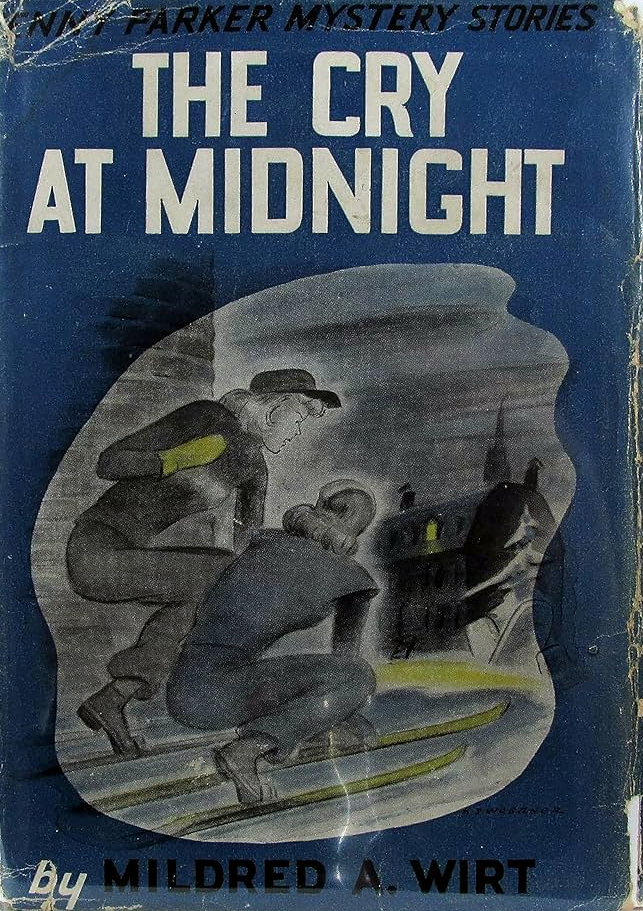
Penny Parker Mystery Stories No. 17 - The Cry at Midnight

And at long last, we've reached the seventeenth and final Penny Parker Mystery Story.  It is a bittersweet feeling, because I've been anxious to see just how this series was going to end, while at the same time, I'm disappointed to have reached the final Penny Parker story.  A seventeen-book series that was published from 1939 to 1947 at two each year (except for 1945, in which only one Penny Parker book was published), the series has offered up some very interesting stories that gradually became more and more dark and intense as the it progressed.  This final book has probably the darkest story in it, and one has to wonder if perhaps the story is a reflection of everything the author had experienced in the years leading up to the printing of this last volume.

The Cry at Midnight opens with a somewhat cheerful winter scene, as Penny Parker and her (boy) friend, Jerry Livingston, are getting ready to ski down the slops of Knob Hill.  Now, anyone familiar with series books from this era, and more certainly, anyone familiar with Mildred Wirt Benson's work is going to stop right here and say:  Knob Hill?  Where have I heard that name before?  Well, it just so happens that the final book in the Penny Nichols series, written by Benson under her pseudonym Joan Clark, was titled The Knob Hill Mystery (you can read my review of that book by clicking on the link).  The Knob Hill in that book was not a hill for skiing, however, nor was the mystery set in the dead of winter; however, it did feature a youngster who was being held captive in a house, similar to the captives in this book.  I suppose it is fitting that Benson ended both of her "Penny" series with a mystery set on or around a place named "Knob Hill."

The story takes a darker, more gothic tone as Penny and her best friend, Louise Sidell, are walking back to their car when they pass by the supposedly haunted Abbington Monastery and they hear a "shrill, piercing scream" from inside the monastery (p. 7).  This, of course, immediately piques Penny's interest, as she immediately sees there is a story to be uncovered here.  The monastery is described as a "structure of moldy stone enclosed by a high brick wall" with a graveyard just inside the wall (p. 4), and that there is a "deserted garden beyond the gatehouse" where "several statues [are] covered with soft white shrouds" (p. 6), giving the reader an imagery of ghostly figures.  When they discover the gate is open, Penny convinces Louise to go inside, where they meet "a grotesque, deformed human figure," and they see "silhouetted against the gray stone walls ... a hulk of a man with a large head and twisted back made unsightly by a hump" (p. 10).  The man who now owns the monastery, when he first appears, is said to be a "very tall man" wearing a "dark hooded robe" (p. 12).  These details are clearly intended to set the mood for the story - a dark, foreboding house inhabited by cloaked and grotesque individuals, which definitely provide the set-up for a good gothic tale!

Jay Highland, who calls himself Father Benedict (p. 14) tells Penny and Louise that he has no secrets within the halls of the monastery, and the only thing they will find are "serene faith and hope for a better world" (p. 14).  Penny has seen enough charlatans by this point to recognize one, and it is obvious to her something is not right here.  And one has to smile at the author's choice of names for the Father - "Benedict" could easily be a reference to the Benedictine monks who used to live in Abingdon Abbey (which is the name of the REAL abbey located in Oxfordshire, founded in 675 AD and dis-established in 1538 - like the Abbington Monastery in this book, the real Abingdon Abbey has some walls and buildings remaining, but a number of the buildings have only a few physical remains on the land).  

From here, Benson introduces another character into the story, who may be a greater mystery than the scream at the monastery.  As Penny and Louise are driving home, Penny nearly hits a young girl walking down the road with a suitcase (p. 16).  They have to literally beg her to get her to enter the car and allow them to give her a ride (but not before they debate the safety of picking up a hitchhiker on page 17 - which is a funny coincidence, as part of the mystery in that last Penny Nichols book also involves a hitchhiker, only in that story, it is a male, not a female), and she refuses to disclose any personal information, including her own name.  She insists she be let out on the docks in Riverview, and it is there that she disappears right at the river's edge (p. 23).

Well, yet another mystery falls into Penny's lap when she gets home to find her father meeting with James Ayling, an investigator for the Barnes Mutual Insurance Company (p. 30).  It seems that one Mrs. Hawthorne and her granddaughter Rhoda have gone missing, and the insurance company is concerned about the extremely valuable star sapphire that they insure - they are afraid she may lose or give away the cursed jewel, leaving the insurance company to pay out!  And, yes, the jewel does come with a curse.  According to the story the star sapphire was set in a necklace worn by a king who met a violent death; since that time, every owner thereafter has had bad luck, with several of them dying in strange ways (p. 31).  Mr. Ayling is worried the older woman may believe in the curse and get rid of the jewel.  Now, this whole segment of the mystery definitely has some interesting things to point out.  First, it is said Mrs. Hawthorne's husband was Nathaniel Hawthorne!  You may recognize that name as the great American novelist and short story writer (1804-1864). What's more coincidental is the real Nathaniel Hawthorne wrote House of Seven Gables while living just outside of Lenox, Massachusetts, a city that was settled by one Jonathan Hinsdale, whose daughter's name was ... Rhoda!  And if that weren't enough, a little digging reveals that the real Hawthorne had a cousin whose name was Rhoda Campbell Morgan (1819-1867)!  Whether Benson used these names because she was aware of the connection, or whether it is simply one huge coincidence, I suppose will remain an unsolved mystery...  And, with regard to the "cursed" sapphire, it turns out there really was a star sapphire with a supposed curse to it.  The Delhi Sapphire is sad to have brought terrible misfortune and financial ruin to anyone who possessed it!

Penny's intuition serves her well in this story, as Father Benedict is easily seen by the reader as a charlatan.  While he proclaims his followers lead lives of poverty, with no desire for worldly possessions, Penny and Louise discover his office within the monastery is furnished with "thick velvet carpet ... a large mahogany desk, a sofa, two easy chairs, and a cabinet filled with fine glassware, gold and silver objects, and a blue glass decanter of wine" (p. 40).  He then informs the girls that collecting art treasures is a hobby of his, explaining the decanter "is a piece of Ching-Hoa porcelain and very rare," while also showing them a Byzantine amulet and golden goblets recovered from a European church destroyed a century ago (p. 42).  But the clincher is when Penny spots the crystal ball supported by the claws of a bronze dragon (p. 40).  One might remember in the very first Penny Parker mystery, Tale of the Witch Doll, features a medium who is scamming people.  Thus, when Father Benedict suggests Penny stare deep into the glass (the frontis piece!), she sees nothing at all (p. 44-45).  Father Benedict says she simply does not believe, to which Penny quips, "Guess I haven't got enough of the witch in me" (p. 45)!   This is one of my favorite things of the Penny Parker series - Benson gave Penny some sarcastic wit that comes out to play now and again and is a joy to read!

While the mystery is not really too hard to figure out (I mean, come on, who didn't immediately figure out that the young girl walking down the street, away from the monastery, was actually Rhoda?), it is following along with Penny as she figures it all out that is half the fun.  And the gothic elements abound within the story - there is a closet that offers a peep hole that allows one to spy into the chapel room (p. 144); there is a secret tunnel from the basement to the graveyard (p. 81); a lift that lowers the canopied bed in the chapel room own into the cellar by secret mechanism (p. 113); and even a crazy old woman (p. 13) who continually warns Penny away from the monastery (p. 38), but who ultimately aids her in her quest to uncover the truth about what is going on at the monastery!  This story could easily transition into one of the gothic novels published in the 1960s and '70s that populated bookstore shelves so heavily during that time.  It has the perfect premise and setting, that's for sure!

One final observation in this book concerns the ceremony given by Father Benedict.  While he starts the ceremony by chanting in Latin, he also recites a somewhat lengthy quote (p. 133) from The Monastery, a novel by Sir Walter Scott published in 1820.  He is reciting a quote of the White Lady from the novel, a character that is a supernatural figure who guides some of the other characters in the story.  Scott's novel, as clear from the title, is centered on a monastery that is based on the real Melrose Abbey in southeast Scotland.  I would love to know what promptly Benson to use this quote for the story, and whether Scott's novel itself gave her some inspiration for the final Penny Parker mystery!

While not the strongest mystery in this series, I would have to say that The Cry at Midnight provides readers with a satisfying conclusion to the Penny Parker Mystery Stories.  That final statement by Penny on page 207 pretty much sums up her future, had the series continued:  "Writing this story will be duck soup compared to digging up the material.  Just lead me to a typewriter!"  And with that, the stories of plucky teen-sleuth Penny Parker came to an end, and we are left with a legacy of great stories by which we will always remember her!

RATING:  9 cheap silver colored rings with a red glass tone out of 10 for sending Penny Parker off into the annals of history with a solid, 17-book legacy that could truly be enjoyed by fans of any age in any decade!