Showing posts with label Mildred Wirt. Show all posts

Thursday, September 24, 2026

The Brownie Scouts at Silver Beach - Book Five of the Brownie Scout Books

It's a week at the beach for the Brownies in Mildred Wirt's fifth Brownie Scouts adventure (I hesitate to call this a "mystery" series, as the books are more about the young girls' adventures and learning experiences than they are about the actual mystery aspect of the stories).  I have to admit, this series has been a much more enjoyable read than I had originally anticipated.  A series about a group of pre-teen girls who are enjoying outings as Brownie Scouts did not exactly scream out to me as readable stories, and the only reason I actually bought them was because (a) they were all purchased relatively cheap, with their dust jackets in tact, and (b) it was another Mildred Wirt series.  I just assumed they would sit on my shelves, unread.  But, when a friend suggested I read and post about them, I thought, "Why not?"  And, quite frankly, I'm glad I did.
 
The Brownie Scouts at Silver Beach finds out favorite little Brownies enjoying the sun and fun at Silver Beach, said to be "along the Atlantic Coast" (p. 3).  Veve (whose spelling is changed to "Vevi" in this book for some reason) McGuire and Connie Williams are once again front and center in the story, with Jane Tuttle, Sunny Davidson, and Rosemary Fritche rounding out the troop.  Miss Gordon, the troop leader, is, of course, on the scene, as is Mrs. Williams, Connie's mother, who is helping to chaperone the girls.  Vevi and Connie are bunked with Mrs. Williams in the rental, Starfish Cottage, while the other girls are staying with Miss Gordon in a "vine-covered cottage overlooking Silver Beach" (p. 3) that the troop leader owns.  By the end of the first chapter, we get the beginnings of a mystery, when Miss Gordon's watch, which she left in the pocket of her beach robe with the rest of the troop's belongings on the sandy beach while they enjoyed the ocean water, is stolen!
 
Readers quickly learn there have been other thefts recently in that area of the beach, which has caused a number of summer visitors to migrate over to the beach belonging to a nearby hotel.  That mystery, however, is put to the side as the girls begin to explore the beach, discover shells, discuss the various types of water birds seen in the area, watch a turtle race, and discover a small house built to look like a ship not far from their cottages.  Along the way, Vevi and Connie get lost in the fog (which is when they stumble across the ship-shaped cottage and discover another mystery - who is using the small house as a place to stay?), the girls have fun adventures trying to catch a turtle so they can enter the next turtle race, they collect shells so that they can put together and showcase a shell display, and they learn all about carrier pigeons, with Vevi nearly getting her very own pigeon that she names Snow White!  And during all of these fun activities, the girls also hear about more thefts and inadvertently witness the thief on more than one occasion attempting to steal items from tourists who are visiting the beach.  Even worse, poor Vevi and Connie wind up on a boat put adrift at sea, with no one knowing where they are!
 
The mysteries, as usual, are not overly complicated, nor are they difficult to solve (at least, for the discerning reader).  The identity of the thief is not at all hard to spot, pretty much from the get-go.  The identity of the person using the ship-shaped cottage is also easy to figure out, as Wirt does not make it hard to see where the story is going.  The mixture of the two lifeguards, the former ship captain, the young boy whose father is a lifeguard at the other hotel, and the man who handles the homing pigeons are fairly straight-forward characters who may be able to hide all of their secrets from the Brownie Scouts, but none of them are so subtle that even a casual reader could not spot them a mile away.  None of that detracts from the enjoyment of the story, though - it's not about actually solving the mysteries; rather, it's more about following along with Vevi, Connie, and the other Brownies as they hop from one exciting escapade to another.
 
Wirt casually included a moment in the story that is definitely a very valuable teaching lesson for young children.  When Vevi and Connie venture out to find Cabell's pond, where there are said to be lots of turtles to be found, a layer of mist begins to roll in from the ocean as dusk draws near.  As they are walking, a "driver stopped for a moment offering the girls a ride.  Vevi and Connie did not know him, so they turned down the offer" (p. 23).  A shining example of the old maxim, "never get in a car with a stranger."  I smiled when I read these lines, thinking how smart Wirt was to integrate a moral lesson into the story without making it overly obvious and beating you over the head with it.  One has to wonder how many children read this back in the day and took this lesson to heart.
 
There is another scene, however, that caught my attention more than the "stranger danger" scenario.  When Miss Gordon and Mrs. Williams take the girls to Brant's Point for a picnic and for an opportunity to search for more shells, the tide starts to come in before they realize it, and soon enough, Mrs. Williams' car is stuck in the sand, unable to get any traction.  As the tide gets closer and closer, my mind kept telling me, "I've read this scene before - but where?"  Thanks to the memory of a very good friend, I found it - in Wirt's Penny Parker mystery, Voice from the Cave.  In that book, Penny and Louise are on a beach near a lighthouse (same as the Brownies are in this book), and like the Scouts, Penny's car gets stuck and the high tide keeps coming in with no help in sight.  The similarities do not stop there:
 
PP 95 - "Even if the car isn't washed away, the salt water will ruin it."
BS 88 - "Salt water ruins a car very easily ... We must get out somehow."
 
PP 95 - The motor began to labor.  Then the car stalled completely.
BS 85-86 - Slower and slower crept the car, its engine laboring ... The car would not budge...
 
PP 95 - "I'll run to the lighthouse," Penny decided desperately...
BS 88 - She glanced hopefully toward the lighthouse.  Connie offered ro un there and ask for help.
 
PP 97 - Penny and Louise seek help from a man they know who is wading through the reef; he sees them, but he turns and walks away
BS 90 - The Brownies seek help from a lifeguard they see in a boat out in the ocean; he sees them, but he turns and speed away in his boat
 
PP 99 - Jerry Livingston shows up on the beach and helps the girls push the car out of the sand
BS 91 - Captain Tarwell shows up on the beach and helps the girls push the car out of the sand
 
The scenes so closely resemble one another, only the names have been changed and some of the wording.  As the Penny Parker book was published in 1944, and this one in 1952, so perhaps Wirt "borrowed" the scene from the earlier book with the thought that readers of this particular book (who would be younger than the intended audience of the Penny Parker book published eight years prior) would not recognize the passage.  (Wirt seems to have had no problem in lifting scenes from previously published books of hers and retooling them into later stories - her Madge Sterling series provided her with a plethora of scenes that she later used in her Penny Parker books, her Mystery Stories for Girls books, and others.)
 
Marguerite Gayer provided both the cover art and interior illustration (the frontis piece being the only interior art) for this book.  The cover art actually depicts a scene related to the mystery surrounding the thefts at the beach, as the girls find a stolen purse buried in the sand (p. 146).  Meanwhile, the interior illustration merely shows the scene where Vevi and Connie happen across the small cottage in the mist while trying to find the pond (p. 34).
 
RATING:  8 dusty old Bibles out of 10 for keeping the Brownies faithful to their code, always helping others, while also learning about nature and valuable lessons at the same time.

Saturday, August 22, 2026

The Brownie Scouts and Their Tree House - Book Four of the Brownie Scout Books

After the hints of what was to come with the third book, I have to admit that I was very disappointed with what took place in this fourth entry in the Brownie Scouts series by Mildred A. Wirt (Benson).  For those who read the last book, the Scouts were voted to be Rosedale's representatives in Washington, D.C. after being elected as the "queens" of the cherry festival, and as the story ended, the Scouts were all excited about heading to Washington and the opportunity to meet the President of the United States!  Since the book ended with this huge announcement, it would only stand to reason the next book would share with readers that fantastic trip!  But, alas, such is not the case.  I wonder if, back in 1951 when this book was published, those young readers who bought this book (or, perhaps, were given this book) opened up the pages to the first chapter and discovered that this book has absolutely nothing to do with the Scouts' trip to Washington!  Somehow, it feels like Wirt cheated her readers out of what could have been a very exciting story...
 
The Brownie Scouts and Their Tree House, instead, focuses on the mysterious tree house that the girls discover built in the limbs of a sturdy tree within the metropolitan national part in Rosedale. Wirt opens the book with the girls exploring the various trees of the part, only to discover that the signs identifying the types of trees do not match what the girls and their scout leader know the trees to be.  Someone has been messing with the signs - but who could it be, and why? That mystery is soon forgotten when Veve McGuire wishes that the brownies (fairies) on which the name of their group is based would provide them with a tree house that they could enjoy whenever they visited the park.  Oddly enough, a stone is thrown at them, which bears an odd message - come back in two days to see if her wish comes true!  No one actually believes it will happen - but sure enough, when the girls come back in two days, there is a tree house built right there in the limbs of the very tree where they stood and made the wish!  Thus, the second mystery takes root (see what I did there?), and the Brownies have two questions before them - who is messing with all the signs around the park, and who built their tree house?
 
Wirt does not make the mysteries complicated, and the reader is easily able to discern who is doing what throughout the course of the story.  Even when more wishes are granted (furniture in the house, a warm meal cooked on a cold afternoon, etc.), the girls remain oblivious to the identity of their benefactor (even though they meet him during their many trips to the park).  And, with all of this going on, Wirt manages to throw in a third mystery involving Minnie Myles, an old woman who comes into the park with an empty sack, but leaves with it full.  The girls soon discover that she is extremely poor and about to lose her house - the one person who can help her is her brother, but she refuses to allow it, choosing rather to go to the poor house than to accept a dime from him!  Connie, Veve, and the rest of the Brownies decide they have to help the poor woman before she is thrown out on the street!
 
While Wirt tries to keep the mysteries an integral part of the story, it reads more like a Brownies' adventure tale than a mystery story.  The girls take no real active part in tracking down clues or unlocking secrets in an effort to solve the mysteries; instead, their story involves surviving a storm in the tree house, collecting buttons, figuring out ways to provide food to Mrs. Myles, and the farewell ceremony for Eileen, as she "flies up" to the Rosedale Girl Scout Troop (having aged out of the Brownies).  Yes, all three mysteries get resolved, but very little of those resolutions have anything to do with the Brownies.  In fact, the only one that has any input by the Brownies is the secret that has kept Mrs. Myles from accepting help from her brother - a resentment that gets resolved when Veve buys a pillow from the auction of Mrs. Myles' home that turns out to hold the very thing that clears up a misunderstanding and reunites Mrs. Myles an her brother after all these years.
 
For those who read the previous book, you'll recall Wirt described a number of different quilts that the girls obtained for their quilt show; well, in this book, it's all about collecting old and unusual buttons - from embroidered taffeta buttons made in a star pattern (p. 79) to opaque glass buttons (p. 80) to a coat cuff button in the shape of a horse head (p. 80) to a tintype button popular in the Victorian time (p. 87) to a glass swirlback button, a Czechoslovakian button, and an old Sheffield silver button (p. 164).  Just as Veve was the last one to find a quilt in the prior story, she is the last one to locate a button in this one.
 
Wirt does not forget to include some Brownie and Girl Scout history within the book.  In the first chapter, we get a very brief re-telling of The Brownies, the 1865 story written by Juliana Horatia Ewing (incorrectly identified as "Julianna" in the book) from which the organization took its name (p. 7).  Near the end, when Eileen is inducted into the Girl Scouts, she must recite the Girl Scout Promise (p. 193), which is almost identical to the actual promise one can find at the Girl Scouts website (Girl Scouts Promise).  The Girl Scout Law (which can be found at that same website) is set forth rather differently in the book (p. 194); however, that could have been what is was back in 1951, or it could simply be Wirt taking some artistic liberties in setting forth the characteristics of a Scout.  In either event, Wirt makes an effort to keep her Scout stories grounded with some real Scout history.
 
Marguerite Gayer continues to provide the cover art (her signature is clearly seen on the bottom right hand corner of the cover).  The internal frontis piece does not contain a signature, but it appears to have the same style as Gayer's previous internal illustrations for this series, so one can assume that she also did the internal, as well as the cover. 
 
While not my favorite book in the series (that would be The Cherry Festival volume), this one does have its merit and is a fairly enjoyable read, particularly when one considers the age of the audience for which the book was originally intended.
 
RATING:  7 neat piles of wood and kindling out of 10 for a smidgen of excitement (during the storm), a small bit of drama (with Mrs. Myles' situation), and a successful family reunion!

Monday, July 20, 2026

The Brownie Scouts in the Cherry Festival - Book Three of the Brownie Scout Books

With this third book, we reach the half-way point of The Brownie Scouts series written by Mildred A. Wirt (Benson).  As Wirt progresses with the series, she is starting to give the girls some more distinct personalities and develop the characters into more than just cookie-cutouts hanging around in the background while the main two (Veve and Connie) take up all the screen time.  In fact, with this third book, Veve McGuire actually moves more into the spotlight, with Connie taking a more supporting role.  Jane Tuttle and Eileen Webber actually have more involvement than in previous stories, and even Rosemary Fritche and Sunny Davidson speak more than just a few lines.  This story actually gives readers a well-rounded group of Brownie Scouts, with all of them involved, in some fashion or another, with the overall story.
 
The Brownie Scouts in the Cherry Festival opens not with any plans for a cherry festival, but rather, with the girls absorbed with the tedious task of sewing blocks for a "crazy quilt" that the troop is making in order to auction it off to raise money for their group.  However, as anyone can imagine, these fourth-grade girls are not overly thrilled with spending every troop meeting sewing, sewing, and more sewing.  Veve, who is, of course, the first one to voice her dissatisfaction with the project, eagerly sets about finding a way for the girls to earn money faster and easier - and she finds it with an ad in the paper looking for people willing to pick cherries!  Before you can blink your eye, Veve and Connie - two fourth-graders, mind you! - take the bus by themselves to a cherry orchard outside the city limits to ask if they, along with the rest of their scout troop, could get a job as cherry pickers.  Right.  Because every parent would willingly let their 9 to 10 year old child go off by themselves with no adult supervision to try and get a job.  Makes perfect sense.
 
Anyway, suspending that disbelief for the time being, the girls end up meeting the vile Carl Wingate, who is berating a young Mexican boy when the girls first walk up.  He rudely tells them he does not hire inexperienced children and tells them to get lost.  As luck would have it (and when do these series book characters not have luck?), Veve and Connie see a sign at the orchard right across the street that says the owner of that farm is looking for pickers.  Pa Hooper is much nicer and, in fact, is greatly appreciative of the help the girls offer him, as he has been unable to get pickers due to Wingate underhandedly monopolizing all of the hired help for the season.  Thus, the Brownie Scouts find themselves waking up early each day to pick cherries (for one-and-a-half cents per pound!) in order to earn money for their group.  And this is where their adventures begin.
 
The first mystery seems to be what happened to the Brownies' quilt that disappears from Pa Hooper's grounds, where Miss Gordon had brought it to show the girls the completed product.  It disappeared without a trace!  The second mystery is discovered by Veve, who learns that Pa Hooper is going to lose his orchard to his cousin, Carl Wingate (that's right - turns out they are cousins!), all because of a second will that Wingate claims to have found.  Pa believes it is a forgery, but he cannot find anything with his sister's signature on it to prove it is a fake.  Thus, Veve makes it her mission to find that needed evidence!  The first mystery is solved fairly quickly (as it turns out the missing quilt was not stolen as originally thought, but found by someone who did not realize it belonged to the Brownies).  The second mystery, however, takes quite literally until the last few pages to reveal the solution - and although an intelligent reader will see that solution pretty early on, I give Wirt credit for coming with a rather ingenious way to provide the sister's needed signature.
 
Wirt goes into quite a bit of details about the various types of patterns used in quilting, as well as the various types of stitching and the manner in which the final quilt if put together.  While the girls put together a "crazy" quilt (one made of block of various shape, color, and size, sometimes even with various styles of stitching), there are references to numerous other patterns, such as "the Hand of Friendship," the "Pine Cone", and the "Album" (p. 5); the "Sunburst" pattern (p. 7) and the "Sawtooth" pattern (p. 16); an "Evening Star" pattern, as well as a "Pine Tree" design (p. 65); there is also a "dogwood blossom" quilt (p. 68) and one with a "Ship's Wheel" pattern (p. 76), as well as one with a pattern called "Duck's Foot in the Mud" (p. 101); and, finally, there is the most important quilt of them all - an old, faded quilt, which provides the girls with an example of an "Autograph Patch" quilt (p. 108).  It is this last quilt that provides the girls with the solution to their second mystery and helps Pa Hooper save his orchard.
 
The story also deals with a rather dark theme involving bigotry and how Mexican workers were seen and treated by people.  Veve befriends a young boy named Juan, whose family and other Mexican migrants are working for the wicked Carl Wingate.  Veve and her friends see first hand how the Mexicans are treated poorly and denied access to public areas, simply because of who the are.  I thought Wirt handled this nicely, as Veve, Connie, and the other Brownies do not see Juan or his family as any different, and they are appalled at the way the Mexicans are treated.  In the end, it is because of the Brownies that the town changes their view and welcomes the Mexicans and their traditions into the big cherry festival. 
 
Marguerite Gayer once again provides both the cover and interior art.  The cover art merely showcases the girls' work at the cherry orchard; however, the interior frontis piece actually displays the scene at the very end of the story, when the girls discover the all-important clue on the quilt that saves Pa Hooper's orchard from his conniving cousin!  It was actually rather nice to see an illustration related to the mystery, instead of simply a scene of the girls' adventures that have no relation to the mystery.  In fact, that is one thing I enjoyed more about this book than the previous two - the fact that the mystery actually plays a larger part of the story.  Sure, we've got the whole cherry picking shenanigans, and the planning of the cherry festival.  But it is the girls' wanting to find their missing quilt and their desire to help Pa Hooper save his land that makes the story truly engaging.  (And the ending seems to provide a lead-in to another story, but whether we actually get that in the next book or not, we'll have to see...)
 
RATING:  8 handsome red-and-white hand-woven blankets out of 10 for a story filled with lessons about friendship, bigotry, responsibility, and generosity - with a fun mystery added in for good measure! 

Wednesday, June 17, 2026

The Brownie Scouts in the Circus - Book Two of the Brownie Scout Books

This second book in The Brownie Scouts series by Mildred Wirt was published in 1949, the same year as the first book in the series.  This series follows the adventures of a group of young Brownie Scouts who live in the small town of Rosedale:  Connie Williams, Jane Tuttle, Rosemary Fritche, Eileen Webber, Belinda Matthews, "Sunny" Davidson, and their seventh and newest member (who joined in the first book), Veve McGuire.  As with the first book, Connie and Veve seem to be the central characters in the story, with the other five girls making random appearances, most often just having their names mentioned with no dialogue or action.  I suppose it would have been difficult to devote time to all seven girls and keep the story on track, so Wirt had to settle upon certain characters to be the focus of each book.  While Connie was in the driver's seat for the first book, she and Veve shared the spotlight in this book.
 
The Brownie Scouts in the Circus is, not surprising at all, an adventure of how the girls inadvertently find themselves a part of an actual traveling circus! However, the book actually begins with the girls preparing for their camping trip, which was alluded to at the end of the first book.  The girls must help earn money in order to purchase the tent and other items they will need for the trip, and poor Veve finds herself at a disadvantage, since her widowed mother does not make enough money for extras (it seems Veve has never even been able to purchase a Brownie uniform during the months between the first book and this book).  Thus, she looks for a way to earn money, and when they see an advertisement for a circus coming to town, they decide to put on their own circus!  Now, picture a few 7 to 10-year old girls putting together a circus in their backyard, and you can imagine how that turns out!  They do, however, manage to make a few dollars, mostly from parents and a friendly policeman who turn out to see the show.
 
Miss Gordon, the scouts' leader, manages to make another way for them to earn money, by selling tickets to the real circus! Not only are they able to make money for their camping trip, but every ten tickets they sell earns them a free ticket to see the show.  Their trip to see the circus eventually leads to the "mystery" in this book, which involves the theft of Miss Gordon's wallet (which happens to have all of the scouts' savings in it!) and her wristwatch.  Connie and Veve both saw the pickpocket and swear they can identify them if they see him again (you can guess where this will lead, can't you?).  Of course, the camping trip is not cancelled, as Miss Gordon makes up the missing money with some of her own, and the girls head out to Shady Hollow for their camping experience - and what an experience it is!
 
Wirt works in a number of mishaps and misadventures to keep the story fun and entertaining.  Once at camp, Miss Gordon allows Veve, Jane, and Eileen to make the first breakfast - which, of course, results in burnt bacon, scorched eggs, and lumpy oatmeal!  A quick trip to town ends up finding Connie and Veve seeing the circus train stopped on the railroad tracks behind the hardware store.  It wouldn't hurt to take a look in the open boxcar, right?  Before you know it, the door to the car is slammed shut, the train starts moving, and the two Brownie Scouts find themselves traveling far away from Shady Hollow, leaving Miss Gordon and their friends behind!  By the time the train stopped, they are over 100 miles away with no way to let Miss Gordon know where they are!  Fortunately, the animal trainer recognizes them from their visit to the circus in Rosedale, and he takes them under his wing while a telegram is sent to their troop leader back at the camp.
 
By now, a mature reader can easily see where the story is going and what the end result will be, and Wirt does not disappoint.   The girls make friends with a young girl their own age who does tricks on horseback for the show, and Connie and Veve are asked to take part in the show by blowing the whistle that signals the change in acts in the three rings.  This, of course, gives them the perfect opportunity to see the audience, where they just so happen to spot the pickpocket!  After a brief chase, the circus' detective snags the man, Miss Gordon gets her watch back (but not her money), and Connie and Veve are awarded $100 reward from the circus for snagging the pickpocket who has been nipping wallets from their customers for some time!  That $100 in 1949 would be worth nearly $1,400 today!  That's quite a large reward for two girls who are not even teenagers yet!
 
Wirt wraps up the story not only with the resolution of the pickpocket incident, but also with the creation of a whole new Brownie Scouts troop within the circus - a traveling scout troop!
 
The cover and interior illustration are once again provided by Marguerite Gayer.  Thanks to some helpful collectors, I was able to find some information on Ms. Gayer (who, it turns out, is Marguerite Solomon Geyer), who, it turns out, had quite the prolific career as an artist!  As far back as 1923, she was illustrating children's stories that appeared in newspapers; during the 1930s, she did illustrations for several romance pulp magazines; and in the 1940s, she illustrated several series for Cupples & Leon, including all three of Wirt's scout series:  Girl Scouts, Brownie Scouts, and Dan Carter Cub Scout.  It was for Cupples & Leon that she signed her name as "Gayer" instead of her real name of "Geyer" with an "e."  Geyer ultimately moved to Florida, where she died in 1963 in Fort Lauderdale.  Her husband passed away eight months after she did.  More information abot Geyer and her work can be found at Pulp Artists - Marguerite Geyer.
 
RATING:  7 beautiful golden coaches out of 10 for a mild-mannered mystery with mishaps, mayhem, and misadventure mixed in for good fun! 

Saturday, May 16, 2026

The Brownie Scouts at Snow Valley - Book One of the Brownie Scout Books

This is one of the few series by Mildred A. Wirt (Benson) that I have not yet read, so when a friend suggested I read it, I took her up on it!  I had heard of the Brownie Scout series before, as well as her companion series (Girl Scouts and Dan Carter, Cub Scout), and while I have all of them, I've only ever read one of them (The Girl Scouts at Mystery Mansion).  These series are aimed at a younger audience than her regular mystery series, more along the level of The Bobbsey Twins readers.  As many people are undoubtedly aware, Wirt (Benson) was the original ghostwriter for the Nancy Drew books back in the 1930s, and she went on to write quite a large number of series books over the course of more than two decades, many under her own name.  Surprisingly, she wrote a number of books for young readers (such as some of the Honey Bunch books, as well as the Dot and Dash series, in addition to those listed above).  This particular series was first published in 1949, with the first two books coming out that year, and the remaining four book coming out one a year through 1953.  So, with a little bit of curiosity and wonder as to whether these series would be as enjoyable as her mysteries for older children, I picked up the first book and gave it a read.
 
The Brownie Scouts at Snow Valley introduces readers to six young girls who make up the Brownie Scout troop of a small town named Rosedale, set in somewhere USA (the exact location of the Scouts' hometown is left rather vague, which I suppose was a purposeful way of keeping the author's stories from being limited by geographical area).  The girls include:  Connie Williams, Jane Tuttle, Rosemary Fritche, Eileen Webber, Belinda Matthews, and "Sunny" Davidson.  Of these six girls, Connie is the one who takes center stage through most of the story, with Jane, Rosemary, and Sunny coming in as supporting characters.  Other than passing mentions, we see very little of Eileen and Belinda (who are pretty much just background window dressing used to fill-out the six-girl troop).  However, there is another major character in the story, Veve McGuire.  Veve is not a Brownie Scout; however, she is a friend of the girls, but she is frustrated with her friends for spending more time with their Brownie activities than playing with her.  Rounding out the main cast is Miss Jean Gordon, "the fourth grade teacher at Rosedale School, [who] had organized the Brownies..." (p. 2).
 
This seems like a good place to stop for a moment and discuss the Brownie Scouts for a moment.  Before picking up this book, I knew nothing about "Brownie Scouts," other than the fact that they are precursors to the Girl Scouts.  Wirt does not specifically identify the age of any of the girls, but some online research reveals that Brownie Scouts are usually anywhere from ages 7 or 8 up to 12 years old (at which point, I suppose, they are old enough to join the Girl Scouts).  Since Wirt does reference Miss Gordon as being a fourth grade teacher, one can assume the six girls are likely around 9 or 10 years old (since this book takes place around Christmas time, most likely the girls are still 9 years old).  According to online sources, the Brownie Scouts do have "promises" and "laws" the same as Girl Scouts, which set forth their standards for the members.  In this book, Wirt has them singing, "We're the Brownies, here's our aim: Lend a hand and play the game!" (p. 3).  This is the actual Brownie opening song, but in the story, Wirt has the girls sing this just before their meeting breaks up and the girls leave to go home.  Later in the book, Wirt has Miss Gordon recite to the girls the "Brownie story" as originally told by Juliana Horatia Ewing (pp. 128-33).  While there are some slight variations (Wirt's version has a little girl named Mary and her brother Tommy; in Ewing's original story, Tommy is the lead character, and his brother's name is Johnnie - there is no girl), the overall story elements are the same, with the charm, "Twist me, and turn me, and show me the Elf; I looked in the water, and saw--" (p. 131), being exactly the same as recited in Ewing's tale.  To read the actual story, you can find it here:  The Brownies and Other Tales.
 
Now, with regard to the story itself, the book features two very minor mysteries - one involves someone stealing trees from the property near the Gordons' home in Snow Valley where the girls go for the Christmas holidays, and the other involves a missing locket that Grandmother Gordon claims was stolen by a poor woman who used to be her housekeeper and cook.  These mysteries do not actually come into play until nearly half-way through the book, when the girls are taken to Snow Valley by their troop leader, whose grandparents have opened up their home to the girls.  The first half of the book is merely the adventures (or in poor Veve's case, MISadventures!) of the girls as they get ready for their Christmas break and enjoy what little snow the small town has.  Veve lucks out and is able to join the girls on their trip when Belinda falls ill at the last moment.  The poor girl seems to be a trouble magnet, as she spills water on a fellow train traveler, then that same man steps on her jacks when she accidentally loses them in the aisle; later, at a train stop, she forgets her purse in the depot diner and nearly misses the train!  Connie continually defends her friend, even when some of the other girls grow weary of Veve's mishaps.  Once the girls arrive in Snow Valley, though, the focus shifts to the mysteries.
 
The Stone family live in a nearby cabin and are very poor, so the girls come up with the idea to pool their money to buy the Stone children a brand new sled for Christmas and provide the family with some food for the holiday.  This is when they learn from Grandmother Gordon that Mrs. Stone used to be the Gordon's housekeeper, and Grandmother believes she stole a precious locket.  The Brownies are determined to find the missing locket and exonerate Mrs. Stone.  At the same time, a neighboring property that is filled with a plethora of pine trees, is the subject of numerous thefts, as someone is chopping down trees and sneaking them off the property.  Poor Mr. Stone is blamed, since he is out of work and has been seen walking down the street with an ax in his hand; but when Connie points out they saw another man from town with an ax, the accuser backs down.  Ultimately, both mysteries are solved - the girls have no hand in the resolution of the stolen tree mystery; however, Connie is the one to uncover the whereabouts of the locket, requiring Grandmother Gordon to apologize for her suspicions of Mrs. Stone and re-hire her as the Gordons' housekeeper. As one might expect, it is a very happy conclusion, as all mysteries are solved, the girls' families arrive in Snow Valley on Christmas Eve night despite a horrible snow storm, and the Stone family is included in the Christmas celebration.
 
There is an interesting bit of information in the story about snowflakes, as Miss Gordon gives the girls some facts about various types of snowflakes, how they are formed, and why they are white (pp. 67-69).  She tells them how the hexagonal shape is "fairly common," while three-sided snowflakes are "considered rare" (p. 68).  I had never heard of three-sided snowflakes before, so even I learned something new from this book.  Some quick research reveals that three-sided flakes form due to special aerodynamic  - when a crystal tips in the air, causing two sides to grow faster than the others, creating the triangular shape.  Thus, like so many of the Stratemeyer series books, one can learn new information even from a non-Stratemeyer series such as this!
 
One thing I found rather amusing was that Wirt included a recipe for brownies in the book!  While preparing goodies for the upcoming Christmas holiday, Miss Gordon allows several of the girls (Veve, Connie, and Rosemary) to assist her.  At the bottom of page 155, Wirt includes all of the ingredients one would need to make a batch of brownies (which, oddly enough, Miss Gordon indicates are a type of cookies!).  I have to wonder how many children who read this book back when it originally was published asked their mothers to allow them to make brownies based on this recipe?! 
 
The book has a dedication at the beginning to "MRS. ELEANOR T. GIBSON, Executive Director of the Toledo Girl Scouts, in appreciation of her helpfulness and cooperation."  This would explain the accuracy of the Brownie Scout information, songs, and stories within the book.
 
As a final observation, at the conclusion of the story, Wirt references a trip the girls will take in the summer to a camp, making specific reference to the next book in the series, "The Brownie Scouts in the Circus" (p. 198).  What is unique, though, is that right after this reference, Wirt adds:
And for boys, also interested in cam life and the out-of-doors, there is a book called: "Dan Carter, Cub Scout."  (pp. 198-99).
I can't say that I can recall ever reading a series book that offers up an ad for another series by the same author like this!
 
The art, for both the cover and the interior frontis piece, was provided by Marguerite Gayer (her signature appears on the art and illustration).  What is strange is that I cannot really find anything about the artist online.  The only thing I could find was an illustrated page that Gayer had obviously done for another book, which features a little boy and a dog enjoying a picnic outside.  Thus, it is clear Gayer illustrated other children's books, outside of her work on the Brownie Scouts series, so it is surprising there is next to no information to find about her online.  I have put some feelers out there, so we will see what we can turn up on Ms. Gayer!
 
I'll readily admit that I did enjoy the story.  It was an easy read, and the characters and situations were fun.  Wirt has a way with making her characters come to life, so that you get drawn into their adventures and mishaps without even realizing it!  I'm looking forward to reading the remaining five books in this series. 

RATING:  9 lost luggage bags out of 10 for a fun-filled romp with some cute new characters as they experience plenty of misadventures in the snow! 

Thursday, March 5, 2026

Will the Real Carolyn Keene Please Stand Up - the Lives of the Creators of Nancy Drew

When I stumbled across this on Amazon.com, I was not sure if I really wanted to buy it.  After all, there are already a number of books out there about the "creators" of Nancy Drew - ones that focus on the Stratemeyer Syndicate itself, others that focus on Mildred Wirt Benson, and some that focus on the evolution and impact of the character, Nancy Drew.  Did I really need another one?  And I had no knowledge of the author, Christine Keleny, other than the brief information provided on Amazon about her.  So, I debated back and forth, but I finally listened to that insistent voice in the back of my mind that kept saying, "if you want all things Nancy Drew related, then you must have this," and I bought it.  Took me a bit before I finally picked it up and read it, but now, I can honestly say, I am so thoroughly glad I bought it, because this book is not just another analytical study of the individuals who created and wrote Nancy Drew - no, this book is actually a well-written, well-researched prose biography of the three people who had the most influence in the character of Nancy Drew - Edward Stratemeyer, his daughter Harriet, and his young ghostwriter, Mildred Wirt!
 
Will The Real Carolyn Keene Please Stand Up gives fans a fresh new look at the history of Nancy Drew's creation. For a character that has been around for nearly 100 years, with new stories continuously published over the course of those nearly ten decades, Nancy Drew has had plenty of books look at her creators, her longevity, her enduring appeal, her pop icon status, and just about every other aspect you can think of as it relates to the girl detective.  Authors like Melanie Rehak, Michael G. Cornelius, Carolyn Carpan, Bobbie Ann Mason, LuElla D'Amico, Emily Hamilton-Honey, Geoffrey S. Lapin, and many others have offered so much insight over the years with books, essays, and countless hours of research on the subject of Nancy Drew and her creation; yet, surprisingly, in all of that time, not once has there ever been a historical look at those creators told in a prose, biographical fashion.  Until now.  Author Christine Keleny (Christine Keleny Books) is not only a writer, but she is also an editor, book designer, and publisher, whose works cross into historical fiction, mystery, adventure, and memoir.  This particular book, while offering well researched biographies on Stratemeyer, Adams, and Wirt-Benson, is also infused with a certain level of historical fiction - since a lot of the conversations and character-thoughts expressed throughout the book are not necessarily factual - but based on everything we knew about these three, they very well could be!
 
Keleny opens her book in the most obvious place - the now-infamous 1980 trial that resulted from the lawsuit filed by Grosset & Dunlap against the Stratemeyer Syndicate and Simon & Schuster over the rights to Nancy Drew, Hardy Boys, and the numerous other series G&D had been publishing for the Syndicate for more than half-a-century.  An aging Harriet Stratemeyer Adams is on the stand, being questioned regarding the creation of Nancy Drew and the books' original author, which sends Adams on a trip down memory lane ... a trip that the reader gets to follow as we turn back the pages of time to 1887, when a young Edward Stratemeyer is striving to become an author, feeling it in is veins, despite his father's and brother's attempts to dissuade him to pick a more steady career.  The book progresses at a fairly fast rate, as we jump ahead one, two, three, or even more years at a time, following Edward as he meets his wife ... as he begins selling his stories ... as he has two daughters ... as his books become so popular he creates a syndicate of writers to help him get his ideas into book form faster.  We read how the twentieth century saw a huge rise in the success of his children's series - The Rover Boys, The Bobbsey Twins, Tom Swift, Ruth Fielding, and many others, eventually leading to 1927 and the publication of The Hardy Boys.  This, as we all know, led to his creation of a companion series for girls, a girl detective that only one person could write - a young ghostwriter who had taken over the Ruth Fielding series for his Syndicate - Mildred Augustine Wirt.
 
Keleny alternates between the various players.  Some chapters focus on Edward, while others look at what Mildred was doing, while others take a look at Harriet and her sister, Edna.  Keleny's story is so well-written, that the reader can visually picture each of the characters as they act and speak on the page, and honestly, this would transition so beautifully into a movie, or even a television mini-series.  Edward, Harriet, and Mildred are all developed far beyond their typical "this is what research tells us about them" found in most books; instead, we get living, breathing characters with emotions, with hopes and dreams, with frustrations and losses, with times of happiness and times of mourning.  Yes, the scenes portrayed throughout the book come from the Stratemeyer Records on file with the New York Public Library ... from the Iowa Women's Archives at the University of Iowa ... from researchers such as Geoffrey S. Lapin (to whom the author credits having done considerable work to uncover Wirt's connection as the original author of the Nancy Drew books) and James Keeline ... and to the descendants of the Stratemeyer family itself ... however, they are expressed through a prose tale that draws the reader in until, just like the children's series that are the subject matter of these individuals, he or she cannot help but turn page after page after page to see what is going to happen next!
 
The one thing I think Keleny does perfectly with this book is acknowledge the fact that there was never just "one" Carolyn Keene.  Sure, Edward Stratemeyer created the idea and the initial outlines for the Nancy Drew series.  Sure, Mildred Wirt (Benson) wrote the original books in the series.  Sure, Harriet Stratemeyer Adams took over the character and molded her into the later image that so many adults today remember her as.  Yet, it was not just one of these three that "created" Nancy Drew; rather, it was the amalgamation of all three - Stratemeyer, Wirt, and Adams - that ultimately defined Nancy Drew and gave her the characteristics and charisma that has helped her endure for nearly 100 years non-stop.  While so many other series fell away, many long forgotten - Nancy Drew is still at the forefront, still recognized as the quintessential girl detective (let's face it - any book, any movie, any television show that features a female detective will always make at least one, if nor more, reference to Nancy Drew).  And this book is the perfect story of how these three individuals, in their own special ways, combined to make (literally!) the world's greatest amateur female detective.
 
Now, for all this praise (and I really did enjoy the book!), that's not to say it's perfect.  It is always a bit off-putting when I come across grammatical errors or misspellings in a published book - and this book had a number of them.  When talking about the gala thrown by Simon & Schuster after they took over publication of the Stratemeyer properties, it states, "[w]asn't Nancy's popularity proven at the gala 15th anniversary party put on by Simon & Schuster for Nancy Drew..." (p. 5).  This was actually referring to the 50th anniversary gala. Later, when we read about Edward acting out a story he is writing, his wife "knew that this roll-playing was important to Edward..." (p. 20).  I believe the author meant "role" playing.  These are only a couple - there are others that could be listed, but it is a reminder that books are no longer edited with precision as they used to be.  While these are small things, and they don't make the book any less readable, they do (for me, at least) present a jarring moment, at which I'm taken out of the story as my mind immediately focuses on the error.
 
As an aside, Keleny does throw in a moment of Hardy Boys history for us, as she gives us a few pages of Leslie McFarlane and his first communications with Stratemeyer (pp. 108 - 114), which ultimately led to his taking on the Hardy Boys books, and later, the first few Dana Girls stories.  There are also moments with members of the Garis family, as well as the addition of Andrew Svenson as a partner of the Syndicate.  Thus, the author gives readers a well-rounded story of everything that was going on in the lives of these three creators, and how it all impacted their work on, and in Harriet's case, her utter devotion to Nancy Drew.
 
Who was the real Carolyn Keene?  Well, once you read this book, I believe you will be in a much stronger position to answer that question, and you will be sparked to delve deeper and do your own research and studies to get a better understanding of everything (and everyone!) that went into creating our favorite teen detective!  Is every word of this book true, and did every thing that is described in this book actually take place the way it is written here?  Probably not.  But that does not in any way lessen this book's value in the annals of Nancy Drew studies, and it certainly should not detract from anyone's enjoyment in reading the story.  
 
RATING:  10 last ditch attempts to sell the Syndicate out of 10 for a well-researched, superbly written story of the lives, loves, hardships, and successes of the three individuals who, in one way or another, created Nancy Drew.

Saturday, October 18, 2025

Flash Evans, Camera News Hawk (Flash Evans #2)

Alas, with the second book in the Flash Evans series, we come to the end of this short-lived series by famed Nancy Drew ghostwriter, Mildred Wirt Benson (writing under the pseudonym Frank Bell).  It's rather a shame this series did not last beyond these first two books, as the stories are quite exciting, fast-paced, and filled with both mystery and adventure.  Benson definitely pulled out all of the stops in this series, constantly putting her title character in some of the most dangerous (and outrageous!) situations; yet, like any good, plucky series book hero, he always manages to come out of each scrape pretty much unscathed.  Both books are great reads, and even for those who are not necessarily fans of boys' series books (like me!), the stories are very enjoyable, and I would definitely recommend them.
 
Flash Evans, Camera News Hawk
is set nine months after the events in the first book, and Jimmy, or "Flash" as he is called by his fellow photographers, is now seventeen-years old. As seems to be his habit of being in the right place at the right time, Flash is invited by his fellow photographer, Joe Wells, to watch Bailey Brooks, a famed aviator and parachute jumper, test out a brand new parachute of his own design.  Joe now works for a newsreel company, filming the scenes rather than simply taking still photographs.  He and Flash snag images of the successful test of the parachute, but Flash grows uneasy when he sees Brooks talking with a man named Albert Povy, who Joe says is an unsavory character that has been suspected of being a spy.  With a scar running down the side of his face, he has the typical appearance of a series book villain!
 
Similar to the first book, this one has an overarching mystery (involving a government agent and a potential theft of important papers), while at the same time putting poor Flash through the ropes with one harrowing adventure after another.  The first is a horrific train wreck (how does Flash always manages to survive these disasters with barely a scratch?!?!), in which his friend Joe Wells is injured, placing Flash in a position to take his place as a cameraman to help out his rather contentious partner, George Doyle. Doyle and Flash take an instant disliking for each other, but to help his friend, Flash agrees to do the camera work.  Their first assignment is to video the Indianapolis auto race (which may have been a vague reference to the famous "Indianapolis 500," which began as far back as 1911), and while they arrive late and other film crews have all the prime spots, Flash's luck aids them out, as their not-so-great spot turns out to be the very place a horrible racing accident occurs, which they capture it all (p. 44)!
 
From there, Flash and Doyle just happen to be at the right spot when a bridge gives out, with a speeding car going down with it (pp. 100-01).  They catch it all on film, of course; however, the driver of the car is caught in the raging waters, so Flash risks his life to dive in and save the man.  As it turns out, the man is a wanted criminal, and when Flash gets him to shore, the police are there to arrest him - and to thank Flash for catching him before he could escape!  After that, Flash finds himself on the wrong end of an oar, and he is left by a villainous cretin (and I won't spoil the story by telling you who that is!) in a river that is surrounded on both sided by an out of control forest fire (pp. 136-39)!  As can be expected, he manages to swim under the water to avoid the intense heat of the fires and swim far enough downstream to get up on shore and get away - only to wind up kidnapped by the villain and held locked in an isolated house.  The poor kid just can't catch a break!
 
All of the stories tie into the aviator and his new type of parachute, and the government agent and the attempt to rob him during the train wreck.  It is one of Flash's photographs from the night of the train wreck, as well as his keen sense of observation and a fortunate find while locked up in that house that lead to the identity of the villain being revealed and his machinations put to an end.  And along the way, Doyle and Flash manage to earn one another's respect and let go of all the animosity between them.  But Flash is nothing but loyal, and despite both Joe and Doyle trying to convince him to join them on the newsreel crew, he sticks with his job at The Brandale Ledger.  However, he admits Doyle in the last paragraph of the book that "[t]aking ordinary pictures will seem pretty tame after this.  One of these days I'll probably be back" (p. 211).  Obviously, this was an open door for Benson to later have her photographer protagonist return to newsreel filming in a later adventure, had the series continued.
 
The cover art is the same as that on the first book - but after reading this, it becomes clear that the top and bottom of the four scenes are taken from this book, while the two scenes on either side of Flash's headshot in the middle were taken from the first.  I would be curious to know if this same cover art would have been continued to be used on future books, if more had been written and published.  The interior art depicts the scene of the car pile-up from the Indianapolis raceway.  With so many thrilling moments in the story, I am sure it was hard for the publisher to decide which scene to depict on the frontis piece!
 
And with that, we reach the end of this short-lived, two-book series.  One has to wonder if Benson had any other ideas for stories in this series, and whether it was her idea, or the publishers, to end it so quickly.  In any event, poor Jimmy "Flash" Evans was put on the series book shelf, a mostly forgotten character that only die-hard collectors seek out and read!
 
RATING:  9 nail files and rusty razor blades out of 10 for keeping the danger high, the mystery exciting, and the hero resourceful - all the great trappings for a fantastic read! 


Wednesday, October 15, 2025

Flash Evans and the Darkroom Mystery (Flash Evans #1)

This two-book series was one I honestly thought I would never own.  For whatever reason (limited print run, short series, scarcity of volumes), any time these books show up for sale, they are always very high prices, especially if you want them in dust jacket!  Recently, though, I lucked upon an eBay auction where a seller was selling both books in this series, no dust jackets, for only $15.99!  While I was hoping to one day own them with dust jacket, at this price, I could not pass it up.  After all, I can always upgrade to a dust jacket later, or even use a reproduction or photocopy dust jacket.  The important thing was, I now owned Mildred Wirt Benson's two book series about the hotshot newspaper photographer, Flash Evans!
 
Flash Evans and the Darkroom Mystery
introduces readers to Jimmy Evans,  a "tall, slender lad with a thick shock of dark, curly hair and frank gray eyes" (p. 3) who is all of sixteen years of age (p. 4).  Having graduated Brandale High School, Jimmy has been trying to obtain a job with any one of the local newspapers as a staff photographer.  As this book opens, he is facing rejection again from Tom Riley, city editor of The Brandale Ledger.  His best friend, Jerry Hayes, tries to convince Jimmy to find another kind of work, but Jimmy is determined to follow in the footsteps of his father, who was "city editor on the Brandale Post ... years ago before the paper folded" (p. 6).  Now that is father was dead, and it was just he and his mother, Jimmy wanted to make a go in the newspaper field.  Fortune shines on Jimmy, however, for that very afternoon, while lunching with his friend at the local drugstore counter, they witness an accident outside, and Jimmy is able to snap some great pictures at the scene.  Not only are Jimmy's pictures important to the police, as the men who caused the accident are wanted criminals - but the photos prove to be Jimmy's way to get himself a job - at The Brandale Ledger!
 
Written by Mildred Wirt Benson, the two Flash Evans books were published in 1940 by Cupples & Leon, who also published her Penny Parker series, as well as her Mildred Wirt Mystery Stories for Girls series of books.  Benson had just completed her Mystery Stories for Girls, as well as her Penny Nichols series, both of which concluded in 1939, and her Trailer Stories series had finished the year prior.  Her Penny Parker series was only in its second year, with books 3 and 4 being published in 1940, and she had books published in the Nancy Drew, Dana Girls, and Kay Tracey series that year, as well.  She had not yet begun her work at the newspaper when these books were written, but her husband at the time (Asa Wirt) had been working for the Associated Press for some time (meaning Benson was no stranger to newspapers, as as evident with her Penny Parker series).  This book (and presumably the second, also) is heavy with the inner workings of a newspaper office, and for this series, particularly with photography, the technical aspects of developing photographs, and the urgency and importance of the right photos for a rushed, important headline story!
 
As far as this first story goes, it does have an overarching mystery involving various incidents that happen in the darkroom at the newspaper - Jimmy, who gains the nickname "Flash" (p. 13), faces embarrassment at every turn. First, some photographs he is developing are damages by a wrong mix of chemicals; then, some photographs he takes of a fire disappear from the editor's desk.  Then, while he is developing an extremely important photo of some criminals he caught in the act trying to burn down a warehouse, Jimmy a/k/a Flash is knocked unconscious and his photos are stolen, getting him in trouble with both the police and his editor. His immediate reaction is to suspect his boss, Fred Orris, who has made it clear from the beginning that he disliked young Flash.  But, as the story progresses, he learns it is wrong to make assumptions about people, and it turns out that a very unlikely person was hiding a secret grudge against Flash, which resulted in all these actions.
 
Alongside this mystery, Benson fills in this book with a number of vignetttes - saving a man from a burning building (which is depicted in the frontis piece), fighting a competing photographer for photos from an out-of-state airline crash, saving a man from an insurance scam racket, flying out to a sinking ocean liner for daring photographs, and several other adventures that allows Flash to prove his worth over and over.  A couple of these scenes appear on the cover art (the burning apartment building and the sinking ocean liner).  Benson knows how to write fast-paced, exciting stories that keep the reader engaged, turning page after page to see what is going to happen next.  Benson's self-created stories are, for the most part, a far cry better than those she wrote based on outlines from others.
 
One can only assume Benson used the "Frank Bell" pseudonym for this series so that a boys' series was written by a "male" author (similar to how male authors used female pseudonyms when they wrote girls' series books). This, of course, is only one of several pseudonyms that Benson used when writing her own stories - including Joan Clark (the Penny Nichols series), Don Palmer (the Boy Scout Explorer series), and Dorothy West (the Dot and Dash series).
 
While I am not normally a fan of boys series, this book is a great opening story for a series, and it's a shame the Flash Evans series only lasted two books.  I am curious to see how the second book compares with this one.
 
RATING:   9 shattered photo plates out of 10 for a fun new character and an action packed new series about a newspaper photographer in the 1940s!

Friday, January 24, 2025

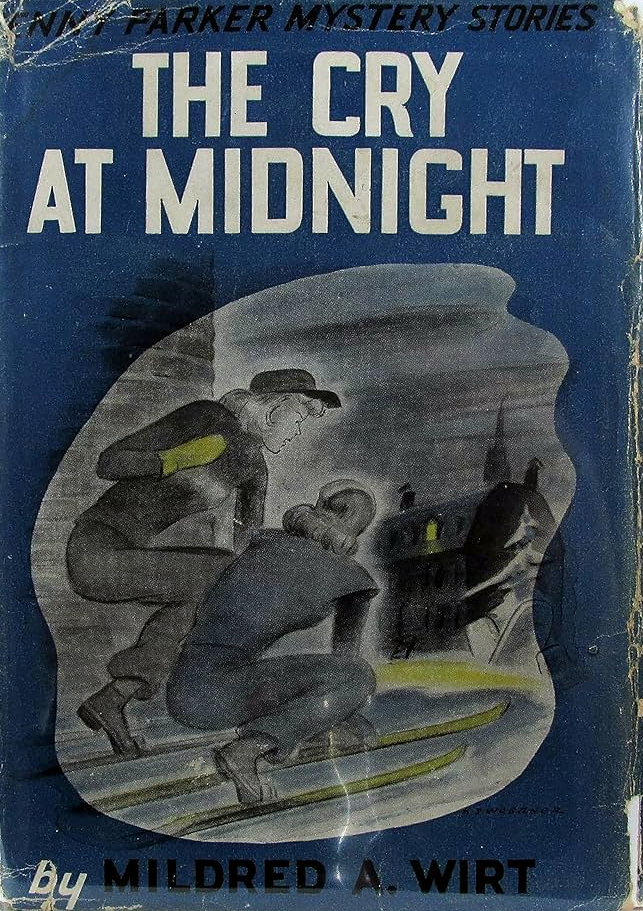
Penny Parker Mystery Stories No. 17 - The Cry at Midnight

And at long last, we've reached the seventeenth and final Penny Parker Mystery Story.  It is a bittersweet feeling, because I've been anxious to see just how this series was going to end, while at the same time, I'm disappointed to have reached the final Penny Parker story.  A seventeen-book series that was published from 1939 to 1947 at two each year (except for 1945, in which only one Penny Parker book was published), the series has offered up some very interesting stories that gradually became more and more dark and intense as the it progressed.  This final book has probably the darkest story in it, and one has to wonder if perhaps the story is a reflection of everything the author had experienced in the years leading up to the printing of this last volume.

The Cry at Midnight opens with a somewhat cheerful winter scene, as Penny Parker and her (boy) friend, Jerry Livingston, are getting ready to ski down the slops of Knob Hill.  Now, anyone familiar with series books from this era, and more certainly, anyone familiar with Mildred Wirt Benson's work is going to stop right here and say:  Knob Hill?  Where have I heard that name before?  Well, it just so happens that the final book in the Penny Nichols series, written by Benson under her pseudonym Joan Clark, was titled The Knob Hill Mystery (you can read my review of that book by clicking on the link).  The Knob Hill in that book was not a hill for skiing, however, nor was the mystery set in the dead of winter; however, it did feature a youngster who was being held captive in a house, similar to the captives in this book.  I suppose it is fitting that Benson ended both of her "Penny" series with a mystery set on or around a place named "Knob Hill."

The story takes a darker, more gothic tone as Penny and her best friend, Louise Sidell, are walking back to their car when they pass by the supposedly haunted Abbington Monastery and they hear a "shrill, piercing scream" from inside the monastery (p. 7).  This, of course, immediately piques Penny's interest, as she immediately sees there is a story to be uncovered here.  The monastery is described as a "structure of moldy stone enclosed by a high brick wall" with a graveyard just inside the wall (p. 4), and that there is a "deserted garden beyond the gatehouse" where "several statues [are] covered with soft white shrouds" (p. 6), giving the reader an imagery of ghostly figures.  When they discover the gate is open, Penny convinces Louise to go inside, where they meet "a grotesque, deformed human figure," and they see "silhouetted against the gray stone walls ... a hulk of a man with a large head and twisted back made unsightly by a hump" (p. 10).  The man who now owns the monastery, when he first appears, is said to be a "very tall man" wearing a "dark hooded robe" (p. 12).  These details are clearly intended to set the mood for the story - a dark, foreboding house inhabited by cloaked and grotesque individuals, which definitely provide the set-up for a good gothic tale!

Jay Highland, who calls himself Father Benedict (p. 14) tells Penny and Louise that he has no secrets within the halls of the monastery, and the only thing they will find are "serene faith and hope for a better world" (p. 14).  Penny has seen enough charlatans by this point to recognize one, and it is obvious to her something is not right here.  And one has to smile at the author's choice of names for the Father - "Benedict" could easily be a reference to the Benedictine monks who used to live in Abingdon Abbey (which is the name of the REAL abbey located in Oxfordshire, founded in 675 AD and dis-established in 1538 - like the Abbington Monastery in this book, the real Abingdon Abbey has some walls and buildings remaining, but a number of the buildings have only a few physical remains on the land).  

From here, Benson introduces another character into the story, who may be a greater mystery than the scream at the monastery.  As Penny and Louise are driving home, Penny nearly hits a young girl walking down the road with a suitcase (p. 16).  They have to literally beg her to get her to enter the car and allow them to give her a ride (but not before they debate the safety of picking up a hitchhiker on page 17 - which is a funny coincidence, as part of the mystery in that last Penny Nichols book also involves a hitchhiker, only in that story, it is a male, not a female), and she refuses to disclose any personal information, including her own name.  She insists she be let out on the docks in Riverview, and it is there that she disappears right at the river's edge (p. 23).

Well, yet another mystery falls into Penny's lap when she gets home to find her father meeting with James Ayling, an investigator for the Barnes Mutual Insurance Company (p. 30).  It seems that one Mrs. Hawthorne and her granddaughter Rhoda have gone missing, and the insurance company is concerned about the extremely valuable star sapphire that they insure - they are afraid she may lose or give away the cursed jewel, leaving the insurance company to pay out!  And, yes, the jewel does come with a curse.  According to the story the star sapphire was set in a necklace worn by a king who met a violent death; since that time, every owner thereafter has had bad luck, with several of them dying in strange ways (p. 31).  Mr. Ayling is worried the older woman may believe in the curse and get rid of the jewel.  Now, this whole segment of the mystery definitely has some interesting things to point out.  First, it is said Mrs. Hawthorne's husband was Nathaniel Hawthorne!  You may recognize that name as the great American novelist and short story writer (1804-1864). What's more coincidental is the real Nathaniel Hawthorne wrote House of Seven Gables while living just outside of Lenox, Massachusetts, a city that was settled by one Jonathan Hinsdale, whose daughter's name was ... Rhoda!  And if that weren't enough, a little digging reveals that the real Hawthorne had a cousin whose name was Rhoda Campbell Morgan (1819-1867)!  Whether Benson used these names because she was aware of the connection, or whether it is simply one huge coincidence, I suppose will remain an unsolved mystery...  And, with regard to the "cursed" sapphire, it turns out there really was a star sapphire with a supposed curse to it.  The Delhi Sapphire is sad to have brought terrible misfortune and financial ruin to anyone who possessed it!

Penny's intuition serves her well in this story, as Father Benedict is easily seen by the reader as a charlatan.  While he proclaims his followers lead lives of poverty, with no desire for worldly possessions, Penny and Louise discover his office within the monastery is furnished with "thick velvet carpet ... a large mahogany desk, a sofa, two easy chairs, and a cabinet filled with fine glassware, gold and silver objects, and a blue glass decanter of wine" (p. 40).  He then informs the girls that collecting art treasures is a hobby of his, explaining the decanter "is a piece of Ching-Hoa porcelain and very rare," while also showing them a Byzantine amulet and golden goblets recovered from a European church destroyed a century ago (p. 42).  But the clincher is when Penny spots the crystal ball supported by the claws of a bronze dragon (p. 40).  One might remember in the very first Penny Parker mystery, Tale of the Witch Doll, features a medium who is scamming people.  Thus, when Father Benedict suggests Penny stare deep into the glass (the frontis piece!), she sees nothing at all (p. 44-45).  Father Benedict says she simply does not believe, to which Penny quips, "Guess I haven't got enough of the witch in me" (p. 45)!   This is one of my favorite things of the Penny Parker series - Benson gave Penny some sarcastic wit that comes out to play now and again and is a joy to read!

While the mystery is not really too hard to figure out (I mean, come on, who didn't immediately figure out that the young girl walking down the street, away from the monastery, was actually Rhoda?), it is following along with Penny as she figures it all out that is half the fun.  And the gothic elements abound within the story - there is a closet that offers a peep hole that allows one to spy into the chapel room (p. 144); there is a secret tunnel from the basement to the graveyard (p. 81); a lift that lowers the canopied bed in the chapel room own into the cellar by secret mechanism (p. 113); and even a crazy old woman (p. 13) who continually warns Penny away from the monastery (p. 38), but who ultimately aids her in her quest to uncover the truth about what is going on at the monastery!  This story could easily transition into one of the gothic novels published in the 1960s and '70s that populated bookstore shelves so heavily during that time.  It has the perfect premise and setting, that's for sure!

One final observation in this book concerns the ceremony given by Father Benedict.  While he starts the ceremony by chanting in Latin, he also recites a somewhat lengthy quote (p. 133) from The Monastery, a novel by Sir Walter Scott published in 1820.  He is reciting a quote of the White Lady from the novel, a character that is a supernatural figure who guides some of the other characters in the story.  Scott's novel, as clear from the title, is centered on a monastery that is based on the real Melrose Abbey in southeast Scotland.  I would love to know what promptly Benson to use this quote for the story, and whether Scott's novel itself gave her some inspiration for the final Penny Parker mystery!

While not the strongest mystery in this series, I would have to say that The Cry at Midnight provides readers with a satisfying conclusion to the Penny Parker Mystery Stories.  That final statement by Penny on page 207 pretty much sums up her future, had the series continued:  "Writing this story will be duck soup compared to digging up the material.  Just lead me to a typewriter!"  And with that, the stories of plucky teen-sleuth Penny Parker came to an end, and we are left with a legacy of great stories by which we will always remember her!

RATING:  9 cheap silver colored rings with a red glass tone out of 10 for sending Penny Parker off into the annals of history with a solid, 17-book legacy that could truly be enjoyed by fans of any age in any decade!

Saturday, December 28, 2024

Nancy Drew Mystery Stories #24 - The Clue iin the Old Album (Original Text)

This Nancy Drew Mystery Story is a rather unusual one, containing a convoluted plot, tons of characters, and a rather unusual high number of places visited by Nancy and her friends.  Written by Mildred Wirt (Benson) based on an outline by Harriet Stratemeyer Adams, the book was published in 1947 - the same year as the final two Penny Parker books written by Wirt.  According to correspondence between Wirt and Adams (thanks for Pam Hancock for sharing these!), Wirt began work on the book in May of 1946 and completed it nearly six weeks later in June 1946.  The correspondence between the two also reveals that Adams was "rather disappointed" with the manuscript, although she readily admits she was not blaming Wirt - she concedes there may have been too much material in the outline to reasonably fit into the story.  And having now read the book (the original text), I would have to say that is likely the case!

The Clue in the Old Album
is the twenty-fourth Nancy Drew Mystery Story.  The plot centers around a gypsy violinist, Romano Pepito, and his young daughter, Rose.  The mystery is, as said above, convoluted and not easily described in a few words.  Basically, Rose's mother, Enid, ran away from her parents, Mr. and Mrs. John Struthers, to marry a gyspy, of whom her parents did not approve.  Circumstances arose that brought Enid and her daughter Rose back to live with her parents - Enid died, as did her father, leaving Mrs. Struthers to care for her young granddaughter.  Mrs. Struthers did not want Rose to know of her gypsy heritage, and so she worked hard to keep it a secret.  Nancy and her father happen to meet Mrs. Struthers in the first chapter while they are attending a concert by renowned violinist, Alfred Blackwell (p. 1).  At the concert, Nancy observes a pickpocket steal Mrs. Struther's purse, so she chases after him - she ultimately recovers the purse, but not its contents.  Needless to say, Mrs. Struthers has a mystery and asks Nancy to come to her house to help her solve it.

Mrs. Struthers reveals to Nancy that on her deathbed, her daughter told her, "The doll! It's gone! Oh, Mother, you must find it for Rose!" (p. 18).  Now, this is an important plot point, because it turns out Mrs. Struthers is a serious doll collector, having a room filled with them on glass shelves - including some original peddler dolls from the 19th century (p. 15).  Now, here, let's stop for a moment and look at this aspect of the plot.  Throughout the story, Wirt not only mentions a number of various dolls, but she goes into considerable detail to describe them - from the peddler dolls (which are real dolls made between the 16th and 19th centuries, crafted to resemble Old London peddlers) to a doll on a velvet-colored music bos that moves from side to side with the music (p. 16) to dolls made of cornhusk and horsehair (p. 29) to ancient Chinese dolls carved from hard ink cases (p. 29) to even a doll in a quaint evening dress (p. 30) that Mrs. Struthers indicates is Jenny Lind (who happens to be a famous singer in the real weorld, known as the "Swedish Nightingale").  There's a French swordsman doll with a tiny steel saber posed as if to duel (p. 30); a king with a jeweled robe (p. 59); a doll with a violin in its hands (p. 80); Civil War dolls that were hollow, used to carry messages and medicine across enemy lines (p. 95); early American rag dolls with shoe button eyes and faces painted with vegetable dye (p. 118); and even a whole set of mannequin dolls dressed up as a full wedding party (p. 148).  The amount of detail given to the description of the various dolls indicates some level of research, which the correspondence between Wirt and Adams confirms when Wirt thanks Adams for the "doll material," which she found very interesting and used as much as possible (informing Adams she had to let some of it go, as she could not fit it all into the story!).

Getting back to the story itself, Wirt had a lot to work with, some of which is not particularly normal for a Nancy Drew book.  For instance, there's a scene where Nancy is poisoned when she pricks her finger on the point of a doll's sword - and Carson is worried the poison may be fatal (p. 33)!  It's not every day we find Nancy on the verge of death.  But miraculously, the doctor who is called out to Mrs. Struthers' home not only recognizes the poison simply by its smell, but is able to create an antidote in mere minutes right there at the house (p. 34).  That is definitely some doctor!  We also get treated to the revelation that Ned has plans for his future that include his desire to "go into business, prosper, and marry a certain golden-haired young lay named..." (p. 37).  I don't recall any other book where Ned so blatantly reveals his romantic intention to marry Nancy!  There is also a hinted death threat by one of the gypsies, who, when talking with Nancy about Rose, remarks, "when her grandmother dies..." (p. 201).  When Nancy gasps at the idea that they would kill Mrs. Struthers, the gypsy backtracks and indicates that the loss of Rose would leave her with a broken-heart that would lead to her death - but still, that's some pretty terse stuff right there.  Finally, there is also the gypsies' ritual of marrying off their daughters very young - in chapter six, Ned and Nancy are witness to a gypsy wedding, where Nancy sees the young girl is "very frightened and could not have been more than fourteen years old" (p. 43); however, before you get too shocked to read this in a Nancy Drew book, the gypsy performing the ceremony makes it clear to all of the attendees (and the reader) that while their girls marry very young, they "have complied with all the laws of this state" (p. 42).  One can only assume Wirt (or Adams in the editing process) threw in that line to keep readers from thinking this marriage was an unlawful act against a minor.

Two of the gypsies - Anton and Nitaka - play a pivotal role in the mystery, and they make a number of appearances, mostly as thieves.  They are also right-hand helpers of the gypsy king, Zorus (whose name is actually from Green mythology, a Trojan warrior who participated in the Trojan war), and they enforce his will upon all of the gypsies in their group, including extortion of money.  What is sad is that the gypsies, for the most part in this book, are not portrayed in a good light.  The one gypsy who helps Nancy and warns her on several occasions turns out to be not a gypsy at all, but someone who married a gypsy and pretended to be from another tribe so as to not cause trouble for her husband (p. 205).  What surprised me was that when one of the gypsies offers to tell Nancy's fortune, her first question is, "Have you a license to tell fortunes?" (p. 113).  I was not aware that a license was required to be a fortune teller, but some quick research online reveals this was actually the case - and in some instances, fortune telling was outlawed altogether, license or no license!

A couple of interesting tidbits worth noting - first is the mention of the Taylor Department Store, where the mannequin dolls are to be on display (p. 148).  This same department store was first referenced in The Secret of the Old Clock, where Nancy goes to buy a new dress.  It's not often you see continuity of places like that in this early series.  Second, Adams may have been right in her disappointment in the story when it comes to Nancy's character.  Adams tells Wirt in one of her letters that Nancy "does not see like the courageous, untiring person she always has been ... she feels like a defeatist, ready to give up ..." And that is certainly true in some instance in the story.  When Nancy is kidnapped at the end of the book, being tied up and on the floor of the truck "made her feel quite ill" (p. 209).  She then thinks, "If only Dad could have reached me in time..." (p. 209) - and when he does arrive and rescue her, her first words are, "Oh, Dad, I thought you'd never come" (p. 209).  Later, when asked by Bess if she were scared, she laughs, "I'm afraid I was" (p. 212).  These are only a few examples, but they show the frame of mind of Nancy's character pretty much throughout most of the book - which, as Adams says, is not typical of Nancy Drew.  Third, Wirt specifically used a couple of real musical pieces in the book - the Hungarian Rhapsody (p. 38) and The Gypsy Airs (p. 149).  One can assume these pieces were chosen because of the focus on gypsies in the story.  Finally, a couple of plot points are never actually explained - such as "the cause" (p. 198) that Zorus is forcing all of his gypsy tribe members to support, as well as the mysterious "substance" inside of Enid's doll (p. 201), that Romano's father discovered in Bear Claw Mountain.  I suppose with so much going on in this story, those points just sort of got lost along the way.

Russell Tandy provided the art for both the cover and the internal frontis.  The internal scene is from page 186, when Nancy, Bess, and George are in the small town of Aiken, where Nancy spots one of Mrs. Struthers' stolen dolls in a store front window.  The cover scene comes straight from page 195, when Nancy sneaks up on the gypsy camp, hoping to locate both Rose and her father, Romano Pepito.  I did notice on the cover art, as well as on the internal, Nancy has a red bow in her hair, something that one usually sees in Penny Parker's hair on the illustrations for many of her books.  

The book is not bad, but it is definitely a lot to take in - I mean, let's face it, I didn't even mention the whole River Heights Yacht Club sailboat race and all of the trouble that comes along with that - including the purchase of a sail boat, the sabotage of that boat, and the ultimate race.  None of it has anything whatsoever to do with the mystery, so one is left to wonder exactly why that material is in the story at all.  (And in case you are wondering, yes, of course, Nancy and her friends do win the race - which, by the way, is called the "Dixon Cup" - hmmmm, perhaps named after another author name used by the Syndicate for a certain boys series?)

8 poisoned "witch dolls" out of 10 for some rather strange plot elements, unusual characters, and the revelation of Ned's true intentions for Nancy!