Showing posts with label Sherlock Holmes. Show all posts

Friday, June 20, 2025

The Sherlock Society (Book One of the Sherlock Society mysteries)

This is another book that came to me as a recommendation.  I had it on my Amazon watchlist already, but I did not buy it until James Keeline gave me the heads up that the author, James Ponti set the book in South Florida.  I was aware Ponti was a Florida resident, but I did not know he was giving us a series set in my home state, so I went online and made the purchase.  I was even more excited to see that Amazon already had the second book available for pre-order!  Keeline told me that the writing of this book was "a cut above most juveniles," so I definitely went into it with high hopes.  I mean, how could it possibly fail - Sherlock, Florida, mystery, children's series - such a fantastic combination!  Well, as the old saying goes, don't judge a book by its cover...
 
The Sherlock Society introduces a group of three middle school children who are getting ready to spend their summer vacation doing the normal things to earn money - babysitting, moving lawns, etc.  Alex Sherlock and his two friends, Lina and Yadi, are not looking forward to the prospects; but they are enjoying the escape room that the school librarian created for them, giving them some fun puzzles to solve within a limited time in order to "escape" the library.  What they did not expect is for Alex's sister, Zoe, to show up and help them work together to "escape" before the time expired!  And even more shocking is Zoe's idea to form a detective club for the summer, to earn money doing something they love!  Enter: the Sherlock Society!
 
I was truly looking forward to an intricate mystery, filled with plenty of riddles and clues; however, what I got was a travelogue of South Florida with snippets of one mystery that gets dumped in exchange for another mystery half-way through the book.  Perhaps it is because I live in Florida, but I got quickly bored with all of the detailed descriptions of Miami,  Biscayne Bay, Alligator Alley, the Everglades, and the surrounding areas, along with considerable exposition about the history of these locations.  And when they made the decision to search for Al Capone's missing millions, allegedly buried somewhere in South Florida, I was actually rather intrigued.  The crew began following up on various clues they were uncovering - but when they reached the place where they believe the money was hidden away, suddenly the entire focus of the mystery changed - the search for Al Capone's treasure was dropped, and the Sherlock Society began searching for who was illegally dumping dangerous waste materials into the Everglades.  So, instead of searching for money that would make them wealthy (in their minds), they decide to save the environment and hunt down the men who are killing the animal and plant life of the Everglades.
 
Do you see the more than obvious morality lesson here?
 
Don't get me wrong - I'm all for saving the environment, and I do believe those who are illegally and purposefully dumping deadly waste into rivers and lakes should be ferreted out and punished.  What I do not particularly enjoy is when a good children's mystery is overtly written to push that idea.  At least Ponti did not have the kids completely give up on Al Capone's missing millions, as the very last chapter of the book has them stumble upon the possible location of the money - perhaps a lead-in to the second book?  (No, checking the description for Hurricane Heist on Amazon, which is set to be released in September, it appears that book has nothing to do with Capone's money.)  It simply feels like a bait and switch - here's a great mystery about missing money with some interesting clues to be discovered along the way - but wait, no, let's forget that mystery so I can teach you a lesson about caring for the environment!
 
With that being said, I did rather enjoy the characters - Ponti breathes life into them that makes them very readable and relatable.  Alex is your typical young teen, ready to jump the gun and get into the action.  Lina is the booksmart fish-out-of-water Midwestern girl, who knows how to research with a thirst for knowledge.  Yadi is the aspiring film maker, with some great devices to help the Society using modern technology (although the constant references to him being a "conspiracy theorist" because of some of his beliefs felt more like a political statement than a characterization).  Zoe is the not-so-stereotypical teenage girl frustrated with her parents for not allowing her to go to camp with her friends, but who learns what true friendship is within the Sherlock Society that she forms!  And Grandpa (the kids' mother's father) is a real hoot - helping the Society as their driver, but ultimately getting them into trouble by letting his own love of adventure take them into some very dangerous territory.  All of the characters (including Mr. and Mrs. Sherlock) play well off of one another, and Ponti creates a diverse, real-world cast that help save the story from being a complete failure.
 
Oh, and I must say - if you are hoping the book will have a lot of references to Sherlock Holmes, based on the title (which is actually a reference to the main characters' last name - Alex and Zoe Sherlock), you will be disappointed.  Sure, there are a few references scattered throughout, but not at much as one would expect.
 
Based on this book, I will not be picking up any further books in the series.  Perhaps the next book, and those that follow, will feature better stories than this one, and if that is the case, then great!  I certainly wish Ponti success with the series.  But I have enough ongoing mystery series, both children's series and adult series, that I find much more enjoyable and readable.  I gave it a shot, and it simply did not meet up to my expectations, particularly given the recommendation I received.
 
RATING:  5 well-loved books on botany out of 10 for creating a fun new cast of young sleuths who (hopefully!) will solve some great mysteries in the future.

Thursday, January 4, 2024

Enola Holmes and the Elegant Escapade - the eighth Enola Holmes mystery

And here we are, going back into the world of Enola Holmes, the younger sister of that great detective, Sherlock Homes.  More than twelve years ago, I thoroughly enjoyed reading the first six books written by Nancy Springer.  Then they stopped.  I assumed that was the last I would see of her.  But then the Netflix film was announced, and suddenly, there was a seventh book.  And some graphic novel adaptations of her previous books.  And then an eighth book came out!  I picked it up, but I've had it sitting on the shelf for a bit and have only just now gotten around to reading it (two Netflix films later....)  And I have to admit, as much as I enjoy the films, I do enjoy delving back into the book series, since there are some major differences between the books and the films - differences that I like better in the books.

Enola Holmes and the Elegant Escapade brings back some of the characters from Enola's second case, the one about the "left-handed lady," most particularly that left-handed lady herself, Lady Cecily Alastair.  It seems Lady Cecily's father is none too pleased with the fact that his daughter was kidnapped and is not longer "unspoiled" for purposes of marrying her off to someone of a higher station.  His attempt to marry her off to a cousin failed, so he now has her (and her mother) under lock and key in their home, to the point where Lady Cecily has no clothing, no art supplies, nor anything else in her room that she could potentially use to escape or contact anyone for help.  But when has that ever stopped Enola Holmes?

Springer's story is not exactly one of mystery in this novel, but more one of adventure, as Enola discovers her friend's plight and determines to do whatever it takes to free Lady Cecily from her mother's control.  Springer reminds readers of Enola's growth as a character - a young girl who was on the run from her brothers and the patriarchal system that would keep her under their control has now evolved into a young woman who is no longer fearful of being discovered, who no longer has to pretend to be Dr. Ragostin's wife in order to walk freely on the streets of London, and who no longer has to be ashamed of her chosen profession as a "Scientific Perditorian" (a finder of things lost).  Over the course of the last seven books, Enola has not only aged physically, but she has matured emotionally and has gained the experience needed to make her own way in this man's world.

But poor Lady Cecily is not quite so lucky...

The story is filled with the usual Enola Holmes adventures - disguises, daring escapes, chases through the streets of London, decoding of secret messages, unexpected trips down laundry chutes, and the ever-so-wonderful confrontations with dastardly men who think they have the power over everyone!  Springer does introduce a fun new supporting cast member in this book in the form of Lady Vienna Steadwell - a tall, elderly woman who resides at the Professional Women's Club (funny how the last book I read also featured a Women's Club!) with Enola and a number of other modern women of all ages.  But Lady Steadwell isn't any ordinary woman - she was friends with Enola's mother, and she has a wealth of knowledge about the upper class members of London's high society (as well as some of those who only WISH they were part of that upper class).  She also has that same daring spirit as Enola, and it is ultimately with her help that Enola is able to help free Lady Cecily and her mother from the grasp of the very controlling Sir Eustace Alastair (and, seeing that name Eustace, I can't help think of that annoying little cousin of the Pevensie children from the Chronicles of Narnia).

The book does address one other element concerning Lady Cecily, and that is her fracturing personality.  Born left-handed, her father has been doing everything he can to force her to use her right hand, and what with the kidnapping, the nearly forced marriage, and the isolation in her room added to it, the poor young lady has formed a split-personality - the adventurous, resilient left-handed lady and the meek, submissive right-handed girl.  This changing personality adds a difficulty to Enola's plans that makes it nigh impossible to be sure things will work out as she intends.  I think Springer does a fairly nice job of addressing this situation and the manner in which "left-handedness" was viewed in the late 19th century.

Even despite the lack of a formal "mystery," I really enjoyed the read, and I already have the ninth book on my to-be-read stack, so I am looking forward to what it has in store!

RATING:  10 purple channel marker like hats out of 10 for a truly elegant escapade worth reading!

Thursday, November 23, 2023

Mycroft's Dangerous Game - an Enola Holmes Mystery Graphic Novel

The Enola Holmes films on Netflix have been very well done.  I thought they did a great job of casting Millie Bobby Brown as Enola Holmes, as she fits the character well - she has the look, she has the spunk, and she has the acting ability to break the fourth wall, yet keep the story believable and in character. So, when I chanced across this particular story on Amazon, I thought perhaps it was a new novel based on the television continuity (since they have taken liberties with some of the stories) - but imagine my surprise when it arrived, and I discovered it was a graphic novel instead of a prose novel!  (Of course, had I read the Amazon description more carefully, I might not have been so surprised.)  But this was a pleasant surprise, as I love comics as well as books, so I placed it on my stack of graphic novels and then promptly forgot about it.  Until now...
 
Enola Holmes: Mycroft's Dangerous Game
was published in 2022.  Since the second Enola Holmes film did not come out on Netflix until the end of 2022, I have to assume this story takes place immediately, or not very long, after the first film. While the story is by original Enola Holmes author and creator Nancy Springer, the actual writing (dialogue, etc) is by Mickey George, a relatively newcomer to the comic world.  Despite being new, I would say George does an exceptional job of capturing Enola's personality and spirit within the story.  Reading this graphic novel, I could very easily see this story being transitioned to a film.  And, well, the art by Giorgia Sposito and Enrica Angiolini certainly helps - Enola, Sherlock, and Mycroft are all drawn so that they appear exactly like their actor counterparts from the film.  In fact, it's uncanny how much they look like the actors in each and every panel!  That shows some amazing talent on the part of the artists!

The story focuses on Mycroft, who still sees his little sister as someone who needs proper teaching and training, who needs to be more like a lady and less like their mother.  But despite his views, when Enola is trying to take back a book he took from her, and she accidentally witnesses her brother being kidnapped, she knows she has to step in and rescue him.  First, though, she has to figure out who took her brother, and why, and then she must take on the harder task of finding where they are keeping him.  Lucky for her, she has Viscount Tewkesbury to give her information; she has her mother's friend, Edith, to give her direction; she has Inspector Lestrade to point her to a police informant that sees more than people suspect; and she gains a new compatriot in Shag, a young boy who isn't afraid to jump into danger to help Enola rescue her brother.

Of course, the mystery turns out to be much bigger than just her kidnapped brother.  It seems a political group of terrorists is planning to set off a bomb in London to prevent Scotland Yard from opening up a new branch of detectives that could put a wrench in all of their plans.  It therefore becomes a race against time for Enola to get to Parliament Square and put a stop to the terrorists' plans before hundreds of people are injured or, worse, killed!

What I liked about this story is that it stays a bit more faithful to the books than either of the films.  In the films, Henry Cavill as Sherlock played a rather large part, while in the books, Sherlock was relegated to the background, and the stories focused solely on Enola.  This story does just that.  Sure, we get a couple of scenes of Enola's more famous brother, but they are irrelevant to the mystery, and he plays no actual part in Enola's investigation ... and other than being the kidnapped victim, Mycroft also has a rather minor role in the mystery.  And, thus, Enola is the star of her own book, as it should be.  (That's the problem with Hollywood adaptations - they often focus on the wrong things, all for the sake of promoting big name stars instead of the actual main character.)

Now that a third Enola Holmes film has been confirmed to be in the works, I'm hoping Legendary will do more of these graphic novels.  This was a great mystery that offers readers both the fun of the television show, while staying true to the source material, combining the best of both worlds!

RATING:  10 well-aimed sling-shots out off 10 for mystery, mayhem, and madcap adventure with an intelligent, yet fun female protagonist!

Monday, November 1, 2021

Enola Holmes and the Black Barouche - the seventh Enola Holmes mystery

It's been eleven years since the last Enola Holmes book was published.  That's more than a decade since author Nancy Springer provided us with one of her uniquely peculiar stories starring the irreverent and unstoppable younger sister of Sherlock and Mycroft Holmes.  When The Case of the Gypsy Goodbye was published and I read it, I pretty much expected that to be the end of the series.  And for quite a while, that was.  Until Netflix aired the movie based on the first book.  It was an enjoyable adaptation, and while the movie featured quite a bit more of Sherlock than the book did, it still managed to capture the true spirit of Nancy Springer's character.  And obviously it inspired new interest in the series, because here we are with the seventh book in the Enola Holmes series.  It's been quite a wait, but it was well worth it!

Enola Holmes and the Black Barouche brings about a number of changes to the series.  First, and foremost, is the fact that Enola no longer needs to hide from and constantly try to evade her brothers.  Sherlock and Mycroft are fully aware of their younger sister's detective adventures, and they have resolved themselves to allow her to have her independence and pursue her own livelihood, even though that is not what proper young girls do in the late 19th century.  Second, and more on the superficial side of things, is the change in publishers and cover art.  While prior books sported more obviously painted covers, this latest book features a cover whose image of Enola is somewhat reminiscent of Millie Bobby Brown's version of Enola in the Netflix film.  Additionally, the title drops "The Case of the..." and merely utilizes Enola's name to headline the mystery title.

The mystery in this book involves a young woman who has just been notified that her twin sister is dead; however, she does not understand what happened, as she knows she would feel it if her sister was gone, and the fact that her sister's husband had her cremated without even telling anyone raises questions in her mind.  Enola is only too happy to take the case, especially when her brother inspects the supposed ashes of the woman's sister and announces that the remains belonged to an animal, not a human! Enola does what she does best - disguises herself as a woman on a mission to discover her family tree, which leads her to Dunhench Hall, where the Earl of Dunhench (the man who married her client's twin sister) resides.  Enola manages to deceive her way into the home, despite the period of mourning the house is under, and she quickly learns that the Earl does not seem to be mourning much at all.  Unfortunately for Enola, he also sees through her disguise, and soon enough, she finds herself captive in the house!

There's plenty of adventure in this book, and while the villain in the story is not necessarily a surprise or even a secret from the reader, the truth about what happened to the missing woman (as well as the Earl's previous wife!) is what Enola and her brother endeavor to find out before it's too late.  Enola has plenty of opportunity to utilize her talent for disguising herself, and she even puts the talent to use on her client when they concoct a daring plan to trick the Earl into revealing himself.  And ultimately, it is the clue of the "black barouche" that provides the answer to where Enola's client's sister has disappeared to, and it will take all her wits (as well as those of her brother) to outwit this dangerous Earl and thwart his plans for his poor wife.  Now, I'll be honest here - I had no idea what the word "barouche" meant, so I had to look it up.  The dictionary describes a barouche as a four-wheeled horse-drawn carriage with a collapsible hood over the rear half, a seat in front for the driver, and seats facing each other for the passengers, used especially in the 19th century.  Thus, reading this book further expanded my vocabulary (although when I will ever get the chance to use this word again remains to be seen!).  

Hopefully, Springer has more books planned, as I rather enjoyed re-entering the world of Enola Holmes.  Plus, there were a few things in the story that made me go, "Hmmmm..."  Like, for instance, the client's twin sister was named "Flossie."  Could the author have been a fan of the Bobbsey Twins growing up, and this is a nice little nod to the younger Bobbsey Twin girl?  Then there is the name of Enola's client - Letitia Glover.  Since her twin sister, Felicity, had the nickname of Flossie, wouldn't it stand to reason that Letitia would have a nickname - perhaps Lettie?  And if so, would that be a nod do the Dana Girls' nemesis from the Stratemeyer series?  Maybe I'm just looking for connections where they don't exist, but it would be a pleasant surprise to find out that Springer enjoyed reading the same mystery stories I did growing up and decided to throw in a few Easter eggs for other fans!

The one thing, however, I did not particularly like was the fact that the front listing of books in the series has the original six books listed.  The problem is, the sixth book in the series, rather than being The Case of the Gypsy Goodbye, it is listed as The Case of the Disappearing Duchess.  A quick search online reveals that for reasons unknown, the current publisher decided to change the name of the sixth book in the series.  You can still find Gypsy Goodbye on Amazon and other booksellers online, but at the same time, you can find the same book with its new title as well.  Sadly, I suspect that the publisher changed the name due to the reference of "gypsy" in the title, and it leaves me wondering if any elements or words within the story itself have been changed to appease today's politically-correct, woke climate.  The book is a period piece, and it in no way demeaned or insulted any person or group of people with its title, and this growing trend to cancel, erase, and otherwise overwrite anything that could potentially offend someone is ridiculous.  I guess I should be glad I got the book back in 2010 when it originally came out, so that I have it in its original, intended condition.

But, aside from that, The Black Barouche was a great way to bring Enola back to readers, and now that she is back, I'm looking forward to seeing more of her!

RATING:  10 uncharacteristically awkward watercolor paintings out of 10 for reviving such a wonderful series with a superbly written mystery that leaves the reader wanting for more!

Wednesday, August 26, 2020

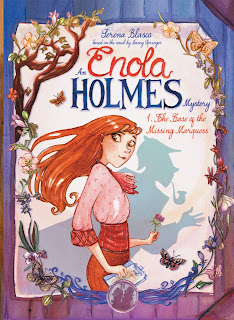
The Case of the Missing Marquess - an Enola Holmes Mystery Graphic Novel

In the early 2000s, I picked up a new mystery series for young readers about Enola Holmes - the younger sister of Sherlock Holmes.  Written by Nancy Springer, this six-book series followed the adventures of young Enola (whose name spelled backwards is "alone," a play on the fact that Enola spends most of the series alone, on her own, trying to find her missing mother).  The series was exceptionally written, with each mystery involving a missing person that Enola must find - all the while, working overtime to avoid discovery by her two overprotective brothers, Sherlock and Mycroft, who want to send her away to a finishing school to become a "proper" young lady.

Once the series ended, I never really gave it more than a passing thought now and then - but recently, IDW comics solicited hardcover graphic novel adaptations of the books. Remembering with fondness the stories I read, I decided to buy them.  Turns out, they are not just adaptations, but they are actually translations as well, since the graphic novels originated in France by writer/artist Serena Blasco.  The art not your typical comic line-art drawings, but rather, what appears to be water-colored paintings, which each panel/page beautifully rendered, with vibrant colors that jump right off the page.  The story flows beautifully from one panel to the next, and from one page to the next - however, as can be expected when you take a full length novel and condense it into a graphic novel with only 56 pages of story and art, it has to be fast-paced, and some elements have to be left out.

The Case of the Missing Marquess, the first book in the series, opens with young Enola getting ready to celebrate her fourteenth birthday - the only problem is, her mother never returns from roaming the countryside, where she goes every day to paint. No explanation, no reason - she simply never returns home, leaving a poor, young Enola truly alone (well, she does have the butler and cook there, but, really, what can they expected to do for a fourteen-year old girl?).  After an unfruitful search, she does the only thing she knows to do - she notifies her brothers, Sherlock and Mycroft.  Only, instead of locating her mother, they decide the best thing to do is to ship their young sister off to a finishing school.  Well, Enola is not having that!

Springer (and Blasco) bring to life a vibrant, young, budding detective who discovers clues that her mother left behind - clues that lead her to quite a bit of money and the logical conclusion that Enola should not have to live and conform to other's expectations - she should be able to live the life of her choosing.  And that she does!  She carefully plots and before she can be sent away, she runs away and heads for London. The idea of living right there under her own brother's nose, yet in full disguise so as to not be recognized, is absolutely perfect.

Until she stumbles across a mystery.  A young marquess has gone missing, and his mother is going frantic with worry.  A so-called psychic believes she can located the young boy, but very quickly, Enola realizes what has happened and informs the local constabulary of where they can find the boy.  And she's right - except, when they get there, the boy is gone.  And so is Enola!  They have both fallen captive to a nefarious, money-hungry criminal who sees the two captives as a means to an easy fortune.  But they don't know Enola!

Yes, there are some definite elements omitted from the graphic novel that play out in the book - particularly with regards to Enola's search for her mother and the cryptic clues involving flowers and their various meanings.  But Blasco manages to capture the charm and essence of Enola Holmes, and the stunning visuals draw the reader into her world with such ease, that even those who are familiar with the books will enjoy the story once again!

One added bonus at the end of the graphic novel is a 6-page excerpt from "Enola's Secret Journal," which provides readers with the various flowers and their meanings, as well as "sketches" that Enola has drawn in her notebook throughout the story - adding further flavor to the book and making it all that more "real" to the reader.  I'm hoping each of the graphic novels has excepts like this.

RATING:  8 overly tight corsets out of 10 for reviving this wonderful series in such a great way!