Showing posts with label Penny Parker. Show all posts

Friday, January 24, 2025

Penny Parker Mystery Stories No. 17 - The Cry at Midnight

And at long last, we've reached the seventeenth and final Penny Parker Mystery Story.  It is a bittersweet feeling, because I've been anxious to see just how this series was going to end, while at the same time, I'm disappointed to have reached the final Penny Parker story.  A seventeen-book series that was published from 1939 to 1947 at two each year (except for 1945, in which only one Penny Parker book was published), the series has offered up some very interesting stories that gradually became more and more dark and intense as the it progressed.  This final book has probably the darkest story in it, and one has to wonder if perhaps the story is a reflection of everything the author had experienced in the years leading up to the printing of this last volume.

The Cry at Midnight opens with a somewhat cheerful winter scene, as Penny Parker and her (boy) friend, Jerry Livingston, are getting ready to ski down the slops of Knob Hill.  Now, anyone familiar with series books from this era, and more certainly, anyone familiar with Mildred Wirt Benson's work is going to stop right here and say:  Knob Hill?  Where have I heard that name before?  Well, it just so happens that the final book in the Penny Nichols series, written by Benson under her pseudonym Joan Clark, was titled The Knob Hill Mystery (you can read my review of that book by clicking on the link).  The Knob Hill in that book was not a hill for skiing, however, nor was the mystery set in the dead of winter; however, it did feature a youngster who was being held captive in a house, similar to the captives in this book.  I suppose it is fitting that Benson ended both of her "Penny" series with a mystery set on or around a place named "Knob Hill."
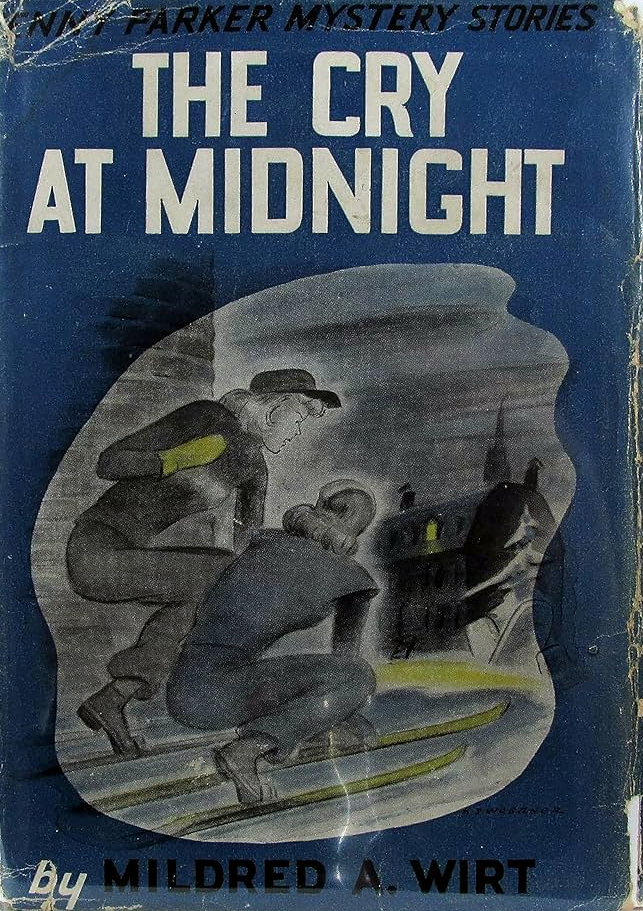
The story takes a darker, more gothic tone as Penny and her best friend, Louise Sidell, are walking back to their car when they pass by the supposedly haunted Abbington Monastery and they hear a "shrill, piercing scream" from inside the monastery (p. 7).  This, of course, immediately piques Penny's interest, as she immediately sees there is a story to be uncovered here.  The monastery is described as a "structure of moldy stone enclosed by a high brick wall" with a graveyard just inside the wall (p. 4), and that there is a "deserted garden beyond the gatehouse" where "several statues [are] covered with soft white shrouds" (p. 6), giving the reader an imagery of ghostly figures.  When they discover the gate is open, Penny convinces Louise to go inside, where they meet "a grotesque, deformed human figure," and they see "silhouetted against the gray stone walls ... a hulk of a man with a large head and twisted back made unsightly by a hump" (p. 10).  The man who now owns the monastery, when he first appears, is said to be a "very tall man" wearing a "dark hooded robe" (p. 12).  These details are clearly intended to set the mood for the story - a dark, foreboding house inhabited by cloaked and grotesque individuals, which definitely provide the set-up for a good gothic tale!

Jay Highland, who calls himself Father Benedict (p. 14) tells Penny and Louise that he has no secrets within the halls of the monastery, and the only thing they will find are "serene faith and hope for a better world" (p. 14).  Penny has seen enough charlatans by this point to recognize one, and it is obvious to her something is not right here.  And one has to smile at the author's choice of names for the Father - "Benedict" could easily be a reference to the Benedictine monks who used to live in Abingdon Abbey (which is the name of the REAL abbey located in Oxfordshire, founded in 675 AD and dis-established in 1538 - like the Abbington Monastery in this book, the real Abingdon Abbey has some walls and buildings remaining, but a number of the buildings have only a few physical remains on the land).  

From here, Benson introduces another character into the story, who may be a greater mystery than the scream at the monastery.  As Penny and Louise are driving home, Penny nearly hits a young girl walking down the road with a suitcase (p. 16).  They have to literally beg her to get her to enter the car and allow them to give her a ride (but not before they debate the safety of picking up a hitchhiker on page 17 - which is a funny coincidence, as part of the mystery in that last Penny Nichols book also involves a hitchhiker, only in that story, it is a male, not a female), and she refuses to disclose any personal information, including her own name.  She insists she be let out on the docks in Riverview, and it is there that she disappears right at the river's edge (p. 23).

Well, yet another mystery falls into Penny's lap when she gets home to find her father meeting with James Ayling, an investigator for the Barnes Mutual Insurance Company (p. 30).  It seems that one Mrs. Hawthorne and her granddaughter Rhoda have gone missing, and the insurance company is concerned about the extremely valuable star sapphire that they insure - they are afraid she may lose or give away the cursed jewel, leaving the insurance company to pay out!  And, yes, the jewel does come with a curse.  According to the story the star sapphire was set in a necklace worn by a king who met a violent death; since that time, every owner thereafter has had bad luck, with several of them dying in strange ways (p. 31).  Mr. Ayling is worried the older woman may believe in the curse and get rid of the jewel.  Now, this whole segment of the mystery definitely has some interesting things to point out.  First, it is said Mrs. Hawthorne's husband was Nathaniel Hawthorne!  You may recognize that name as the great American novelist and short story writer (1804-1864). What's more coincidental is the real Nathaniel Hawthorne wrote House of Seven Gables while living just outside of Lenox, Massachusetts, a city that was settled by one Jonathan Hinsdale, whose daughter's name was ... Rhoda!  And if that weren't enough, a little digging reveals that the real Hawthorne had a cousin whose name was Rhoda Campbell Morgan (1819-1867)!  Whether Benson used these names because she was aware of the connection, or whether it is simply one huge coincidence, I suppose will remain an unsolved mystery...  And, with regard to the "cursed" sapphire, it turns out there really was a star sapphire with a supposed curse to it.  The Delhi Sapphire is sad to have brought terrible misfortune and financial ruin to anyone who possessed it!

Penny's intuition serves her well in this story, as Father Benedict is easily seen by the reader as a charlatan.  While he proclaims his followers lead lives of poverty, with no desire for worldly possessions, Penny and Louise discover his office within the monastery is furnished with "thick velvet carpet ... a large mahogany desk, a sofa, two easy chairs, and a cabinet filled with fine glassware, gold and silver objects, and a blue glass decanter of wine" (p. 40).  He then informs the girls that collecting art treasures is a hobby of his, explaining the decanter "is a piece of Ching-Hoa porcelain and very rare," while also showing them a Byzantine amulet and golden goblets recovered from a European church destroyed a century ago (p. 42).  But the clincher is when Penny spots the crystal ball supported by the claws of a bronze dragon (p. 40).  One might remember in the very first Penny Parker mystery, Tale of the Witch Doll, features a medium who is scamming people.  Thus, when Father Benedict suggests Penny stare deep into the glass (the frontis piece!), she sees nothing at all (p. 44-45).  Father Benedict says she simply does not believe, to which Penny quips, "Guess I haven't got enough of the witch in me" (p. 45)!   This is one of my favorite things of the Penny Parker series - Benson gave Penny some sarcastic wit that comes out to play now and again and is a joy to read!

While the mystery is not really too hard to figure out (I mean, come on, who didn't immediately figure out that the young girl walking down the street, away from the monastery, was actually Rhoda?), it is following along with Penny as she figures it all out that is half the fun.  And the gothic elements abound within the story - there is a closet that offers a peep hole that allows one to spy into the chapel room (p. 144); there is a secret tunnel from the basement to the graveyard (p. 81); a lift that lowers the canopied bed in the chapel room own into the cellar by secret mechanism (p. 113); and even a crazy old woman (p. 13) who continually warns Penny away from the monastery (p. 38), but who ultimately aids her in her quest to uncover the truth about what is going on at the monastery!  This story could easily transition into one of the gothic novels published in the 1960s and '70s that populated bookstore shelves so heavily during that time.  It has the perfect premise and setting, that's for sure!

One final observation in this book concerns the ceremony given by Father Benedict.  While he starts the ceremony by chanting in Latin, he also recites a somewhat lengthy quote (p. 133) from The Monastery, a novel by Sir Walter Scott published in 1820.  He is reciting a quote of the White Lady from the novel, a character that is a supernatural figure who guides some of the other characters in the story.  Scott's novel, as clear from the title, is centered on a monastery that is based on the real Melrose Abbey in southeast Scotland.  I would love to know what promptly Benson to use this quote for the story, and whether Scott's novel itself gave her some inspiration for the final Penny Parker mystery!

While not the strongest mystery in this series, I would have to say that The Cry at Midnight provides readers with a satisfying conclusion to the Penny Parker Mystery Stories.  That final statement by Penny on page 207 pretty much sums up her future, had the series continued:  "Writing this story will be duck soup compared to digging up the material.  Just lead me to a typewriter!"  And with that, the stories of plucky teen-sleuth Penny Parker came to an end, and we are left with a legacy of great stories by which we will always remember her!

RATING:  9 cheap silver colored rings with a red glass tone out of 10 for sending Penny Parker off into the annals of history with a solid, 17-book legacy that could truly be enjoyed by fans of any age in any decade!

Wednesday, December 4, 2024

Penny Parker Mystery Stories No. 16 - Swamp Island

And so we come to the penultimate Penny Parker mystery story, as we reach the 16th book in the series.  It is truly amazing to me how far this series has come, and how Mildred Wirt's writing has evolved over the course of the nine years and 17 books that were published in this series.  What started as a more-or-less typical children's mystery series has gradually grown into stories with more intricate plots, more dastardly and dangerous villains, and definitely more adult-oriented stories.  This story definitely ups the ante in all of those aspects.

Swamp Island is a story that leads readers to think the mystery is one thing, but then takes it in an entirely different direction.  Wirt opens the mystery with Penny and her best friend, Louise, sailing a flat-bottomed skiff through a local swamp to collect flowers for a banquet that her father is putting together (p. 1).  Now, right off the bat, this raises a few questions, the main one being just where in the world if Riverview?  Previous books indicated the town is only a few hours from a beach (see Voice from the Cave).  Yet, now, here the girls are making their way through swamp land to collect flowers, such as Cherokee roses, water lilies, yellow jessamine, and iris (p. 3).  A quick internet search reveals that these flowers are native to the southeastern areas of the United States; so, does that mean Riverview is located in the south (such as Florida)?  Other tidbits from the books would be more indicative of a mid-western setting, such as those clues to River Heights in the Nancy Drew books.  I suppose that is something we will never know.

Regardless, Penny stays true to nature (no pun intended), as her father had given her $20 to purchase flowers for the banquet (p. 3), which is equivalent to $350 in today's money; yet, she decides to pocket the money and gather swamp blossoms instead.  While in the swamp, the girls come face-to-face with some rather not-so-nice gun-carrying men who warn the girls away - forcing them to leave Louise's dog, Bones, behind (p. 8)!  I wonder when Louise got the dog, as she never mentioned having a dog in any prior book.  The girls learn the men are Ezekiel Hawkins and his two sons, Hod and Coon (p. 13).  You have to give Wirt credit for using some rather unusual names.  Ezekiel and Hod are both Biblical names, but Coon is an odd choice, considering its negative connotation (although, back in Wirt's day when this book was published, the word may have been more connected with hunting and working dogs).  And Ezekiel's wife's name is actually Manthy (p. 14)!  By the end of this second chapter, we get a hint at what we think will be the mystery - a radio warning to be on the lookout for escaped convict Danny Deevers, alias Spike Devons (p. 15).  It is interesting to note that "Danny Deevers" is the name of an 1890 poem by Rudyard Kipling, considered by many to be one of Kipling's most significant early works, which tells the story of the execution of a British soldier in India for murder.

We quickly learn that Danny Deevers was sent to prison because of some stories Jerry Livingston wrote about shortages at the Third Federal Loan Bank in Riverview (p. 17), and so readers have the expectation that the story is going to center around Deevers and his desire for revenge on the man who put him away - similar to the story of the original Cape Fear film from 1962.  But, if that is your belief, well, you'd be sadly mistaken.  Other than one incident where Jerry is knocked unconscious (p. 46), Jerry plays little part in the mystery, and as a result, so does Danny Deevers.  Instead, Penny's focus is on finding out exactly what the Hawkins men are up to in that swamp (and although she believes it is somehow connected to Danny Deevers, there are incidents that occur - such as a stolen shotgun, a last-minute save from a charging boar, and missing food - that are misdirects and red herrings that are ultimately revealed to be completely unrelated to Deevers).  While the book and overall mystery are good, the false start ended up with a bit of a let-down by the end of the story.

As usual, Wirt throws some things into the story that have real life connections.  For instance, more than once in the story there are references to Neco cigarettes - described as "one of the strongest cigarettes on the market" (p. 47).  As it turns out, NECCO was a candy company back in the day that sold chalky white candy cigarettes back in the '20s and '30s, so one might assume that Wirt perhaps had some of those as a child and perhaps integrated them into her story as a cute nod to them.  There is also the hotel where Penny's father is throwing the banquet - Hillcrest Hotel (p.21).  Back in the day, there was a hotel by that name in Toledo, Ohio, where it is said authors, artists, and business people would regularly stay (including Amelia Earhart, who stayed there in 1933).  In addition, an accident that provides Salt and Penny with an important clue occurs at the intersection of Jefferson and Huron (p. 30) - and, wouldn't you know it, but there is such an intersection in downtown Toledo, Ohio, just blocks away from the Maumee River!

And we certainly must not forget Black Island, a remote island in the middle of the swamp, which holds secrets that Penny is determined to uncover.  Now, the name of this island has several possibilities when it comes to references outside of the story.  First, the name is also the title to the seventh volume in The Adventures of Rin Tintin, a comic series by Herge (The Black Island).  It was first published in black and white in 1938, and later republished in color in 1943, just four years prior to this book being published.  Black's Island is also the name of an island off the gulf coast in Florida, which was so named after the pirate, Black Sam Bellamy, who made the island his home back in the 1700s (and in case you're interested, this particular 7-acre island is currently for sale for just $50 million!).  Also, there is another Black Island, located at the center of Muscongus Bay (in Maine).  This 15-acre island was settled by Europeans back in the early 1800s, and at the start of the 1900s, approximately 50 people lives on the island.  No doubt, there are other Black Islands out there in the world, so it leaves one to wonder which one inspired Wirt for this book!

K.S. Woerner provides the art for both the cover and the frontis piece, and I have to say, neither of them are his best work.  His art from the earlier books is definitely superior to the art in this one.  One thing I did note, however, is that in the early books of the series, Penny is depicted by Woerner with a bow in her hair on most of the illustrations; however, Penny lacks the bow in both the cover and the internal of this book, and her hair is more modern, curled style.  One wonders if he was instructed to give Penny an older appearance, and so the bow was done away with, or was it simply a matter of changing hair styles for young women from 1939 to 1947 that prompted the change.

Again, the story was not bad at all - definitely more mature storylines than in the earlier books; but, I was disappointed by the hinted mystery surrounding Danny Deevers at the beginning of the book that was never truly the main mystery of the book.  I was looking forward to the Cape Fear-style tale of a convict looking for revenge on the man who put him away, but instead got a story about bootleggers hiding in the swamp.  Well, with only one more book left in the series, I'm looking forward to see how Wirt ends her tales of Penny Parker's adventures!

RATING:  8 large puts of turtle stew out of 10 for sending Penny into more dangerous situations, while deepening the relationship between her and Jerry Livingston!

Sunday, October 20, 2024

Penny Parker Mystery Stories No. 15 - Whispering Walls

As I finished this fifteenth mystery in the Penny Parker series, I realized with sadness that there are only two books left before I take leave of Mildred Wirt Benson's perky little amateur sleuth.  This truly has been a wonderful series to read, with only one or two stories lacking the strength that most of the series has.  As the series has progressed, I also noticed that Benson's writing also matured - the stories became more adult and darker in nature, and the writing became less geared towards young adults and more similar to adult mysteries.  Benson never shied away from having her characters carry and use guns; poor Penny faces some truly life-threatening situations; and, in some instances, characters actually died as a result of their actions (as I found out in this book!).  I would love to know the real reason why the Penny Parker series ended after the seventeenth book - had sales truly decreased?  Did Benson simply not want to write any more?  Did the publisher decide the series had run its course?  Or were there other factors that contributed to the demise of the series?  I suppose that nearly 80 years later, we will likely never know for sure...

Whispering Walls is definitely much darker, dealing with black magic and its affects on people (regardless of whether the "magic" itself was real or not).  The story begins innocently enough, with Penny using her press card (p. 3) to get into a bank where the police are investigating the disappearance of the bank president, Hamilton Rhett (p. 5).  And before we go any further, let's take a look at that name - my friend, Pam, pointed out to me that the name "Hamilton Rhett" appears to be a combination of Ashley "Hamilton" and "Rhett" Butler, the two loves of Scarlett from the novel/film, Gone with the Wind.  Having never read the book, nor seen the movie, I would not have caught this, but since the book came out just 10 years prior to this book, and the film was only 7 years prior to this book, it is possible Benson had read the book or seen the film, and the names just stuck with her.  In any event, back to the story at hand - it seems Mr. Rhett's disappearance happens to coincide with the disappearance of $250,000 in negotiable government bonds (p. 6), which would equate to well over $4.2 million in today's cash!  While Penny is trying to get the story, she happens upon a piece of paper with the drawing of a "crude and sinister looking winged serpent" (p. 10), which thus begins her descent into the world of black magic.

From the president's secretary, Albert Potts, Penny (and the reader) learns that Mr. Rhett collected weird trophies of ancient cults from around the world (p. 12), and the drawing was that of a plumed serpent - which, in the real world, may represent Quetzalcoatle from the pre-hispanic Mesoamerica (Central Mexico).  When Penny goes back to the newspaper to tell the editor what she has learned, DeWitt sends her to the Rhett mansion to "get all the dope you can from Mrs. Rhett" (p. 15).  The mansion is described in typical gothic terms - discolored, with trees and bushes overgrown from lack of care, while the house itself has on each side a circular tower room with two small windows "which resembled human eyes" (p. 21).  That last description seems to give the Rhett house a life of its own, as it if were its own character in the story, watching over the other characters as the drama unfolds.  Mrs. Rhett is a recluse who refuses to admit anyone to the house and is adamant about not wanting the police or reporters anywhere near her.  Penny, however, meets Rhett's step-daughter, Lorinda (interesting name!) when the girl shoots an arrow that barely misses Penny's head in an effort to keep Penny out of a thatched-roof cottage located behind the house (p. 24).  Of course, Penny befriends Lorinda and offers to help her and her mother find out what really happened to Mr. Rhett.

Penny meets Anton and Celeste, the Rhetts' handyman and housekeeper, who are oddly enough described as "dark-skinned" (p. 38) rather than colored, black, African, or any other term.  And I say "odd" not because the characters are black, but rather because Benson has never shied away from using derogatory terms to refer to non-white characters, so to see her not use them to describe Anton and Celeste seems a bit out of the ordinary for her.  Penny (and the reader) quickly learns that Anton and Celeste were brought to America by Mr. Rhett, and that they are "natives" from an unnamed country that practices voodoo and other dark rituals.  In fact, Benson points out in the story that Celeste is wearing "one of those heathenish ouange charms" (p. 39).  I was curious as to what "ouange" meant, and a search for that word revealed it was actually the name of a movie from 1936 that is heavy with voodoo.  In the film, one of the characters use a death charm known as a "wanga."  Also, one of the character is named Klili, but on the movie poster for a renamed cut of the film called "The Love Wanga," the character's name is spelled "Clelie."  Interesting that Benson would choose to name her character "Celeste" and have her wear an ouange charm!

What is more intriguing about the writing of this mystery is Benson's use of the Zudi Drum as a major plot point in the story.  This book is not the first Benson book to have a mystery involving a Zudi Drum.  Back in 1932, some 14 years prior to this book, the second Madge Sterling mystery, The Deserted Yacht, also featured a Zudi Drum at the center of the mystery.  What is especially interesting to note is that Benson not only utilized the same plot device, but she also lifted an entire scene from that earlier book and re-purposed it in this book (compare the description of Enid removing the Zudi Drum from her father's wall safe in The Deserted Yacht at pages 81-82 with the description of Lorinda removing the Zudi Drum from her father's wall safe in Whispering Walls at page 49).  But Benson goes much further with this story into the superstitions and omens that Anton and Celeste have brought with them - from an evil ouange of two burnt matches with their ends tied together with a bit of scarlet string (p. 40) to an effigy doll of Mrs. Rhett, intended to frighten her (p. 98).  Penny and Lorinda even uncover dark rituals being performed in a cave not far from the Rhett mansion (p. 172), where Anton and Celeste, with some others, are chanting and performing weird rites to their Serpent God (pp. 171-72).
 
The thing that probably surprised me most about this story is the event that takes place during the hurricane.  And yes, you read that right.  Benson, who is famous for utilizing storms to create tension within her stories, brings a hurricane far enough inland to affect Riverview.  During the storm, Penny, Jerry (yes, he's back!), and Mr. Rhett chase Celeste down to the docks.  The storm becomes so intense, Penny and the others take shelter in a shed - but poor Celeste remains out in the storm, and the strong winds sweep her off the dock ... she tries to cling to a dock post, but she loses her grip and "with a scream, topped over the edge into the churning water" (p. 198).  I don't believe I've read such a horrific description of a villain dying in any children's mystery before, and it came as a shock to read it in this one.  At least when the dam burst in Hoofbeats on the Turnpike, the characters we thought died actually turned up alive in the end.  But not this time.  Celeste meets her demise, and such a tragic way to go.

K.S. Worner is back to provide both the cover art and the line illustration in the front of the book.  The cover art gives us a overly-dramatic confrontation between Penny and Celeste, while the frontis piece inside marks the moment when Penny discovers the hidden staircase that leads them down to the cave where Celeste and Anton hold their dark rituals.  In both illustrations, Penny is missing her trademark bow in her hair that so many of Worner's earlier illustrations had, leaving me to wonder if this was perhaps a way of showing how Penny has grown up over the course of the series (from being simply an amateur sleuth who happened to have the good fortune to fall into mysteries to a determined young reporter who, even though she is still in school, knows how to scoop out a story when she sees one!).  

One final observation is that regarding the budding romance between Jerry Livingston and Penny Parker.  While it was hinted at in prior books, there's been no opportunity for Benson to explore that avenue, since she sent Jerry off to fight in the war.  But in this book, Jerry is back full time, and he assists Penny in some of her detecting.  At the end of the story, after all has been resolved, and Mr. Rhett restored to his family and the truth behind the missing bonds revealed, Jerry and Penny have a rather amusing moment
"My reward or tonight's work.  Girl reporters, even cute little numbers like you, can't snatch my by-lines without paying the piper."
 
"And what fee do you require?" Penny asked with pretended innocence.
 
"We'll go into that later," [Jerry] chuckled, pinning her neatly into a shadowy corner of the vestibule. "Just now, I'll take a little kiss on deposit!"  (p. 212). 
I have to say, this scene has quite a bit of innuendo and some not-so-subtle subtext that could make even an adult slightly blush.  Between the dark tone of the mystery, the horrific death of Celeste, and this scene, this story could easily have been written and marketed to adults rather than young adults!  It leaves me anxious to see what the last two books in this series has in store!

RATING:  10 whispering, drum-pounding walls out of 10 for a superbly-plotted tale of magic, mystery, and mischief!

Thursday, July 25, 2024

Penny Parker Mystery Stories No. 14 - Signal in the Dark

As we draw closer and closer to the conclusion of the Penny Parker series, I am finding that the mysteries are becoming more and more adult in nature.  From German spies in Voice from the Cave, to brass thieves in Guilt of the Brass Thieves, to a man claiming to have invented a device that will destroy enemy mines in this books, the mysteries have definitely steered into more adult/war territory and away from the standard haunted house, missing relative, lost inheritance, etc. that was the standard fare of children's series books in the 1940s.  Mildred Wirt (Benson) could easily have been writing these mysteries for adults rather than children, and with just a few tweaks, could have marketed these stories to an older audience.  It certainly leaves me wondering what I have in store for me over the last three books in the series...

Signal in the Dark is the fourteenth Penny Parker mystery, published in 1946.  This was the year after the end of World War II, the second great war having officially ended on September 2, 1945.  The memory of the years spent fighting enemy forces was still fresh in the minds of the American people, so it would only be natural that Wirt, who had been working as a reporter for the Toledo Times since the latter part of 1944, also still had the war in the back of her mind.  Thus, it makes sense that she would write stories that would have some sort of military involvement in them.  In this case, the story starts off focused on an explosion at the Conway Steel Plant and the possible saboteur who set off the explosion; however, Penny soon finds herself involved with a professor who claims to have created a laser (of sorts) that can use light beams to destroy mines some distance away!  And interestingly enough, although there are two mysteries, their only connection is one slimy, underhanded flunky who turns out to be helping two different criminals with two different crimes!

Salt Sommers actually takes center-stage with Penny in this mystery, even moreso than he did back in Danger at the Drawbridge.  The first mystery actually begins as a result of Penny talking her father into hiring her at the newspaper, where he is extremely shorthanded.  She is not happy about being paid $25.00 per week (p. 5), and I can imagine, since that equates to only $421.35 per week in today's dollars - that's not a lot!  In any event, before you know it, she gets the chance to actually cover a story when DeWitt asks her to accompany Salt to the Conway Steel Plant, where there has just been reported a massive explosion (pp. 15-17).  Salt unwittingly takes some damning photographs, and through a crazy set of circumstances, Penny is forced to throw his camera, with the film, into the backseat of a passing car in order to keep them from being damaged (p. 24)!  Luckily, she is smart enough to get the license plate (and it is this detail that actually leads Penny to become involved in the second mystery...)

I find it amusing that when Penny informs Salt of what she did, his response is, "Let's call the license bureau and get the owner's name..." (p. 26).  Because, sure, the license bureau is just going to give out that kind of information to anyone who calls them.  Although, who knows, maybe back in the mid-40s, information such as that was not necessarily as privileged as it is considered today.  Goodness knows, Nancy Drew and the Hardy Boys obtained information about people from government bureaus like this all the time!  In any event, Penny happens across the car with that license plate when she and Louise are picnicking near Blue Hole Lake (p. 86).  It belongs to a Professor and Mrs. Bettenridge - he is an inventor and says he has developed a "light ray machine which explodes mines ... expects to sell it to the Army or Navy" (p. 85).  Penny becomes suspicious when she sees a man named Webb (p. 96), who happens to be the same man she saw earlier that week down on the pier being thrown into the water (yes, that's a whole 'nother story - I guess you could say that is a THIRD mystery in this book involving the pier, a mysterious boat named the Snark, and exactly what kind of unsavory activity is going on with that boat - and how does it affect the disgraced reporter, Ben Bartell?).

As you may have figured out by now, there is a LOT going on in this book.  Not only does Penny want to figure out who caused the explosions at the Conway Steel Plant, but she wants to help the disgraced Bartell clear his reputation and get a job; she wants to figure out where Salt's camera and his photos are; she wants to uncover the truth about Professor Bettenridge's supposed light ray; and she wants to determine who is breaking into the newspaper's photo morgue and why!  And, oh yes, that's another odd thing about this story.  The photo morgue is apparently located on the top floor of the building in which the Riverview Star is located, because the room has a skylight (which is an odd thing to have over a room where you are keeping photographs that you don  Ver't want to fade or be damaged by light in any way) through which an intruder keeps entering.  That wouldn't be odd in and of itself, but the shack where good ol' Webb is doing his dirty work for the professor also happens to have a skylight that allows Penny and Louise, and later Penny and Salt to look down into and watch the unscrupulous activities!  Don't know that I've ever seen a shack on the edge of a lake have a skylight.  I guess it makes for a great plot device, but it is rather funny that Wirt utilized two skylights like this in the same story!

For those wondering about that "laser" that the professor uses, Wirt is not very detailed about its creation and how it works.  She does describe it as "a complicated mechanism of convex and concave mirrors which rotated on their bases" and "in the center was a small crystal ball" (p. 90).  When the professor is showing them the machine, he does not explain how it works, telling them, "a technical explanation would be too involved for you to understand (p. 91).  Which also means that Wirt herself likely was unsure exactly how a contraption like this would actually work were it real.  Now, in reading the story, one can easily see the device is sort of an early form of what we consider to be "lasers" today - "a device that emits light through a process of optical amplification based on the stimulated emission of electromagnetic radiation" (Laser - Wikipedia).  Wirt's light ray in the story is more stimulated through the use of vibration and a tuning fork, but her descriptions of how it supposedly uses light to strike out at an object in the distance very much has the idea of a laser.

Perhaps Wirt was aware of the principles surrounding lasers, the groundwork for which was actually laid back at the turn of the 20th century with Max Planck's theory that "energy is emitted and absorbed in discrete chunks called 'quanta,' upon which Einstein further built, predicting that "photon emission could be stimulated by the passage of other photons" (History of the Laser).  The actual first laser was not built until after the mid-20th century, when Theodore Maiman began studying infared "optical masers" based on theoretical work by Charles H. Townes and Arthur Leonard Schawlow (Laser - Wikipedia).  And the actual term, LASER (which was an acronym for Light Amplification by Stimulated Emission of Radiation), was not actually used until 1959 by Gordon Gould.  Thus, one could certainly say (as Geoffrey S. Lapin would agree!) that Wirt put forth a very early example, if not one of the earliest, of a form of laser (even if the one in the book is fictional and actually turned out to be a fraud - the concept behind the mechanism is still the idea that would one day develop into the actual laser!).  Very forward thinking of Wirt, indeed!

But, enough of the mechanics and science of things.  Another aspect (besides that) that gives this book the feeling of a more adult story is the descriptions of violence in the story.  Ben Bartell, the disgraced reporter, is at one point found bound and gagged in the bottom of a boat, and upon being rescued, Wirt describes his face as being "bruised, his hair matted with blood, and one eye was swollen almost shut" (p. 195).  Salt and Webb get into a physical fight on board of a moving train, and when one is pushed and the other jumps from the train, Wirt writes that "Webb's face was a sorry sight" and that his nose was crimson, both of his eyes were blackened, and his lips were bleeding (p. 185).  Even worse, when Penny is at the steel plant asking questions about the explosion, she learns that two men were killed, and three or four more were injured (p. 20).  Unlike the Nancy Drew series, which rarely, if ever, actually refers to a death, unless it is something that has already happened in a non-violent way - such as Josiah Crowley's passing in The Secret of the Old Clock - Wirt has no problems including deaths and bloody beatings into her stories!

And with all of these things going on, we must not forget that one little subplot that has absolutely nothing to do with any of these mysteries, but which is probably one of the most fun parts of this book - and that is the venomous villainy of Elda Hunt - the reporter wanna-be at the Riverview Star who is upset at Penny being hired, sure that because she is the boss's daughter, she will be paid more, get all the best assignments, and will be promoted before anyone else!  Described as "blond, with heavily-rouged cheeks with rigid rolls of hair" (p. 6), Elda reminds me very much of Lettie Briggs from the Dana Girls Mystery Stories.  Elda does her best to sabotage Penny's work at the paper, but her own attempts backfire, and ultimately Mr. Parker sees through her and by the end of the book fires her (p. 209).  Which, in a way, is a shame, because Elda would have made a good nemesis to foil Penny's work at the paper now and again, and she certainly would add a nice humorous element to the series!

Before signing off, I should mention that we do get a quick mention of Jerry Livingston, who fans will recall went off into the Army Air Force to serve his country.  Not only does Penny see his empty desk and feel sad about his not being there (p. 11), but she gets a letter from him that reveals he is expected to fly a big bomber to Hawaii (p. 75) - which is interesting, since by this point, the war was already over, so why hadn't Jerry come home yet?  I'm anxious to see if he returns in the next book.

Overall, this was a pretty good read - not one of the best in the series, but it definitely rates up there as one of the good ones.

RATING:  8 cracked plates of bacon and fried potatoes out of 10 for an interesting mystery of science, sabotage, and secrets!

Saturday, May 11, 2024

Penny Parker Mystery Stories No. 13 - Guilt of the Brass Thieves

People always say that the number 13 is an unlucky number; however, for Mildred Wirt, number 13 is actually a pretty lucky number, as her thirteenth Penny Parker mystery actually got this series back on track after the oddity that was book 12 (Voice From the Cave).  With this book, readers get the Penny Parker and Anthony Parker that they loved so much in books 1 through 11.  Penny is perky, snarky, and downright plucky as she sets about to find the identity of the thieves who are stealing brass from an airplane factory owned by her father's friend, Mr. Gandiss!

Guilt of the Brass Thieves actually takes Penny and her father on yet another vacation (if you recall, they went on a vacation to a nearby beach in the last book!).  I'm guessing Penny must still be on summer break from school, since there is no mention of classes at all in this mystery.  Thus, I supposed it would not be entirely unrealistic for Mr. Parker to take his daughter on another vacation; although, it does beg the question - who is minding the Riverview Star while its owner and editor is away so much?  In any event, this story, like the several before it, features a war-related mystery as someone is stealing brass and copper from the Gandiss airplane factory, which is producing materials necessary for America's war effort.  In fact, Mr. Gandiss indicates that, at the rate the thieves are going, he could stand to lose upwards of $60,000 within one year (p. 29), which, if you stop and consider that this book was published in 1945, would equate to more than $1 million in revenue loss by today's standards!  That's quite a bit of money!  The blatant war references are not abundant, but there are subtle references, such as the fact Mr. Gandiss' factory is made up almost entirely of working girls (p. 30, p. 48), who would have stepped in to fill positions normally held by men when they were called away to fight in the war.

The story opens with Penny and her father waiting for Mr. Gandiss to pick them up in his boat to ferry them across to Shadow Island (p. 2), where he and his wife and son reside.  As it turns out, there is a real Shadow Island in the Gulf of St. Lawrence in Canada, where it is also known as Prince Edward Island.  (This also happens to be the setting for the children's classic, Anne of Green Gables by Lucy Maud Montgomery.)  Instead of Mr. Gandiss, however, the Parkers are picked up by his son, Jack, who they quickly learn is irresponsible and rather headstrong when the boat he is using to ferry the Parkers runs out of gas, and he has no anchor and no oars in it either (p. 7)!  As luck would have it (because what would any series book be without its protagonist always having good fortune?), a large riverboat, the River Queen, comes along and provides them passage.  It is here that Penny meets young Sally Barker, a dark-haired girl the same age as Penny (p. 9), whose father owns the ferry.  One must take note here that there was a real steamer called the River Queen that was used as a ferry back in the late 1800s and early 1900s, but which met its ultimate demise when a single lantern on the boat exploded, catching the boat on fire that ultimately engulfed the entire thing (and pay attention to those details, as they actually mirror some events that take place in this mystery...)

While on the steamer, Penny admires a brass lantern that she quickly learns was won by Sally the previous year in a sailboat race, in which she defeated Jack Gandiss (p. 16), for which he is bitter and determined to win it back in this year's race.  "Provided the lantern isn't stolen first," he warns Sally (p. 16), which, to any astute reader, is a clear case of foreshadowing.  When the Parkers finally make it to the Gandiss' home, they finally learn the real reason for their invitation.  "How are you two at solving mysteries?" Mr. Gandiss inquires of them (p. 27).  He proceeds to tell them of the thefts from his factory, and introduces them to two detectives - Jason Fellow and Stanley Williams (p. 28) - who are trying to find the thieves, but have been unsuccessful to date.  Penny and her father agree to help, and Mr. Parker even brings in a prominent detective from Riverview (pp. 72-73), who opens up a faux pawn shop in the hopes of drawing out the thieves who want to sell the brass and copper.  Penny, in the meantime, stumbles upon some clues of her own when she overhears a maintenance man and security guard talking about how "it worked slick as a whistle" (p. 65) after getting Sally fired from a position at the airplane factory where she was trying to earn money for college (p. 66).  This, of course, makes Penny more determined than ever to not only find the culprits, but to clear Sally's name.

There is quite a bit going on in this story.  Not only do we have the thefts at the factory, but there are also the midnight excursions of Jack Gandiss to a rather disreputable establishment owned by Ma Harper and her husband, Claude (p. 104), which Sally describes as the "meeting place of scum of the city" (p. 104).  The brass lantern is then stolen from the River Queen, and Sally feels responsible (p. 111).  Then, thanks to a twist of fate, a taxi ride takes Penny to the Harper residence, where Penny learns Ma Harper is engaged in the selling of black market silk stockings (pp. 138-44).  Penny finds herself in quite the pinch when the Harpers realize she is a snoop, and she spends several chapters trying to escape and evade them so she an report to the police that not only are they selling the illegal silk, but that they also have all of the stolen brass in their basement (p. 147)!   Now, we must stop here and talk about this basement for a moment...

When readers are first introduced to the Harpers' house, it is described as a two-story building "that appeared to stand on stilts over the water" (p. 119), as it was built right on the river side.  Yet, when Penny is inside the Harpers' house after being taken there by the taxi driver, she decides when left alone for a moment, togo down into the basement to see if the brass lantern is down there with the other brass that was stolen (p. 147).  Now, I have to ask - if a house is built on stilts so that it is raised over the water, now in the world could the house possibly have a basement?  By the time she reached this point in writing the story, had Wirt forgotten she described the house as being built on stilts?  Unless, perhaps, a small portion of the front of the house was actually built on solid ground, with only the back on stilts over the water, but even that would be questionable, as the ground so near the riverbank would surely not be sturdy enough to support a basement being built into it.  I suppose this is merely a moment where we need to suspend out disbelief and just move on with the story.

Penny eventually gets rescued by Sally and the River Queen (p. 173), and it is here that Wirt adds a very dramatic, dangerous scene involving an excursion boat that catches fire when the oil tanks explode, causing it to catch fire, threatening not only the lives of the passengers, but also the freight sheds along the shore, which could easily catch fire if any sparks jump from the boat (p. 179).  Sally's father uses some ingenuity to first catch a tow-line to the other boat and drag it away from the shore (p. 181), and after the tow-line breaks, by ramming the other boat repeatedly with the River Queen to force it further away from inhabited shoreline (p. 183).  Sadly, one man, an engineer, does die from the explosion on the other boat (p. 197), but Captain Barker, with Penny and Sally's help, manage to save the lives of everyone else.  

The Harpers and their cohorts are eventually all captured, and Sally does manage to recover the brass lantern, although at a very high cost to her own safety (pp. 194-97).  As a result, she asks Penny to man the sailboat for the upcoming race (p. 203), and not only does Penny win the race, but Captain Barker is awarded a gift of $1,000 for saving the lives of so many people from that excursion boat - a prize that, in today's money, would be approximately $17,000!  He informs Sally this would be the money to pay her way to college, to which she responds, "I only know I'm scheduled for the same place Penny selects! She's been my good luck star, and I'll set my future course by her!" (p. 210).  I believe this is the first time there is any mention of Penny attending college, and hints at the fact that she is at an age where she would be thinking of college, placing her possibly in her junior or senior year of high school.

Wirt uses a considerable number of sailing and nautical references throughout the book, once again affirming her love of the water and all sports related thereto.  In fact, Penny is even described in the story as an excellent swimmer and as someone who enjoys sailing and all water sports (p. 4).  Wirt makes reference to the centerboard of the sailboat (p. 45), the jib sail (p. 79), the tiller (p. 81), and the ultimate description of the sailboat race (p. 205), all of which are provided in detail with the assumption that the reader would be at least somewhat familiar with the terms (or, perhaps, that the reader would look them up and learn more about them as a result of reading the story - such as I did!).  Multiple times in the story, Wirt refers to the boats' inability to land near certain areas of the islands due to the existence of "shoals," which she does not specifically define.  Looking them up, I discovered that "shoals" are naturally formed ridges or bars that are just below the surface of the water and pose a danger to boats attempting to cross that particular area of water. 

One final thing I just have to make note of is the fact that the Gandiss' family has a made by the name of ... wait for it ... Effie!  One has to wonder if this is Wirt's way of poking fun at the Syndicate, since Effie was the substitute housekeeper for the Drews in Nancy Drew's Password to Larkspur Lane (1933, Walter Karig), but more recently in Nancy Drew's The Secret in the Old Attic (1944, Mildred Wirt).  Perhaps since Wirt had just used the character in a Nancy Drew book published one year prior, she used the name in this book as a quick jab at the Nancy Drew series she was writing for the Syndicate.
 
And before I sign off this post, I do want to mention the dedication at the beginning of the book.  On the page prior to the table of contents,  there is a short and simple dedication to Asa Wirt, who was Mildred Wirt's husband at the time this book was written.  At first, I wondered if the dedication was a result of Asa's passing, but upon a bit of research, I learned Asa Wirt did not pass away until 1947, two years after this book was published.  However, he did have a stroke in 1940, and suffered several more thereafter, until he was forced to leave his position with the Associated Press in 1943.  After this, Mildred Wirt took on a job at the Toledo Times in 1944, meaning she was working and taking care of a sick husband at the time this book was written.  This, perhaps is part of the reason why Wirt only had two books published in 1945 - this book and the Nancy Drew title, The Clue in the Crumbling Wall. 

Overall, this book was a far cry better than the previous one, and it definitely re-establishes the character of Penny Parker that Wirt had created and been writing for the previous six years.  I was glad to see her back on track, and it gives me high hopes for the remaining four books in the series.
 
RATING:  9 small couplings of brass out of 10 for another well-written, exciting mystery that proves just how great Penny Parker is as a series detective!

Saturday, February 24, 2024

Penny Parker Mystery Stories No. 12 - Voice from the Cave

This is definitely the most unusual Penny Parker book to date.  Published in 1944 (same year as Penny Parker #11 - Hoofprints on the Turnkpike, Nancy Drew #21 - The Secret in the Old Attic, and Dana Girls #13 - The Secret in the Old Well), this book is blatantly set in the middle of World War II.  While other series books avoided mentioning the War, Mildred Wirt (Benson) had no hesitancy about using the War as a major element in this mystery.  But that is not what makes this book so different from the rest (so far, at least).  Geoffrey S. Lapin, who knew Wirt and had many discussions with her over the years, says that she revealed to him that the outline for this book was not her own.  She indicated that this was only one of two times where she purchased outlines for books she wrote under her own name.  According to Lapin, Wirt purchased the plot for this story from Andre Norton, who is best known for her science fiction tales (and who I also learned recently wrote some gothic novels under pseudonyms).  Perhaps that is why this story has such a different feel than Wirt's other mysteries in this series.  Let's see...

Voice From the Cave, the twelfth book in the Penny Parker Mystery Stories, opens with Penny waiting on her father to get home so they can leave for their vacation to Sunset Beach.  (And yes, I find it amusing that the place they are going was a television soap opera in the late '90s, but there really is a Sunset Beach community in Huntington Beach, California, which just so happens to contain an "Old Lookout House," which was a former Coast Guard lookout during World War II - coincidence?)  Penny's joy for the coming trip is quickly dashed when Mr. Parker arrives home with a woman in tow - one Mrs. Deline, a widow who has lived in Riverview for less than a month (p. 4).  Mr. Parker seems completely enamored with Mrs. Deline, but Penny can see right away there is something not right about this woman - and thus, from the opening scene, there is a high-level friction between Penny and Mrs. Deline, one which creates a rift between her and her father (which is rather out of character for both Penny and her father, based on the relationship we have seen in the previous eleven books).  

But Mrs. Deline is not the only mystery Penny must face.  While waiting for her father, she is changing dials on the radio and happens across a strange broadcast that begins with, "Attention Comrades" (p. 5) and signs off with the name, "the Voice from the Cave" (p. 5), an obvious reference to the title of the book.  Louise and Mrs. Weems, neither one, heard the broadcast, and when she mentions it to her father, he brushes it off.  This only adds to the growing rift between Penny and Mr. Parker.  It's almost as if Wirt were intentionally crafting circumstances whereby the father/daughter relationship could be broken, leaving Mr. Parker annoyed and Penny upset.  While Penny has always been one to jump to conclusions and act before thinking, she's never been portrayed as a spoiled brat; yet, in this story, she sulks quite a bit, and at one point, her father even tells her she is acting "very stupid and silly" (p. 29).  I never imagined Mr. Parker saying those things to his daughter, particularly after the number of times she has proven herself with the mysteries she has solved in the past (all of which garnered his newspaper some spectacular stories!).  Her father does eventually hear the outlaw station (pp. 38-39), and Penny is surprised to learn that he seems to already be aware of this Voice from the Cave.  It is here that the reader starts to garner some clue as to what Mr. Parker is actually doing in Sunset Beach, and astute readers will figure out why he is acting the way he is (which may have been part of Wirt's plan all along, but it just doesn't read well in those beginning chapters).

Eventually, Louise joins her friend in Sunset Beach, albeit in a confusing way (to the reader). With Penny becoming more frustrated, Mr. Parker offers to pay for "train fare" for Louise to join her (p. 52); however, when the time comes, Penny goes to the airport to pick up her friend, who arrives on a "big silver twin-motor transport) (p. 66).  There is no mention of why Louise came by plane rather than train, nor is there any hint as to whether Mr. Parker paid for the plane instead of a train.  Not sure why the switch, or even if Wirt realized she had originally written Mr. Parker offering train fare rather than plane fare.  Then, as coincidence would have it (and let's be realistic - no children's mystery would be complete without multiple coincidences!), Jerry Livingston arrives by plane at the same time - only he comes in on a Flying Fortress (pp. 67-68).  Readers who have been following the series might remember Jerry signed up to serve in the War, and now he returns in a captain's uniform (p. 68).  He also happens to have a Distinguished Flying Cross medal and a Purple Heart medal on his uniform.  The DFC medal I can understand, but normally, Purple Hearts are only given out to those wounded or killed in battle - and there's no mention of him being wounded.  

So, at this point, we have Mr. Parker going to Sunset Beach to potentially be looking for this mysterious Voice from the Cave.  Now we have Jerry Livingston arriving in full military form to hunt down a prisoner of war who escaped from a Canadian camp (p. 71).  There is the obnoxious Mrs. Deline, who seems to have a strange connection with the man in the lighthouse just down from the hotel where she is staying, and the suspiciously friendly George Emory, who appears all to keen in offering Penny's father aid in tracking down that outlaw station.  Oh, and we musn't forget Jim McCoy, the lighthouse keeper who refuses to allow Penny and Louise to see the lighthouse, but welcomes Mrs. Deline with open arms.  And last, but not least, there is Old Jake Skagway, a beachcomber who may be more than he appears.  The story definitely has its share of characters, but honestly, each of them are pretty transparent, and the reader is not really fooled by any of them.  

Moving on, let's talk about the romantic elements in this story.  I can't recall any of the previous Penny Parker books relying so heavily on romance (or even suspected romance) in the stories, but this one seems saturated with it.  Penny's jealousy of Mrs. Deline, to the point where she tells Louise, "she's aiming to be my stepmother!" (p. 85), seems a bit off-kilter for Penny, and Jerry's reaction upon seeing Penny after he descends from the plane at Sunset Beach - he sweeps her into his arms and kisses her (p. 69), explaining his reaction is what should be expected "when you've not seen your one and only girl"(p. 69).  Since when did that happen?  They've always been friends, and yes, I think readers were always hoping in the previous books that they would eventually get together.  But Jerry has been a reporter for a bit, meaning he is well beyond the age of 18 ... and in this book, Wirt says that Penny has "lived for fifteen happy, eventful years" in Riverview (p. 12).  Wouldn't she be way too young for an adult man to consider as his "one and only girl"?  Now, one could interpret that line about "fifteen happy, eventful years" to mean that perhaps the Parkers had lived elsewhere, and she and her father had only lived in Riverview for fifteen years.  None of the other books ever reference her age, so there is a question here of whether this sentence is meant to indicate she is 15 years old, or whether it simply means she and her father lived in Riverview for fifteen years.
 
Something I have to mention is the picnic basket Mrs. Deline is carrying through the woods when Penny and Louise spy her in Chapter Fifteen.  The hamper is described as heavy (p. 119), but it is not until Penny opens it that the reader discovers it contains food for at least a dozen people, along with a folded wool blanket, as well as men's clothing underneath that (p. 120)!  Seriously?  Food for a dozen people?  Just how big was this hamper?  When Mrs. Deline lay out the food, it includes:  "sandwiches, a salad, cake, cookies, and fruit" (pp. 122-23).  That must have been quite a huge hamper Mrs. Deline was carrying from the hotel, all the way out into the woods.
 
And while we are the subject of strange descriptions, we must consider the drive from Riverview to Sunset Beach.  The seaside resort is said to be "nearby" to Riverview (p. 2) and "within easy driving distance" (p. 28), and after an hour of traveling, Mr. Parker indicates the remaining distance is only about fifty miles (p. 10).  However, he then makes the odd comment that he "can't make much time at thirty-five an hour" (p. 10).  Now, I'm not a whiz at math, but at thirty-five miles per hour, with only fifty miles left to travel, that would only leave about an hour and half travel time before they arrived at the beach.  So, how is it then, they are forced to stop at a hotel for the night rather than finishing the distance - and the description of the travel to Sunset Beach the next morning gives the impression of Penny being cramped in the backseat with the luggage for some time (p. 29).  If there is one thing we've learning reading through these Penny Parker books, it's that Wirt played very loose with her time when writing the stories.

Let's turn our attention to and look at a couple of plot elements that come and go without any resolution.  When Penny and her father first reach the forest near Sunset Beach, where they will be camping, the ranger mentions that "several acres of timber were destroyed by fire at Alton" (p. 33).  Later, he tells Penny that there were plenty of fires farther south (pp. 46-47).  These mentions give readers the impression that perhaps the escaped prisoner was starting fires to distract the authorities; but, no, there's no further mention of any fires, and that plot thread simply disappears.  There's also the matter of the pencil bombs that Mrs. Deline buries in the sand dunes outside the hotel.  When the girls first see her bury them, they see her carrying "a package of considerable size" (p. 103).  Later in the story, when Louise manages to find it, it is a "small package" (p. 169), which contains not only a number of pencil bombs**, but also a knife and some grenades (p. 170).  Did Wirt forget about the size of the package between pages 103 and 169?  Then, when Penny recovers the box, intending to use the pencil bombs to stop the enemy, she opens the box to discover the pencil bombs are no longer there (p. 196).  What happened to them?  How did they disappear? There is no explanation, and the reader is left to wonder if the enemy got them, and if so, why leave the box with the knife and grenades still in it behind?  It's unlike Wirt to leave so many things unexplained...

**By the way, "pencil bombs" are actually real things, incendiary time bombs designed by German chemist Walter Scheeledjge during World War I.  

The final confrontation against the Germans and their comrades on the dunes at Sunset Beach is quite explosive (nearly literally!).  The battle reads less like a standard mystery climax and more like a war novel, or men's adventure story.  A shoot-out (p. 193), a grenade lobbed through the air (p. 196), a desperate last-ditch attempt to stop the enemies from escaping by slashing their rubber boat (p. 196), the sinking of a submarine by a patrol plane (p. 202), and escaping enemy agents captured both on the land and in the sea.  And despite all of these incredible events, Mr. Parker gives Penny the sad news that the story of what just happened "may never be published" (p. 204).  Thus, with everything wrapped up, Penny observes that "this was an A-1 scoop for Uncle Sam!" (p. 204) - definitely giving the book the feel of war propaganda, written to keep the reader rooting for the USA, rather than simply a good children's mystery.  Whether this was because of the outline/plot purchased from Norton, or whether the details of the story were always what Wirt intended for the story to be, I suppose we will never know.

This certainly was not one of the better Penny Parker mysteries.  While I would not necessarily say it was bad (although my fellow book club readers used stronger words than "bad" to describe it, that's for sure!), I would say this probably ranks lowest on the scale for me when it comes to this series.  Let's just hope that with the next book, Wirt returns to her normal writing style.

RATING:  6 overcooked steaks out of 10 for at least not shying away from the War when writing books in the mid-40s. 

Thursday, December 14, 2023

Penny Parker Mystery Stories No. 11 - Hoofprints on the Turnpike

Okay, we have reached the 11th book in the Penny Parker series, and this one definitely takes a step to the side from all of the stories thus far.  I have been thoroughly enjoying the series, and most of the mysteries have been really good (a few off beat, and a few not great, but still good).  This one, however, strays into some strange territory, and I'm not sure if Mildred Wirt intended it that way, or she was just rushed when writing the story.  The theme of the story is definitely lifted straight out of Washington Irving's short story, with Wirt even referencing the story a number of times throughout this book.  The story also contains the most Gothic elements of any of her Penny Parker mysteries up until this point.  But the odd thing about the story is that the mystery seems to not be the main focus of the story - rather, it's the impending flood that could devastate the valley that is the major plot point!

Hoofbeats on the Turnpike is set in Hobostein County, in the Red River Valley.  Penny is lured to visit the area when an elderly man comes into the Riverview Star to place an ad, offering for sale an old spinning wheel, an ancient loom, and a set of wool carders (p. 5).  But it's his story to Penny about the $500 reward for any information that leads to the capture of a Headless Horseman that has been haunting his hometown that captures her attention.  Unable to look the other way when she is presented with a mystery, Penny drags Louise down to Red River Valley to find out what she can and hopefully earn that $500 (since she is "stony broke" and will not get her allowance for another ten days! [p. 1]).  Anyone who knows the story of the Headless Horseman can probably see where this is going...

Upon arriving in the Valley, Penny and Louise are surprised at what they learn about the folk who live there.  Silas Malcom, the old man who told Penny the story, is very cryptic about the Headless Horseman, and Penny quickly realizes he purposefully told her the story to get her there.  John Burmaster is a wealthy man who bought up nearly all of the local land, displacing many folks, and built himself a large estate to resemble Sleepy Hollow from the story - including a long bridge leading up to the house, just as it was described in Irving's story (p. 22).  Mrs. Lear is an old woman who Penny and Louise first mistake for a witch (for the first time they see her, she is standing over a cauldron outside, stirring something slowly), and although she welcomes the girls into her home to stay while they are visiting, it is obvious she is up to something.  Joe Quigley is the station agent in town, and while he's very nice, he also seems to be harboring some secret when it comes to the Headless Horseman tale.  Byron Schultz, the editor of the Hobostein Weekly, will not even discuss the Headless Horseman to the girls; rather, he is more focused on Burmaster's refusal to help the town fund repairs to the local dam, which he claims is about ready to burst - and if it does, the entire valley will be washed away!

While Wirt somewhat keeps the girls on the track of the "Galloping Hessian" (p. 37), there is just as much talk about the weaking dam and the possibility of a flood.  In fact, the horseman mystery is resolved by chapter twenty, and Wirt spends the last five chapters on the book focused solely on the devastation caused when the dam breaks.  The whole scenario reminds me a lot of the dam that breaks in the first Judy Bolton mystery, The Vanishing Shadow, published in 1932, which also destroyed a town (and that flood was based upon a real event that happened in Pennsylvania).  This Penny Parker book was published in 1944, and just one year prior (which may have been when Wirt was writing the story), there were two dams in Germany that were destroyed, causing considerable damage with flooding and destruction during the war (WW II), leaving one to wonder if those stories might have inspired Wirt's inclusion of the flood into this book.  I was surprised at how graphic Wirt became with her descriptions of the destruction done by the flood waters, and the references to lost lives (although some lives thought lost miraculously turn up alive before the story ends).  The lack of communication due to downed telephone and telegraph lines, the desperation of the town folk in finding food and shelter, the complete loss of homes and livelihoods - it is a somewhat depressing read, which I wonder wasn't too strong for young readers at the time.

An interesting part of this story is Penny's determination to get a story for her father at any cost, even pushing aside her own safety.  She continually uses the excuse of the possibility of a good story to keep returning to Red Valley, and when the flood hits, she not only acts quickly to save a mother and her children from the rushing flood waters (p. 163), but she swims across the swiftly moving water to get into the train station and send off a wire to her father, telling him what has happened (p. 173).  He asks her to giving a running report, but when all the lines go down, she feels she has failed him - yet, she continues to work for the story, and eventually convinces the manager of the local telephone company to let her be one of the first to get out her story to her father when the lines are restored (p. 197).  Wirt even goes into considerable detail about the use of a Lyle Gun to shoot the wire across an expanse of flood waters (p. 194), as well as the portable wire photo equipment she and Salt Sommers use to get photos Penny has taken to her father for print (p. 208).  Thankfully, Wirt does touch upon Penny's conflicted feelings about the loss all of these people have suffered versus the need to tell the story and get it out there for the world to see.  Wirt was good enough to show readers that Penny was not completely heartless - she had to get the story, yes, but her heart went out to the people who had lost so much.

A very good friend happens to have a copy of Wirt's outline for this book, and he let me read the outline - I was surprised to see that the old man who brought the ad into the Star originally held a clipping about the Headless Horseman from a newspaper called the Miami County News.  This took me aback, as Miami is right here in Florida, where I live.  Perhaps her thought had originally been to set the tale in Florida, as her use of "Huntley Lake" for the body of water being held back by the dam happens to coincide with Lake Huntley, a mid-size lake located in Lake Placid, Florida!  This was obviously changed at some point, as Wirt also used the town of Delta in her story, and Delta is a city just west of Toledo (where Wirt was living at the time this book was written and published).

Overall, it was a good read, but there are definitely some questionable elements to the story, such as how do Penny and Louise have the money for all of this traveling, when the book starts off by telling readers Penny is "stony broke"?  And don't these girls ever bathe?  No matter how dirty they get, there are only a couple of references to "rinsing off" in basins of water, never actually taking a bath or showering!  And when Penny buys a camera from one of the towns folk in order to take pictures for her father, she tells him she has no money, but her father will send him the money later - and he says, "you look honest - I'll take a chance" (p. 201).  Seriously, who does that with a total stranger, particularly in a situation like this!  I suppose when reading fiction like this, there has to be a level of suspension of disbelief, so I did not let any of these things take away from my enjoyment of the mystery!
 
There's a lot more that could be said about this book, but it's probably best not to spoil the fun.  And with only six books left in the series to read ... can't wait to see what Wirt has in store next!

RATING:  9 stolen deeds out of 10 for keeping each mystery different, not just in title, but in concept and content.

Monday, October 30, 2023

Penny Parker Mystery Stories No. 10 - Ghost Beyond the Gate

What better way to close out the month of October than to read a Penny Parker mystery? This series has truly been a joy to read, and while not all of the stories have been outstanding (some have only been "good," while others have only been "great"), this one definitely stands out as one of the outstanding ones.  The story reads much like an adult mystery, rather than one aimed at children.  As the series progresses, it is evident Mildred A. Wirt (Benson) has gotten a better feel not only for her characters, but also for writing mysteries that are more dangerous and more complicated, dealing with some very real issues that were being faced by her readers at that time.

Ghost Beyond the Gate
, published in 1943, is the tenth book in the series.  The mystery involves not only a black market tire scheme (a very real thing during World War II!), but also centers around Penny's father, Anthony Parker, who has disappeared.  The story opens with Penny and her best friend, Louise, enjoying a ride in Penny's homemade iceboat, aptly named the Icicle, on the frozen Big Bear River (p. 1).  Of course, there is a mishap, and the girls, although having a great time, have to pull the boat back to the car, parked at the Riverview Yacht Club (p. 3).  It is there they discover Penny's car is missing - and they find it pushed over into a nearby ditch, all of its tires missing!  It turns out there is a huge market for tires right now (during the war), and so a gang of thieves are stealing and re-selling tires to individuals who need them and can't get them due to the government's ban on sales of new tires (p. 36).  As it turns out, this actually occurred back in the early 1940s, when the U.S. government placed a ban on the sale of new tires for automobiles at the end of 1941, which resulted in the black market flourishing!

If this story sounds somewhat familiar (as it did to me), well, that's because Wirt used a very similar plt in her first Penny Nichols book, Penny Nichols Finds a Clue (you can find my review of that book here: Penny Nichols Finds a Clue).  In that book, there was a ring of tire thieves who were stealing not just tires, but also other car parts as well and re-selling them on the black market.  In any event, in this book, Penny's father is planning to expose the criminals; however, on his way to see the state prosecutor, Mr. Parker is involved in an automobile accident and literally disappears!  A witness claims a woman drove by and offered him a ride to the hospital (p. 43), but after an exhaustive search, it turns out Mr. Parker was never admitted to any hospital in Riverview!  So, where did he go?  And did his disappearance have anything to do with the evidence he had with him that would put an end to the tire thieves' activities?  What is interesting here is that the only person who had knowledge of what evidence Mr. Parker possessed was Jerry Livingston, the Star's star reporter.  But he took a much-needed vacation to the Canadian wilds before heading into the Army Air Corps in just a few weeks (p. 33).  I have to wonder what the full extend of Wirt's connection to Canada is, because it seems she uses Canadian locations in quite a number of her personally written books.

So, now with two mysteries on her hands - the tire thieves and her missing father, Penny must work overtime to figure out what is going on.  But Wirt doesn't stop there.  With her father gone, and the Star's editor in the hospital with appendicitis, assistant editor Harley Schirr has taken over the publishing of the newspaper.  Penny is suspicious of the man, because he has been insistent that Mr. Parker will not be found, and is even likely to be dead!  When Schirr fires the paper's elevator operator, Penny uses her position as Mr. Parker's daughter to get him reinstated, reminding Schirr that "Only Dad's money is invested here..." (p. 67).  She then catches him going through her father's safe (p. 72), which results in her "firing" the assistant editor (p. 74)!  The staff of the paper sides with Penny, and before you know it, she's running her father's paper, while still trying to figure out where her father is.

Now, here's where the story really heats up.  Penny actually goes to the police for help (can you believe it?  a children's mystery series protagonist actually going to the police for assistance?!), and they encourage her to offer a $5,000 reward for information on Mr. Parker (p. 86).  That may not sound like too much by today's standards, but if you think about the fact that this book was published back in 1943, that amount would equate to $88,956 in today's dollar!  That's quite a lot of money for Mr. Parker!  Oh, and it is around this point that Penny first sees the "ghost" that the elevator operator told her about - a white-robed figure that paced back and forth in front of what everyone says is an abandoned house (p. 95).  It seems like yet one more mystery to add to Penny's plate - until she gets a possible clue to her father's whereabouts, and discovers the woman who holds that clue happens to be staying at that very same house!  And to further connect the mysteries, Penny also believes the ghost haunting that house is none other than her own father (p. 140).

The mystery is definitely a complicated one, and Wirt pulls out all the stops.  There is definitely a lot of danger involved - not necessarily for Penny, but definitely for her father - especially when he is inadvertently turned over to the very criminals that he was threatening to expose before he disappeared!  Wirt plays up a few "bait and switch" plot devices, leading readers to believe certain things about a couple of the characters, and then reveals them to be exactly the opposite by the end of the story.  And Penny's iceboat at the beginning was not just a quirky way to the start the story - that boat plays a very important part near the climactic moments of the tale, particularly with respect to restoring Mr. Parker's memory (did I mention he had amnesia due to the car accident?).  

As with most of her books, Wirt plays very loose with her timelines in the story.  Jerry Livingston is said to be heading into the Army Air Corp in just "a couple of weeks" (p. 33).  Yet, the events of the story take place over the course of at least two weeks, if not longer, and then Mr. Parker's recovery takes another week or more, and after the criminals are caught, Penny is worried Jerry may not make it home in time to testify at the trial (p. 207), which would have to be at least several weeks out (since no trial occurs immediately after a criminal is arrested).  So, all-in-all, Jerry was gone for at least a month or more before returning to Riverview - which leaves one to wonder what the Air Corp had to say about him not showing up in that "couple of weeks" time frame!

One thing I did find rather amusing in the book is that early in the story, Penny sits down for breakfast and has "orange juice, two slices of toast, four pancakes, and then, somewhat concerned lest she lose her slim figure, debated whether to ask for another helping" (p. 30).  That's quite a hefty breakfast!  Yet, later in the book, after her father has been missing for what we can assume is at least a week or more, Wirt writes that "Penny had lost so much weight she looked thin and sallow" (p. 126).  Thus, in the span of just 100 pages, Penny goes from being ravenous and worrying about her weight to being "thin and sallow."  That's quite a change in such a short period of time.

There's also a remark made by the deskman at the Star that caught my attention. When Penny inquires as to whether anyone has sighted her father, the deskman responds with, "Your father's been seen in every section of the city from the RIVER to the HEIGHTS" [emphasis added] (p. 121).  Of course, everyone knows Nancy Drew lives in River Heights, and Benson wrote a number of the early Nancy Drew books, so this is obviously a little nod to Benson's other work - and if it's not, then that's an awfully funny coincidence!

Again, this series just seems to get better and better with each book, and I can definitely see why Benson felt these books were among her favorite to write!

RATING:  10 snow white bathrobes out of 10 for providing a suspenseful mystery without the life-threatening chapter cliffhangers, but with plenty of danger and distress to keep the pages turning!